
You notice the paint near the bottom of the frame looks odd. The door starts sticking. Then you tap the wood and it sounds hollow. That’s usually the moment your stomach drops.
If you’re dealing with termites in door frame areas, your concern is justified. Termites invade about 600,000 homes each year, and U.S. homeowners spend $5 billion annually on control and repairs, according to Absolute Exterminating’s termite damage overview. In warm, moist conditions like we get around Fayetteville, serious damage can happen fast enough to wreck a sale timeline and turn a manageable repair into a bigger property problem.
Still, panic won’t help. A clear plan will.
That Sinking Feeling Discovering Termites in Your Door Frame
Finding termite activity around a door frame hits differently than spotting a small plumbing leak or chipped siding. A door frame is something you touch every day. When it’s damaged, it feels personal. It also tells you the problem may be deeper than one bad board.
In Fayetteville, Hope Mills, Spring Lake, and the neighborhoods around Fort Bragg, this issue often shows up at the worst possible time. A homeowner is getting ready to list. A landlord is trying to turn a vacancy. A military family is staring down a PCS move. Then the frame starts crumbling, the door drags, and the whole plan changes.
Why this problem deserves immediate attention
Termites in a door frame usually aren’t there by accident. They use hidden paths and stay out of sight until the wood starts failing. By the time you see visible damage, you may already be dealing with more than a cosmetic issue.
That doesn’t mean every case is a disaster. It means you need to stop guessing.
Here’s the practical approach:
- Confirm what you’re seeing. Don’t assume it’s only age, swelling, or old water damage.
- Protect the evidence. Don’t tear the frame apart before a pro sees it.
- Decide quickly whether this is a treat-and-repair situation or a sell-as-is situation.
Practical rule: If the frame is soft, hollow, or pulling out of shape, treat it like a real structural warning until a licensed pro tells you otherwise.
What homeowners often get wrong
A lot of owners do one of two things. They either ignore it because life is busy, or they go straight to patching over the surface with caulk, putty, and paint. Both moves cost time.
A patched frame can still hide active termites. And if you’re planning to sell, delay only makes the next conversation harder.
Your First Hour What to Do and What to Avoid
The first hour matters. You don’t need to become a pest expert. You do need to avoid making the job harder for the inspector, the contractor, or yourself.

Start with a quick, calm inspection
Look at the bottom corners of the frame first. That’s where trouble often shows itself. Check for mud-like lines, crumbling wood, bubbling paint, or a door that suddenly rubs when opening or closing.
A termite specialist cited by Saniex in its guide to termites in door frames observed that nearly 80% of door frame termite infestations start with moisture issues. That same source explains termites are drawn to moisture from irrigation overspray or A/C condensation, can enter through cracks less than 2 mm wide, and may chew wood at 5 grams per day for the colony.
What to photograph right away
Take clear photos before you touch anything. Get close-ups and wider shots.
- Frame bottom and threshold: Show where the wood meets the slab or exterior surface.
- Visible tubes or dirt lines: These help a pest pro identify active pathways.
- Door alignment: If the door is sticking or sagging, photograph the gaps around it.
- Moisture source nearby: Sprinkler heads, wet mulch, condensate drains, or stained trim matter.
If you’ve seen unusual signs elsewhere, such as overhead mud trails, compare them with this guide on termite tubes in ceiling warning signs.
What not to do
Don’t spray household bug killer into the frame. Don’t rip the trim off. Don’t sand the area. Don’t start filling holes.
Those moves can scatter activity, destroy clues, and make the inspection less useful.
If termites are active, the surface damage is only part of the story. Your job in the first hour is to preserve evidence, not hide it.
Check for nearby moisture
This is the part too many people skip. If you’ve got wet soil, sprinkler overspray, condensation dripping near the door, or a chronically damp threshold, address that exposure right away. Turn off the overspray. Redirect the condensate line if possible. Dry the area as best you can without tearing materials apart.
Moisture is often the welcome mat.
Professional Inspection and Treatment Options
If you’ve confirmed likely termite activity, stop thinking in terms of spray-can solutions. This is licensed-inspector territory.
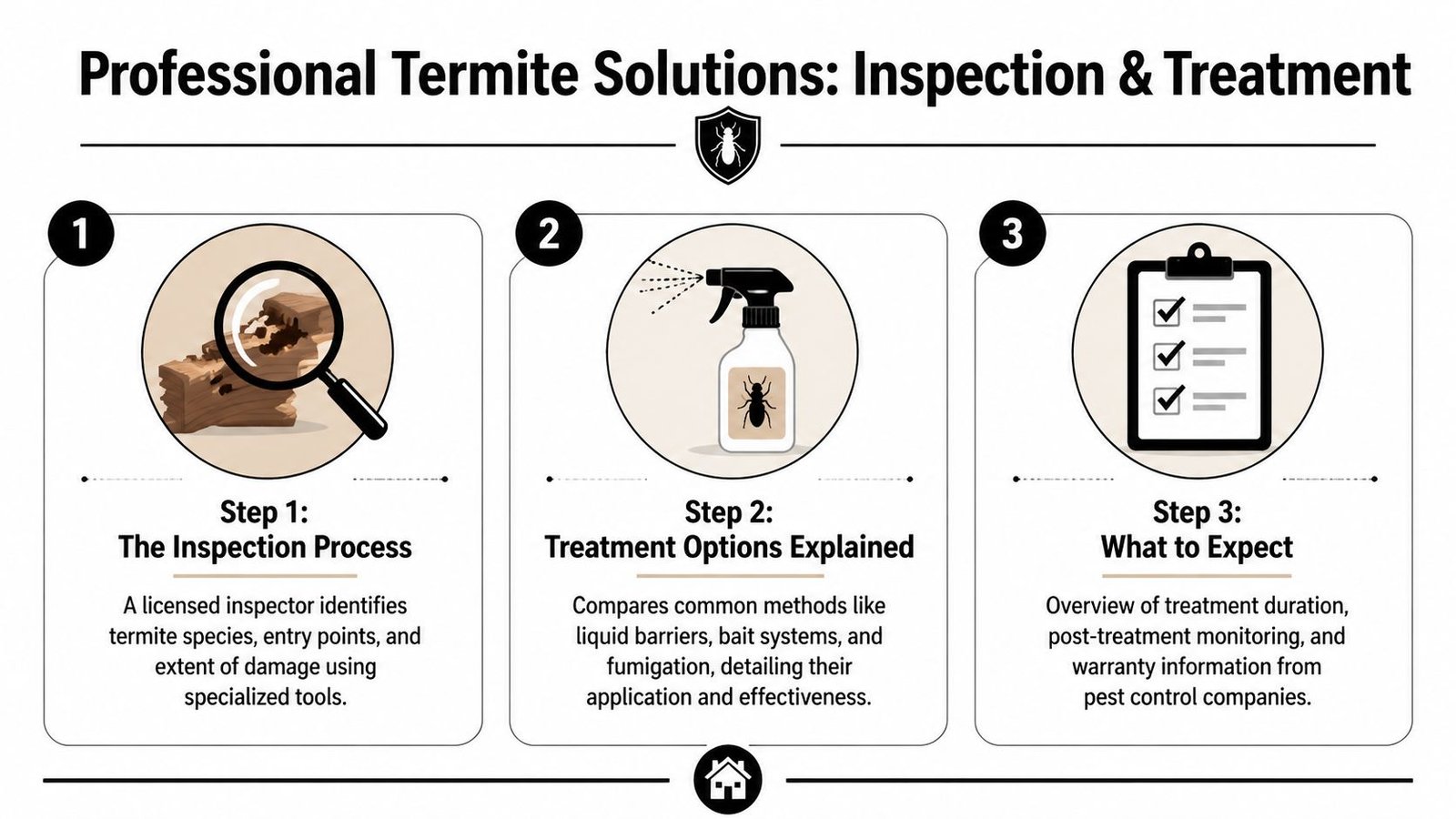
A proper inspection should identify the likely species, entry route, moisture conditions, and how far the damage extends beyond the visible frame. If the inspector only glances at the door and gives you a generic answer, keep looking. You need someone who checks the slab edge, surrounding trim, nearby walls, and any signs of soil contact.
What proper treatment looks like
The EPA termite identification and control guidance is clear on the basics. Soil-applied barrier treatments are a common method, and proper application may involve trenching, rodding, or injecting termiticide into concrete slabs. The same guidance says door frames should extend at least 6 inches above grade to reduce access from soil, and minor damage can sometimes be repaired with wood hardener and filler. If structural integrity is compromised, professional repair is mandatory.
That last point matters most. If the frame has lost strength, pest treatment alone doesn’t solve your problem.
The two common approaches
Most homeowners will hear about liquid barrier treatment and baiting systems. Both have a place. I’m opinionated on this. If termites are already in a vulnerable door frame area, you need a plan that addresses both the active route and the broader colony risk.
| Feature | Liquid Barrier Treatment | Baiting System |
|---|---|---|
| Best use | Fast perimeter defense around soil entry areas | Ongoing colony targeting and monitoring |
| Application | Trenching, rodding, or slab injection by a licensed professional | Bait stations placed and checked over time |
| Strength | Direct barrier between soil and structure | Good fit for long-term monitoring |
| Limitation | Requires proper application around foundation conditions | Usually slower and depends on regular servicing |
| Door frame issue | Strong option when termites are likely reaching the frame from below | Helpful when an owner wants continued monitoring after treatment |
Questions to ask before you hire anyone
Don’t ask only for a price. Ask how they’ll treat your exact entry point.
- Ask about the moisture source: A good inspector should care about sprinklers, grading, condensation, and slab contact.
- Ask what gets documented: You want a written record of active areas, treatment method, and next steps.
- Ask whether the frame is repairable: Pest control and carpentry are not the same thing.
- Ask what monitoring follows treatment: Especially important if you own the property from out of town.
Local reality: A cheap inspection that misses the access route is worse than no inspection. It gives you false confidence.
When you need more than pest control
If the frame supports surrounding trim, sidelights, or a load path that looks compromised, bring in a qualified repair professional after treatment. Termites hollow wood from the inside. A frame can look mostly intact and still be weak enough to fail under normal use.
That’s why I tell Fayetteville owners to separate the problem into two jobs. First, kill the infestation correctly. Second, decide whether the wood can be repaired or needs replacement.
Repairing the Damage and Preventing Future Infestations
Once the termites are treated, you’ve got a second decision to make. Repair what’s there, or replace damaged parts before they cause a bigger failure.

What you can repair and what you shouldn’t touch
Minor damage can sometimes be fixed in sequence. Stabilize the wood, fill the damaged area, sand it smooth, then protect it with paint or stain. That can work when the frame is still solid and the damage is limited.
It is not a smart DIY job if the frame has gone soft deep inside, the door no longer hangs correctly, or nearby trim and wall material are shifting. In that case, you’re not doing finish work. You’re dealing with compromised carpentry.
- Good DIY candidate: Surface-level damage after confirmed professional treatment.
- Bad DIY candidate: Hollow jambs, sagging hinges, a loose threshold, or movement in the surrounding opening.
- Non-negotiable step: Fix the moisture issue before any cosmetic work begins.
Prevention is mostly a moisture job
Most repeat infestations happen because the conditions never changed. The termites got treated, but the wet soil, splashback, or hidden condensation remained.
Here’s the practical checklist I’d use on a local property:
- Cut sprinkler overspray: Don’t let irrigation hit the threshold or lower trim.
- Keep wood clear of soil contact: Exterior wood should not sit down in wet mulch or grade.
- Improve drainage: Move water away from the doorway and slab edge.
- Check A/C condensate routing: Don’t let that drip beside an exterior door.
- Inspect yearly if the home is older or vacant: Especially if the property sits empty between tenants or during a relocation.
This quick video gives a useful visual sense of how termite damage can show up in wood components and why repair has to follow treatment, not replace it.
One construction detail that matters
If you ever replace the frame, pay attention to grade clearance and soil contact. The earlier EPA guidance on door-frame height above grade isn’t a minor detail. It’s one of the clearest ways to reduce easy access from below.
A lot of recurring termite problems start with bad installation details that stayed hidden for years.
Special Challenges for Absentee and Military Homeowners
Termite problems then turn from a repair issue into a logistics mess.
A local owner may notice the sticking door or the soft trim early. An absentee owner usually won’t. A military family preparing for a PCS often finds out when a tenant mentions a bad door, a property manager spots damage late, or a buyer’s inspection blows up the timeline.
A Fayetteville scenario I see all the time
A service member gets orders. The house has been rented out, or it’s been sitting vacant while the family prepares to move. Nobody is checking the exterior door frames closely. By the time someone sees the damage, there’s pressure to make decisions fast.
That’s exactly why Window World Alabama’s discussion of termite damage in windows and doors points out that absentee and out-of-state owners are at a disadvantage. The same source notes that for military families in areas like Cumberland County, a termite discovery during a PCS timeline can be catastrophic, and remote tools like IoT pest monitors and virtual inspection planning are often overlooked.
What remote owners should do differently
If you don’t live in the house, you need a system. Not hope.
- Set an inspection calendar: Have someone local physically inspect vulnerable exterior wood on a routine schedule.
- Use moisture alerts: Smart sensors near doors, HVAC lines, or leak-prone areas can flag a problem before visible wood failure.
- Request photo-based check-ins: Don’t settle for “looks fine.” Ask for clear photos of thresholds, jamb bottoms, and exterior trim.
- Use virtual walkthroughs when needed: A live video call won’t replace an inspector, but it can help you catch obvious trouble sooner.
Remote ownership changes the game. Small wood-damage issues stay small only when someone actually looks for them.
Why speed matters more for military moves
A termite problem discovered in the middle of a PCS isn’t just annoying. It can derail contractors, delay sale prep, and force you to manage repairs from another state.
If that sounds familiar, it helps to know your local sale options before the problem gets bigger. Owners who need a quick exit often start with this page on selling a house fast in Fayetteville.
When to Sell As-Is Instead of Repairing
Not every termite problem deserves a full repair project. That’s the truth. Sometimes repair is the right move. Sometimes it’s a money pit with a fresh coat of paint.
The tipping point usually comes down to three things. How bad the damage is, how much time you have, and whether the house already has other issues stacked on top of it.

Repair makes sense in a narrow set of cases
If the infestation was caught early, treatment is documented, the frame damage is limited, and the rest of the house is in good shape, repairing the affected area can be reasonable.
That’s not the reality for many distressed properties around Fayetteville and Hope Mills. Older homes often have compounding issues. Moisture intrusion. Deferred maintenance. Vacancy. Tenant damage. Tight cash flow. Inherited properties nobody wants to rehab.
Here’s when I’d seriously consider selling as-is
The Acadian Windows discussion of door frame termite damage says the cost-benefit is critical for distressed properties, notes DIY failure rates can be up to 40%, and says professional repairs often exceed $3,000 to $5,000. That’s the kind of math that changes the conversation.
I’d lean hard toward an as-is sale if several of these are true:
- You’re short on time: PCS move, foreclosure pressure, divorce, probate, or job relocation.
- You’re short on cash: Treatment, carpentry, paint, and surprise repairs are all landing on your shoulders.
- The property has multiple issues: Termites are only one item on a longer repair list.
- You live out of state: Managing treatment and reconstruction remotely is a headache most owners underestimate.
- You don’t want disclosure risk after patchwork repairs: Half-fixes come back to bite sellers later.
Hard truth: If the house needs pest treatment, carpentry, and cleanup before it can even compete on the market, you’re not just selling a house. You’re funding a pre-sale rehab.
Why an as-is sale can be the cleaner decision
Selling as-is isn’t giving up. It’s choosing certainty over a repair spiral.
You avoid coordinating exterminators, carpenters, painters, and follow-up inspections. You avoid listing prep. You avoid showing a house with a recent termite history and hoping buyers don’t bolt when they see the paperwork.
If you’re weighing that route, this breakdown of what selling a house as-is means is a good place to start.
A blunt decision filter
Ask yourself these questions:
| Question | If the answer is yes |
|---|---|
| Is the frame damage part of a larger deferred-maintenance problem? | Selling as-is may save you from a chain of repair costs |
| Do you need a fast closing more than top-dollar retail exposure? | Repairing first may not fit your timeline |
| Are you managing this from another city or state? | Coordination burden alone may justify an as-is sale |
| Would repair costs strain your budget? | Preserving cash may matter more than maximizing listing appeal |
There’s no prize for pouring money into a house you no longer want, can’t manage, or can’t afford to stabilize.
Frequently Asked Questions About Termites and Home Sales
Can you sell a house with termites in the door frame
Yes. You can sell a house with termite issues, including active or past damage. What matters is honesty, documentation, and choosing the right sale path. A traditional retail buyer may demand treatment records, repairs, or credits. An as-is buyer usually looks at the whole property condition and prices accordingly.
Do you have to disclose termite damage in North Carolina
If you know about active infestation, treatment history, or visible damage, disclose it accurately. Don’t try to hide it with cosmetic patching. That creates bigger legal and financial problems than the termites themselves.
Will homeowners insurance cover termite damage
Usually, owners shouldn’t assume it will. Many termite losses are treated as maintenance-related rather than sudden damage. Read your policy and ask your carrier directly, but don’t build your plan around reimbursement unless you have written confirmation.
Can you just repair the frame and move on
Only after treatment and only if the damage is minor. Cosmetic repairs on untreated or structurally compromised wood are wasted money. If the frame is weak, get it rebuilt properly or consider selling the property as-is.
Is a sticking door always termites
No. Doors stick for several reasons, including moisture movement and settling. But when a sticking door comes with hollow wood, visible dirt lines, discarded wings, or crumbling trim, termites need to be ruled out fast.
What matters most if you live out of town
Get eyes on the property. Use a local inspector, require photos, and don’t rely on tenant descriptions alone. Remote ownership turns small issues into expensive surprises because nobody catches them early.
If termites in your door frame have turned your Fayetteville-area house into one more problem you don’t want to manage, DIL Group Buyers offers a practical way out. They buy houses as-is, which means you don’t need to repair the frame, hire exterminators first, or get the property market-ready. If you’re dealing with a PCS move, inherited house, foreclosure pressure, vacancy, or an out-of-state headache, their team can make a cash offer and work on your timeline so you can move on without the usual stress.