
Some homeowners in Fayetteville already know they need to sell fast. The hard part is figuring out whether a fast sale will solve the problem or create a new one.
Maybe you just got PCS orders and do not want to manage a vacant house from another state. Maybe you inherited a property in Stedman that needs work you cannot coordinate from afar. Maybe you are behind on payments and trying to avoid a longer financial mess. In Cumberland County, those situations are not rare. They are everyday real estate problems, and they need practical answers.
A cash sale is not the right move for every seller. But for the right seller, it can be the cleanest path out. The key is understanding how nc cash home buyers work, what you are giving up, what you are gaining, and how to protect yourself before you sign anything.
Selling Your House in NC? What to Know About Cash Buyers
A lot of sellers first hear "cash buyer" and assume it means desperation. That is not how it works in real life.
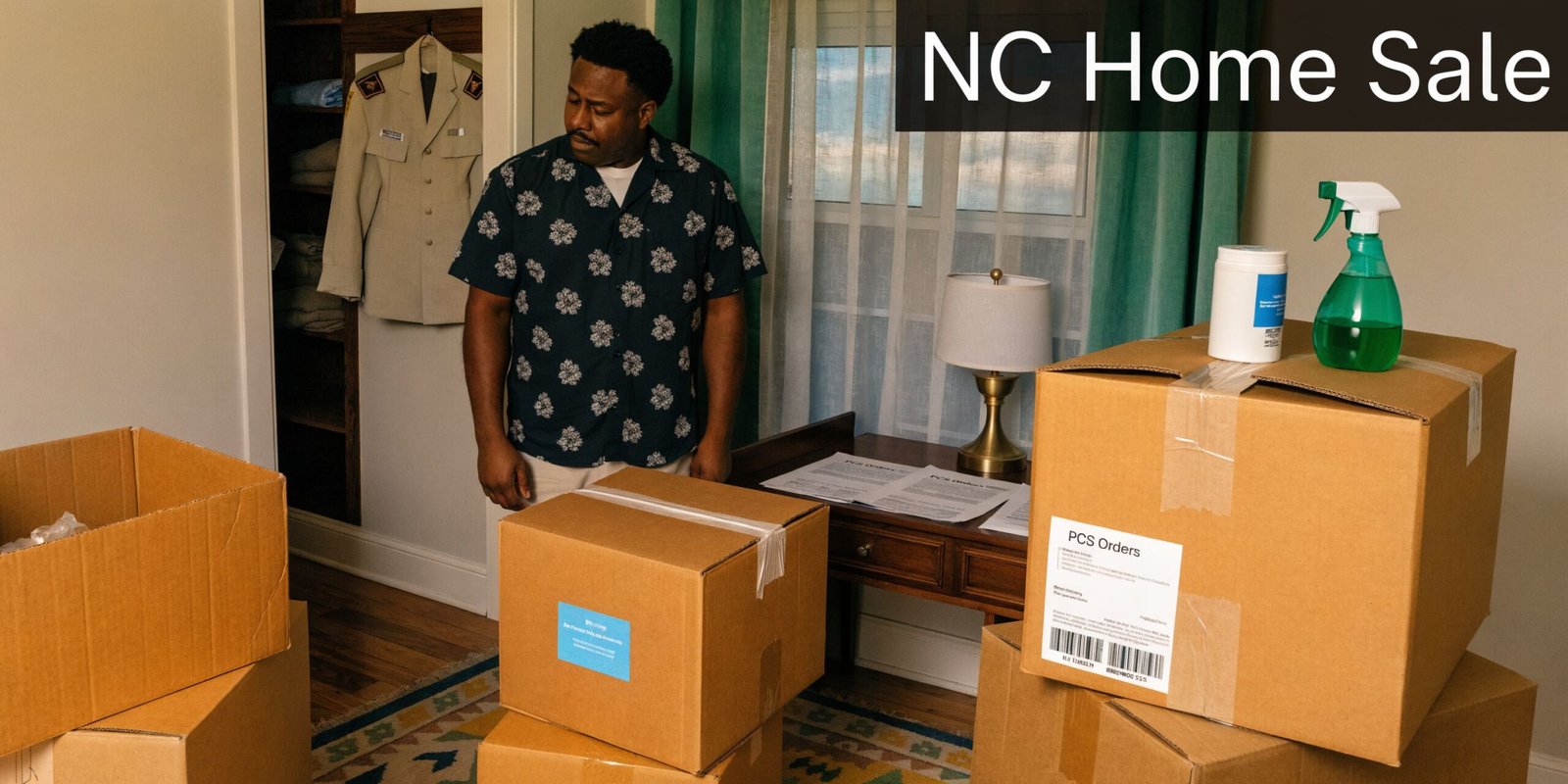
In Fayetteville, a cash sale is often a timing decision. A military family gets transfer orders and needs certainty. An adult child inherits a house near Eastover and does not want to spend months cleaning it out, fixing it up, and juggling contractors. A homeowner falls behind and wants a way out before the problem gets worse.
Why more NC sellers look at cash offers
Cash buyers have become a part of the market, not a fringe option. Cash sales account for over one-third of home transactions in recent years in North Carolina, which shows many sellers are choosing speed and convenience when their situation calls for it, as noted in this North Carolina cash sales market overview.
That matters because it changes the way you should think about the option. You are not stepping into something unusual. You are looking at one of several legitimate ways to sell.
For some owners, the best outcome is not squeezing every possible dollar from the sale. It is getting a firm offer, avoiding repairs, skipping showings, and moving on without financing delays.
What cash buyers are really solving
A traditional sale works well when the house shows well, the seller has time, and everyone can wait out the listing process.
A cash buyer helps when time and condition are the main issues.
That usually means situations like these:
- PCS pressure: You need a clear closing plan before reporting to your next duty station.
- Inherited property: The house may need cleanout, repairs, or legal coordination between family members.
- Mortgage trouble: A fast sale may give you a chance to resolve the property before the situation gets more painful.
- Absentee ownership: You cannot be in town every week to manage repairs, inspections, or showings.
A cash sale is not automatically better. It is better when certainty matters more than holding out for a higher retail price.
If you are still sorting out the basics, this plain-English guide on what a cash offer on a house means is a good starting point.
Understanding How NC Cash Home Buyers Operate
Most confusion comes from one simple mistake. People assume a cash buyer is just another version of a real estate agent.
It is not.
An agent helps you market the house to find a buyer. A cash buyer is the buyer.
Selling a Car Comparison
The simplest comparison is this.
Selling through an agent is like selling your car to a private party. You might get more money, but you have to clean it up, list it, answer calls, schedule meetings, negotiate, and hope the buyer's financing comes through.
Selling to a cash buyer is more like selling to a dealership. The offer is usually lower, but the sale is direct, fast, and predictable.
That trade-off is the entire business model.
Why cash buyers pay less than retail
Cash home buyers buy properties as investments. They usually plan to do one of two things:
- Repair and resell the property
- Repair and hold it as a rental
That means they are not pricing your house the same way a family buying their forever home would. They are looking at the property's current condition, the work needed, the resale risk, and how long their money will be tied up.
In Cumberland County, that local knowledge matters. A buyer who understands neighborhoods around Fayetteville, Hope Mills, Spring Lake, and Fort Liberty will usually evaluate the property more realistically than someone working off a statewide formula alone.
What they usually want from the seller
The process is often lighter than people expect. Most nc cash home buyers do not need you to stage the house or make cosmetic improvements.
They usually need:
- Basic property details
- A chance to see the home's condition
- Clear title information
- A seller who can make a decision on timeline and terms
If the property has issues like deferred maintenance, old roofing, bad flooring, junk left behind, or tenant problems, that does not automatically kill the deal. It just affects the offer.
Practical rule: If a company says condition does not matter, the next question should be how they inspect and price repair risk.
What they are not doing
A cash buyer is not listing your house on the MLS for you. They are not acting as your fiduciary the way an agent would. They are not promising to expose the property to the broadest pool of retail buyers.
They are offering to take the property off your hands directly.
That direct purchase model can be useful. It can also be a bad fit if your house is in solid condition and you have time to list traditionally.
Where sellers get tripped up
Problems usually start when owners expect the wrong kind of service.
A few common misunderstandings:
- "They will help me test the market." No. A direct buyer is making a buy-now offer.
- "They will price it like a retail buyer." Usually not. Investors build in margin and risk.
- "If I decline, I am stuck." Not at all. You can compare options and walk away.
If you are comparing different investor models, this breakdown of companies that buy houses for cash helps clarify who is doing what.
The Step-by-Step Cash Sale Process in North Carolina
Most sellers relax once they see the process laid out in order. A cash sale is usually straightforward. The value is in knowing what happens next, who handles what, and where you need to pay attention.
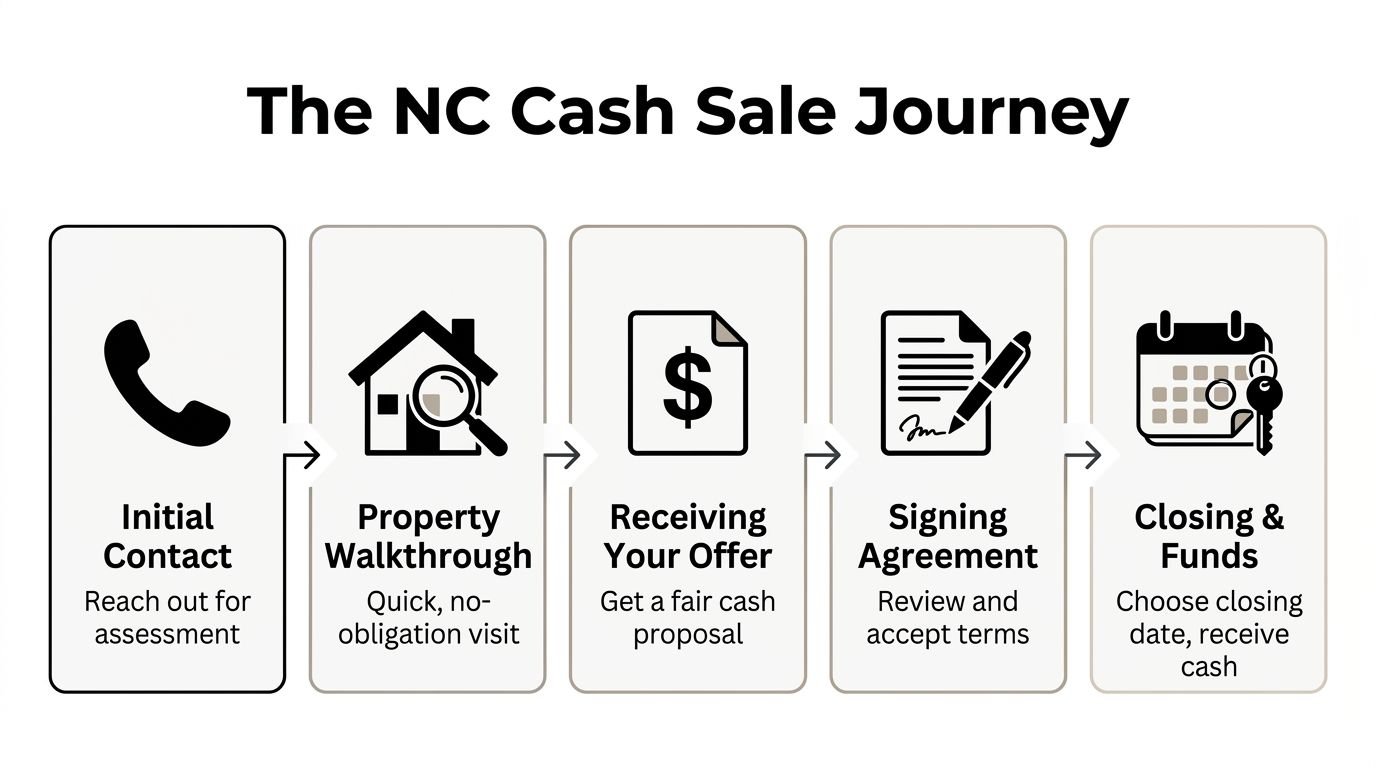
Step one starts with basic property info
You contact the buyer by phone, text, or online form.
At that point, they usually ask for the address, the property's condition, whether anyone is living there, and what timeline you are working with. If you are selling from out of state, expect some questions about access, documents, and whether anyone local can help if needed.
This early conversation matters. A serious buyer should sound organized, not vague.
Step two is the walkthrough
The buyer will usually schedule a visit to see the house in person. If you are remote, they may coordinate access with you, a tenant, a neighbor, or a family member.
They are not looking for staging. They are looking for facts.
That includes things like:
- Roof, HVAC, and foundation concerns
- Water damage or mold signs
- Layout and functional issues
- Trash, personal property, or cleanout needs
- Occupancy and access complications
A good walkthrough is usually direct and calm. You should not feel like you are being judged for the condition of the house.
Step three is the offer
After reviewing the property, the buyer gives you a cash offer. In a legitimate transaction, the numbers should reflect the home's condition and the speed and convenience being offered.
At this stage, sellers should slow down and read carefully.
Ask:
- Is this the actual purchase price?
- Are there any deductions later?
- Who pays closing costs under this agreement?
- Can the buyer explain the basis for the offer?
If the answer changes depending on who you talk to, that is a warning sign.
Step four is the contract
If you accept, both sides sign a purchase agreement.
North Carolina is an attorney state, so a real estate attorney typically handles the closing work. That is useful for sellers because title review, payoff coordination, and document prep move through a formal legal channel rather than through a casual handshake arrangement.
Before signing, make sure the contract clearly states the purchase price, any earnest money, the closing date, and whether the buyer can back out for broad or vague reasons.
Step five is closing and getting paid
Cash sales distinguish themselves from financed deals here. Homes on the open market in North Carolina need a median of 71 days just to go pending, while cash buyers can often close in as little as 7 to 14 days, according to this North Carolina cash buyer timeline guide.
For a seller under pressure, that is not a small difference. It can be the difference between solving a problem and carrying it for months.
The attorney's office typically handles final title work, payoff statements, signing coordination, and disbursement of funds. If you live out of state, many closings can be coordinated remotely.
What usually makes the process faster
Cash deals move quickly because they avoid many of the delays that come with retail transactions.
Here are the usual time-savers:
- No lender approval
There is no mortgage underwriting holding up the deal. - No listing period
You do not spend weeks preparing, showing, and waiting for offers. - Fewer repair negotiations
The buyer is usually purchasing as-is. - Flexible closing coordination
If title is clear and both sides are ready, the schedule is much easier to control.
For sellers who want a simple visual of the flow, this 3-step home sale overview gives the short version.
What can still slow a cash deal down
Cash does not solve everything.
Closings can still get delayed by:
- Title issues
- Probate questions
- Unknown liens
- Difficult tenant access
- Multiple heirs who do not agree
- Missing documents from remote sellers
The key question is not just "Can you buy for cash?" It is "How do you handle the problems that come up before closing?"
Is Selling to a Cash Buyer Right for Your Situation?
For some sellers, the answer is obvious within five minutes. For others, it takes a hard look at the trade-off.
The trade-off is simple. A cash sale usually gives you speed, convenience, and less work. A traditional listing may bring a higher price if the home is financeable, presentable, and you have time.
The right choice depends on the problem you are trying to solve.

If you're facing foreclosure pressure
When payments have fallen behind, time matters more than theory.
A traditional listing can still work in some foreclosure situations, but it asks a lot from a seller who may already be overwhelmed. You may need cleaning, repairs, showings, buyer financing, and a closing timeline you cannot control well enough.
A cash offer can make sense if the main goal is speed and certainty. If the numbers work, a direct sale may help you resolve the property before more damage is done to your finances.
What works well here:
- Clear payoff coordination
- A buyer who can move quickly
- An attorney-driven closing
- A written timeline with no fuzzy promises
What does not work:
- Waiting on buyers who still need loans
- Putting money into a house you may not keep
- Signing with anyone who pressures you before title is reviewed
If you inherited a house you don't want
Inherited houses in Cumberland County often come with more than deferred maintenance. They come with family logistics.
One heir may be local and another may live three states away. The house may still contain furniture, paperwork, or years of belongings. Sometimes no one wants to become the project manager.
In that situation, a cash buyer can be useful because the property can often be sold as-is. You do not have to repaint every room or replace worn flooring just to make the home "market ready."
Still, inherited sales require care.
Pay attention to:
- Whether probate is complete or still pending
- Whether all heirs are aligned
- Whether liens or unpaid bills exist
- Whether the buyer is experienced with estate-related paperwork
A cash buyer is not a substitute for legal clarity. But once the legal side is lined up, the sale itself can be much simpler.
If you're dealing with military PCS orders
Fayetteville differs from many markets in this regard.
Military families often do not get the luxury of a long selling window. Orders arrive. Schedules compress. Kids need to be moved. The next assignment does not wait for your buyer's lender to finish paperwork.
A cash sale can fit well when your top priority is to avoid carrying the house from a distance.
That can help you avoid:
- Managing repairs after you have moved
- Coordinating last-minute showings while packing
- Becoming an accidental long-distance landlord
- Worrying about whether the buyer's financing will collapse
For a PCS seller, the biggest question is usually not "Can I get the top price?" It is "Can I hand this property off cleanly and move on with my next assignment?"
If the house needs work and your report date is close, convenience is not a luxury. It is part of the decision.
If you're an absentee or out-of-state owner
This group is often overlooked in generic guides, even though it is a major issue around Fayetteville.
Some owners moved away years ago and kept the property as a rental. Some inherited a house here but live elsewhere. Some left after military service and do not want to return just to handle a difficult sale.
For these sellers, distance creates risk. Out-of-state owners are a growing segment in Cumberland County, and an as-is cash offer that closes in 7 to 14 days can reduce the risk tied to not being able to verify condition or oversee repairs in person, as described in this discussion of absentee-owner risks in NC cash sales.
That does not mean every remote owner should take the first offer. It means the structure of a cash sale often aligns with the needs of remote ownership.
What usually matters most:
- Remote walkthrough coordination
- Clear title and lien review
- Digital document handling
- A closing process that does not require repeated travel
- Confidence that the buyer can take the house as it sits
When a cash sale is probably not your best option
Cash buyers are not the best fit when the house is in strong condition, you have time, and you are comfortable with normal listing prep.
You may do better listing traditionally if:
- The property is clean and financeable
- You do not need an immediate closing
- You want full market exposure
- You are willing to handle showings and negotiation
In other words, a cash sale solves stress well. It does not usually maximize sale price.
How to Vet Reputable NC Cash Home Buyers
A legitimate cash buyer should make the process simpler, not murkier. If the conversation gets slippery, the documents stay vague, or the pressure ramps up fast, step back.
The safest approach is to assume you need to verify everything.
Start with the offer logic
Most investors in this space are not inventing prices out of thin air. Many nc cash home buyers use the 70% rule, where the offer is based on roughly 70% of the home's after-repair value minus repair costs. On North Carolina's median $375,400 home, that often works out to around $253,395, depending on condition, as explained in this breakdown of the 70% rule in North Carolina.
You do not need to become an appraiser to use that information well. You just need to understand the framework.
If a buyer says your house needs major work, ask what they are counting. If they say the resale value is lower than you expected, ask why. Serious buyers should be able to walk you through the reasoning.
Red flags that deserve a hard stop
Some warning signs are obvious. Others hide behind polite language.
Watch for these:
- Upfront fees: A direct home buyer should not be charging you just to make an offer.
- Pressure to sign immediately: If the deal is sound, it can survive a night of review.
- Vague inspection language: "We will finalize later" often means the offer is not as firm as it sounds.
- No proof of funds: If they cannot show they can close, the cash promise is weak.
- Unclear assignment terms: If they are wholesaling, you should know that upfront.
- Changing numbers late: A last-minute price drop without a real basis is one of the oldest tricks in this business.
A good buyer welcomes careful questions. A bad buyer treats questions like a problem.
Green flags that usually point to a real operation
You do not need perfection. You need consistency and transparency.
Look for signs like these:
- Local familiarity: They know Fayetteville, Hope Mills, Spring Lake, and nearby communities without speaking in generalities.
- Straight answers: They explain how they reached the number.
- A written contract you can review calmly: No rushing. No verbal-only promises.
- Attorney closing: They use a normal legal closing process in North Carolina.
- Reasonable communication: Calls get returned. Questions get answered.
Questions worth asking every buyer
Ask the same core questions to each company. Their answers will tell you a lot.
- Can you provide proof of funds?
- Will you buy the property as-is, exactly as discussed?
- How do you calculate repairs and resale value?
- Who closes the transaction?
- Can the price change after I sign? If so, under what exact conditions?
- Are you buying this property directly or assigning the contract?
Traditional sale vs. cash buyer sale at a glance
| Factor | Traditional Sale (via Realtor) | Cash Buyer Sale (e.g., DIL Group) |
|---|---|---|
| Who the buyer is | A retail buyer found through listing exposure | A direct buyer purchasing as an investment |
| Property condition | Usually benefits from cleaning, repairs, and presentation | Often purchased as-is |
| Showings | Usually required | Usually not required beyond a walkthrough |
| Financing risk | Buyer financing can delay or derail closing | No mortgage contingency in a true cash deal |
| Best fit | Sellers focused on market exposure and price | Sellers focused on speed, certainty, and convenience |
| Pricing approach | Aims for retail market value | Discounted to reflect repairs, risk, and investor margin |
The best protection is simple. Compare more than one option, ask direct questions, and do not let urgency make the decision for you.
Your Fayetteville and Cumberland County Seller Checklist
By the time most sellers reach this point, they do not need more theory. They need a practical list.
If you are selling in Fayetteville, Hope Mills, Spring Lake, Eastover, Stedman, or nearby parts of Cumberland County, use this checklist before you agree to anything.
Get your paperwork together first
You do not need a perfect file. You do need the basics.
Start gathering:
- Your deed if you have it
- A recent mortgage statement
- Any HOA information
- Tax notices or utility balances if relevant
- Probate or estate paperwork if the property was inherited
- Lease details if a tenant still occupies the home
Remote sellers should scan everything early. It keeps the process moving once title work starts.
Write down the house issues
Do not fix everything first. Just make a clean list.
That list might include:
- Roof leaks
- Old HVAC
- Floor damage
- Water intrusion
- Code notices
- Foundation concerns
- Trash or furniture left behind
- Tenant issues or vacancy damage
This saves time and helps you compare buyers on the same facts.
Research local buyers, not just statewide brands
North Carolina is not one uniform market. Regional differences matter, and a buyer who understands Cumberland County's military-driven market and local repair realities can make a more reliable as-is offer than a broad algorithm-based iBuyer, according to this look at regional variation in North Carolina cash buying.
That matters a lot in this area. Fort Liberty relocations, rental turnover, aging homes, inherited properties, and absentee ownership all shape how houses get evaluated.
Check whether the buyer knows the local submarkets you care about.
Compare offers the right way
Do not compare only the top-line number.
Compare:
- The price
- How firm the price is
- Who pays what at closing
- Whether the buyer can close on your timeline
- Whether they will still buy it as-is
- How they handle title issues or occupancy problems
A slightly lower offer with a cleaner closing path can beat a higher one that falls apart.
Remote and military sellers should ask one extra question: "What parts of this process can you handle without me being physically present?"
Pick the path that fits your actual goal
A lot of bad real estate decisions come from chasing the wrong outcome.
If your goal is highest possible market price and you have time, a listing may fit better. If your goal is getting rid of a problem house, avoiding distance management, or closing on a deadline, a cash buyer may be the better tool.
Use this short decision check:
- Need speed? Lean cash.
- Need convenience? Lean cash.
- Need full market exposure? Lean listing.
- House in rough shape? Cash often makes more sense.
- House show-ready and no time pressure? A traditional sale may be stronger.
Frequently Asked Questions About Selling for Cash in NC
Can I sell for cash if the house has liens?
Yes, sometimes you can. Liens do not automatically kill a sale, but they do have to be addressed during closing.
The closing attorney handling the transaction will usually review title, identify what has to be paid or cleared, and determine whether the sale proceeds can resolve those issues. The most important thing is telling the buyer and closing attorney about any known liens early.
Can I sell an inherited house if I'm not in North Carolina?
Often, yes. Remote inherited sales happen all the time, but the paperwork has to be in order.
If probate is required, that comes first. Once the legal authority to sell is clear, many parts of the transaction can be handled without repeated travel, especially if the buyer is comfortable with an as-is purchase and the closing team can coordinate documents remotely.
Do I need to clean out the property before selling to a cash buyer?
Not always.
Some buyers are willing to take the house with unwanted items still inside, but you need that spelled out clearly in the agreement. Do not assume "as-is" automatically means full cleanout is included. Ask directly.
What if the property has tenants?
You can still explore a cash sale, but the answer depends on the lease, the tenants' status, and property access.
Some buyers are comfortable purchasing tenant-occupied properties. Others are not. Be upfront about the situation, especially if the tenants are behind on rent, damaging the property, or making access difficult.
Can I sell while I'm behind on mortgage payments?
In many cases, yes. Sellers often reach out to cash buyers because time is tight and the traditional listing route may take too long.
The important move is acting early. Once you are behind, delay usually makes every option harder. A buyer and closing attorney can review payoff timing and see whether a sale can still solve the problem.
Are all nc cash home buyers the same?
Not even close.
Some are experienced local operators. Some are wholesalers. Some are marketing-heavy companies that do not close many deals themselves. That is why questions, proof, and contract review matter so much.
If a buyer cannot explain their process clearly, keep looking.
If you are in Fayetteville, Hope Mills, Spring Lake, Eastover, Stedman, or nearby and need a direct, local option, DIL Group Buyers buys houses for cash in Cumberland County without listings, repairs, or hidden costs. They work with inherited properties, foreclosure situations, military PCS moves, liens, tenant problems, and out-of-state owners who need a reliable as-is sale and a closing date that fits their timeline.