
You might be reading this with moving boxes half-packed, a lease or closing date hanging over your head, and a house that still looks like real life happened in every room. That’s the hardest part of quick downsizing. The job isn’t only physical. It’s mental, emotional, and usually tied to a deadline you didn’t choose.
I’ve seen the same pattern over and over. People lose time because they treat downsizing like a broad life project instead of a short-term operation. If you need to know how to downsize your home quickly, you need two clear options. One is a rapid DIY plan that cuts decisions down to what matters. The other is the honest shortcut: skip the cleanup and sell the property as-is if your timeline, stress level, or circumstances make the traditional route unrealistic.
That second path matters more than most guides admit. Military families facing PCS orders, owners handling inherited houses from another state, landlords worn out by tenant damage, and sellers dealing with foreclosure, divorce, or job loss often don’t need a perfect decluttering system. They need relief, speed, and fewer decisions.
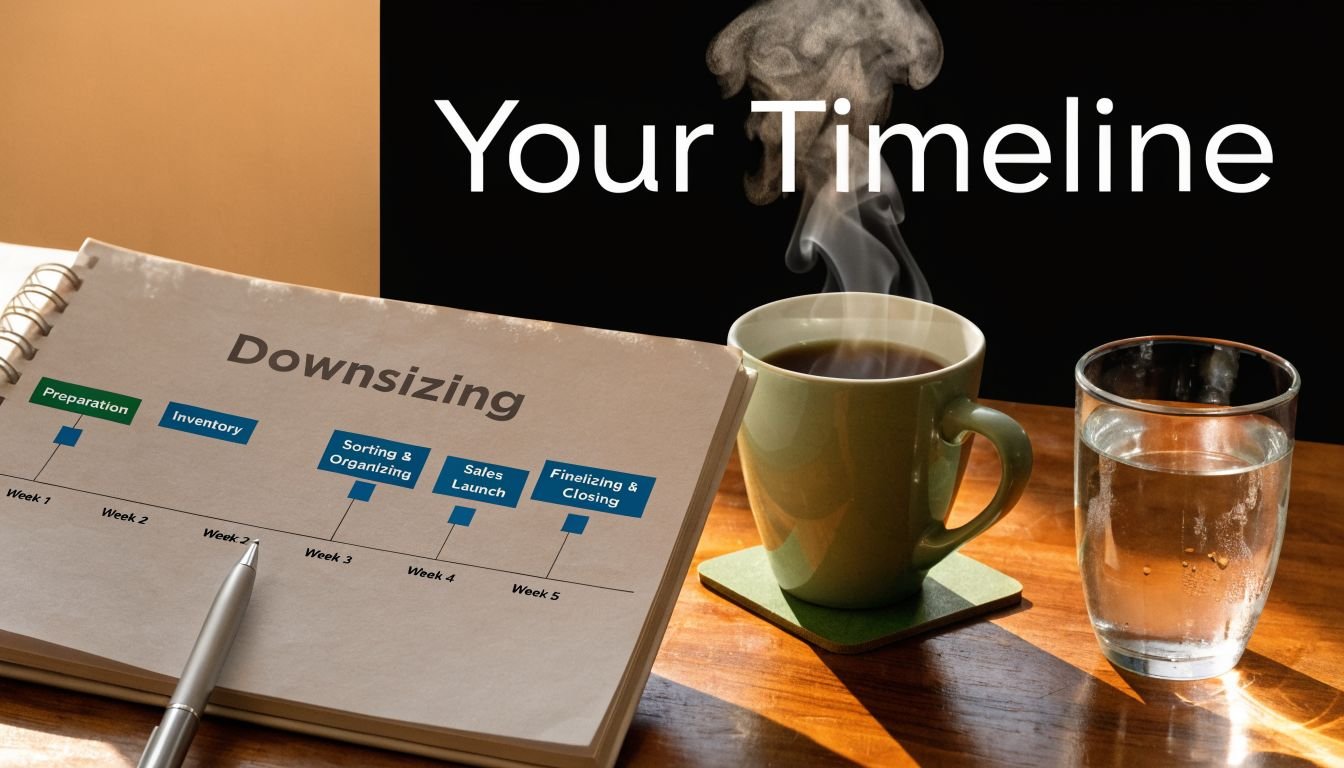
Create Your Rapid Downsizing Timeline
A quick downsize falls apart when the schedule lives in your head. Put the deadline on paper and build the plan backward from there.
Use the date that cannot move. Your closing date. Your lease start. Your report date for PCS. Your handoff date to a property manager or buyer. Members 1st advises starting a downsizing plan a few months before a move, which is helpful if you have that kind of runway. If you do not, compress the work into weekly targets and daily decisions tied to that hard deadline, as outlined in Members 1st’s downsizing guidance.
Start with the rooms that change the house fastest
Start where you can remove bulk without getting trapped in memory-based decisions. That usually means the garage, attic, basement, guest room, storage closets, and oversized furniture.
I tell clients to go after cubic feet first, feelings second. One afternoon spent clearing a guest room or removing a dining set that will not fit the next home creates more momentum than three hours spent debating framed photos or old paperwork.
Focus on:
- Garage and storage areas: duplicates, broken tools, leftover project supplies, bins you have not opened in years
- Guest rooms: extra beds, unused dressers, spare décor, backup linens
- Attic or basement: seasonal items, old boxes, things you already proved you can live without
- Large furniture: sectionals, hutches, dining sets, desks, and bed frames that may not work in the next space
A visible win lowers stress. It also makes the rest of the house easier to assess clearly.
Practical rule: Ask, “What can leave this house today that creates the most space?”
Measure before you sort the small stuff
This step saves expensive mistakes.
Many sellers donate lamps, kitchen gadgets, and closet overflow first, then learn too late that the biggest pieces are the biggest problem. Measure the new home, or get the floor plan if you are relocating for military orders or buying from out of state. Then compare that layout to your current furniture before you spend a weekend packing décor.
As noted earlier, space reductions should be calculated, not guessed. If the sectional blocks the new living room or the king bed leaves no walking space, make that decision now. For absentee owners and distressed sellers, this is often the moment to be realistic about the property itself too. If the timeline is too tight for sorting, repairs, cleaning, and a traditional listing, review how long it takes to sell a house in 2026 and decide whether an as-is cash sale fits the deadline better.
Build a week-by-week plan you can actually finish
A short timeline needs clear assignments, not broad intentions. Each week should answer one question: what has to be gone by the end of these seven days?
A practical schedule looks like this:
Week 1
Measure the next home. Identify furniture that will not fit. Clear garage, attic, basement, and storage rooms.Week 2
Remove extra furniture from guest rooms, offices, and unused spaces. Schedule donation pickups, junk hauling, or buyer appointments.Week 3
Sort main living areas and bedrooms. Pack what is definitely going. Stop protecting items that do not match the next home or the next season of life.Week 4
Handle kitchen overflow, linens, office supplies, files, and utility areas. Confirm change-of-address tasks and transfer services.Final days
Pack daily essentials, set aside documents and medications, confirm movers or loading help, and clear anything still left behind.
If you have less than a month, condense this into day blocks instead of weeks. If you are dealing with probate, foreclosure pressure, divorce, tenant damage, or a sudden PCS move, be honest about capacity. A rushed DIY downsize is one option. Selling as-is for cash is another, and for some households it is the cleaner, calmer choice.
The Ruthless Triage System for Decluttering
Speed comes from fewer categories, not more. If every object turns into a personal debate, you’ll stall.
Use a four-part triage system in every room: Keep, Sell/Donate, Discard, Relocate. The point is to decide an item once. Not five times.

Advanced downsizing guidance recommends setting up physical zones within each room for multi-pile sorting so items don’t get shuffled around the house and re-decided later. For out-of-state owners, that same guidance also recommends creating detailed inventory lists for packed items so remote coordination is easier and unnecessary shipping is reduced, as explained in SilverStone Living’s downsizing tips.
How to use the four categories
Keep means it has a place in the next home and a reason to go there.
Sell/Donate means the item has use or value, but not for you.
Discard means broken, expired, stained, incomplete, or not worth moving.
Relocate means it belongs in another room right now. This is the smallest pile. If the relocate pile gets too big, you’re just reorganizing clutter.
A garage is a good example. One shelf might hold paint rollers, holiday bins, old sports gear, and a broken leaf blower. Don’t pull everything into the driveway and create chaos. Work left to right. Touch one item, make one decision, move on.
Use decision rules that reduce emotion
Quick downsizing works best when you stop asking whether something is “still good” and start asking whether it earns the move.
Try these filters:
- Used recently: If you haven’t used it in a long time, it’s probably not serving your current life.
- Fits the next space: A thing can be useful and still wrong for the new home.
- Easy to replace: If it’s common and inexpensive, don’t let it take up emotional space.
- Heavy to move: Big, awkward items need a stronger reason to stay.
If an item only makes sense in your current house, it usually shouldn’t come with you.
That mindset matters for military families and absentee owners especially. When you’re coordinating from another city or another state, every extra item becomes another logistical problem.
A short visual walkthrough can help if you need to see the system in action before starting:
Inventory matters more when you’re not local
If you’re packing remotely, managing an inherited property, or sending help on your behalf, write down what’s being kept and where it’s going. Don’t trust memory. Label boxes by room and purpose, not just “miscellaneous.”
Use a notes app, Google Sheets, or a basic legal pad. The tool matters less than consistency.
For example:
- Primary bedroom closet: keep, two wardrobe boxes
- Kitchen upper cabinets: donate, boxed glassware
- Garage back wall: discard, broken yard tools
- Hall linen closet: keep, one tote for next bathroom
That kind of list keeps family members, movers, and helpers from undoing your work.
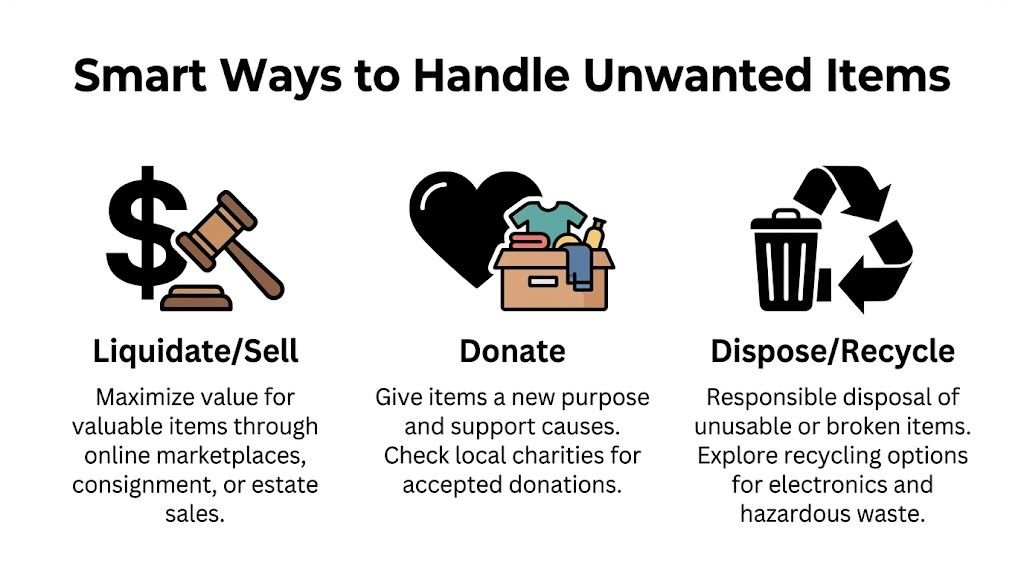
Smart Ways to Handle Unwanted Items
Once the keep pile is under control, the primary bottleneck appears. What do you do with everything else?
The answer depends on what you need most: speed, convenience, or money back. You usually won’t get all three. That’s the trade-off people need to accept early.
Compare your options honestly
| Method | Best For | Speed | Effort Level | Financial Return |
|---|---|---|---|---|
| Donation center | Everyday household goods, clothes, kitchenware, books | Fast | Low to moderate | Low |
| Facebook Marketplace | Furniture, tools, working appliances, décor | Moderate | Moderate to high | Moderate |
| Consignment shop | Better furniture, designer clothing, select home pieces | Moderate | Moderate | Moderate |
| Estate sale company | Full households with many sellable items | Moderate | Low after setup | Moderate |
| Junk removal | Broken, unsanitary, low-value bulk items | Fast | Low | None |
| Storage unit | Items you refuse to decide on yet | Fast today, slow later | Low now, high later | Negative over time |
When donation makes sense
Donation is the best option when time matters more than squeezing every dollar out of old stuff. Goodwill, Habitat ReStore, local church charities, and community nonprofits can often move ordinary household goods faster than you can sell them one by one.
Donation works well for:
- Functional basics: Dishes, lamps, side tables, linens, and clothing in decent shape.
- Fast cleanout days: When you need a room clear by tonight, not next weekend.
- Emotionally loaded items: Giving something a second life can feel easier than throwing it away.
If you’re dealing with a house that has years of accumulation, this guide on how to sell a hoarder house can help you think through cleanup decisions without getting stuck on perfection.
When selling is worth the trouble
Selling only makes sense if the item has enough value to justify the calls, no-shows, messages, and pickup coordination.
Facebook Marketplace is usually the quickest local option for useful furniture, lawn equipment, tools, and appliances. Consignment works better for nicer items if you have a little more time. Estate sale companies can help when the house is full and many categories have resale value.
The mistake is trying to sell too much. Don’t spend an hour listing a used toaster, an old chair, or a box of random kitchen gadgets. Save your effort for pieces people search for.
Keep the sales pile small and selective. The goal is to clear the house, not open a part-time store.
Why storage is usually a delay tactic
Storage feels like a relief because it removes pressure today. In practice, it often turns one hard decision into a stack of expensive delayed ones.
For fast downsizing, storage usually means:
- you’re paying to keep items you already chose not to live with
- you’ll have to sort them again later
- family members may inherit that unfinished project if you don’t return to it
There are exceptions. Temporary storage can help during a short overlap between homes. But if the plan is vague, skip it.
Dispose of the obvious junk immediately
Don’t let broken items linger in the corners while you negotiate over the “maybe” pile. If something is damaged, expired, moldy, unsafe, or incomplete, remove it first. That creates space for the better decisions.
Good fast-disposal candidates include:
- Broken furniture
- Dead electronics that aren’t worth repair
- Stained mattresses or unusable rugs
- Old paint, chemicals, and hazardous waste that need proper local disposal
- Duplicate plastic bins and random cords with no clear use
When people say they’re overwhelmed, they usually aren’t overwhelmed by their best belongings. They’re overwhelmed by deferred junk.
The Ultimate Shortcut Selling Your Home As-Is
There’s a point where downsizing advice stops being useful. It happens when the problem isn’t clutter. It’s the situation.
If you’re facing foreclosure, handling a divorce, moving after a job change, dealing with an inherited property from another state, or trying to relocate from Fort Bragg on a tight timeline, the usual advice can become one more burden. You may not need a better donation strategy. You may need the house gone.

That’s where an as-is sale becomes a practical downsizing tool, not a last resort. According to Go Green Team Junk’s discussion of downsizing and cash sales, out-of-state owners hold 28% of U.S. single-family homes and report 40% higher stress during a sale. The same source notes that for sellers in situations like a military PCS in Cumberland County, selling as-is to a cash buyer can shrink a 6 to 8 week process into a 7 to 14 day closing, while removing repairs and uncertainty.
When skipping decluttering is the smarter move
Traditional advice assumes you have time, energy, and local access to the house. Many sellers don’t.
An as-is sale makes the most sense when:
- You’re out of state: You can’t supervise repairs, donation pickups, cleaners, and showings.
- The house has damage: Deferred maintenance, code issues, tenant damage, or inherited neglect make prep work harder.
- Your deadline is fixed: PCS orders, court dates, job relocation, or mortgage pressure don’t wait for a neat checklist.
- The contents are part of the burden: Sometimes the fastest path is leaving behind what you don’t want to sort.
That last point matters more than people say out loud. A fast sale can remove the need to decide the fate of every old chair, every garage shelf, and every box of mixed paperwork before you can move on.
What you give up and what you gain
You do give something up when you sell as-is. You won’t stage the home, test the open market, or spend weeks trying to optimize presentation.
What you gain is different:
- Certainty
- Speed
- No repair list
- No cleaning for showings
- No repeated buyer negotiations
- Fewer moving parts for already stressed sellers
For some owners, that trade is worth it immediately. Especially if they’re carrying the house from a distance or trying to protect their credit while the property keeps creating bills, stress, and delay.
“Fast” only helps if the process is simple. A quick closing with endless prep work behind it still feels heavy.
North Carolina sellers often need fewer steps, not better intentions
In military-heavy areas and surrounding North Carolina communities, quick moves are common. So are inherited homes, distressed properties, and landlord situations that aren’t worth rehabilitating before a sale. The cleanest solution is often the one with the least friction.
A basic as-is process is usually straightforward:
- You contact the buyer and describe the property.
- They evaluate the house in its current condition.
- You receive an offer without being asked to repair, clean, or stage it.
- You choose a closing date that fits your timeline.
If you’re comparing paths, it helps to understand what an as-is home sale means in practical terms before you commit to a long cleanup project.
This option is about reducing strain
Some homeowners can absolutely follow the rapid DIY route and do well with it. Others are already stretched thin before the first box is packed.
If the house is full, damaged, tenant-occupied, inherited, or tied to a hard deadline, the best downsizing strategy may be the one that removes the property from your plate quickly. That isn’t giving up. It’s choosing the path that fits your actual life instead of the ideal version of it.
Finalizing Your Move and Moving Forward
The last stretch matters because small misses create big headaches. Once the house is handled, shift your focus to movement, access, and essentials.
Use a short closing checklist:
- Book movers or load help early: Confirm arrival windows, truck size, and what they won’t transport.
- Transfer utilities: Electricity, water, gas, internet, trash, and any security monitoring.
- Forward your mail: File the change with USPS and update banks, insurance, payroll, and subscriptions.
- Gather your key documents: IDs, closing papers, school records, prescriptions, pet records, and moving contracts.
- Pack a first-night box: Toiletries, medications, chargers, coffee supplies, paper towels, clean clothes, basic tools, and bedding.
A first-night box sounds minor until you arrive exhausted and can’t find your phone charger, blood pressure medicine, or the screws for the bed frame.
Leave with a clean handoff
If you’re moving out after a DIY downsizing push, do one final sweep by category, not by emotion. Open every drawer. Check every cabinet. Look behind doors, in the attic access, and inside outside storage.
If you chose the as-is route, the handoff may be much simpler. Either way, finish cleanly. Loose ends are what make a move feel unfinished.
The bigger picture is worth remembering. Downsizing has become more common, with 2025 described as a turning point as more homeowners prioritize flexibility, financial security, and less maintenance, and seniors are estimated to spend $30,000 annually on unused bedrooms, according to William Chuff’s 2025 downsizing trends summary. That doesn’t mean every move is easy. It means there’s a reason so many people decide that a smaller, simpler next chapter is worth the effort.
You don’t need a perfect move. You need a completed one. If you downsized room by room, that’s a win. If you chose speed and sold the property as-is, that’s a win too. The right method is the one that gets you out of a stressful situation and into a home, schedule, and budget you can manage.
If you need to sell fast in Fayetteville, Hope Mills, Spring Lake, Raeford, Dunn, or nearby North Carolina communities, DIL Group Buyers offers a straightforward cash sale option for houses in any condition. They work with military families on PCS, absentee owners, landlords, inherited property owners, and sellers facing foreclosure, liens, repairs, or major life changes. You can reach out by phone, text, or form, get a guaranteed cash offer, and choose a closing date that fits your timeline without repairs, showings, commissions, or hidden costs.