
Dealing with a bad tenant is more than just a headache—it's a direct assault on your investment and your sanity. If you're a landlord, learning how to evict a bad tenant the right way isn't just a useful skill; it's essential for survival. But let's be honest, the process is a nightmare of lost rent, endless stress, and court appearances.
This guide will give you a clear-eyed look at what you're up against.
The True Cost of a Problem Tenant
A problem tenant can turn a profitable rental into a money pit, fast. It usually starts small. A late payment one month, a noise complaint the next. Before you know it, you're in a full-blown crisis that’s draining your bank account and your will to keep going.
The financial bleeding is immediate. Every single month of unpaid rent is income you’ll probably never see again.
On top of that, you could be facing thousands in property damage—trashed carpets, holes punched in walls, you name it. When you add up the repair bills and the legal fees to push an eviction through, you can easily be out $3,500 to $10,000.
Common Scenarios That Force an Eviction
No landlord wants to evict someone. But sometimes, you're left with no other choice. Knowing these triggers helps you see when it's time to stop hoping and start acting to protect your property.
Here are the situations we see most often:
- Chronic Non-Payment of Rent: This is the number one reason. When a tenant is always late or just stops paying, your cash flow dies.
- Significant Property Damage: This isn't normal wear and tear. We're talking about real destruction that tanks your property's value and costs a fortune to fix.
- Serious Lease Violations: From sneaking in pets that destroy the place to conducting illegal activities, some violations are too serious to ignore.
- Disrupting Other Tenants: If one tenant's constant noise or drama is driving your good tenants away, you have a major problem that needs to be solved.
Eviction filings don't just hurt tenants—they devastate landlords. From 2000-2018, there were 3.6 million eviction cases filed annually in the U.S. That's a tidal wave of financial pain, and for landlords here in North Carolina, especially around Fayetteville and Fort Bragg, it’s a familiar story. You can read the hard data on the National Center for Biotechnology Information's website.
The Alternative to a Drawn-Out Legal Battle
For many landlords—especially those who own property in Cumberland County but live out-of-state—the thought of an eviction is a complete nightmare. The time, the stress, the court system… it's overwhelming.
There's a better way.
Instead of fighting for months in court, you can sell your property "as-is" to a cash home buyer. Companies like DIL Group Home Buyers specialize in buying houses with problem tenants still in them.
We take on the difficult tenant so you don't have to. You get a fair cash offer, and you walk away free and clear. It’s the fastest way to turn a huge liability into cash in your pocket. Once you sell, it's also smart to know the tax implications of selling a rental property.
Don't Even Think About Evicting Without This Paper Trail
I've seen more landlords lose in eviction court over sloppy paperwork than for any other reason. You can have the worst tenant in the world, but if you walk in front of a judge with nothing but your story, you're going to walk out disappointed.
Judges need cold, hard proof. They won't take your word for it. Winning an eviction is all about the evidence you bring to the table. A weak file means a weak case, and that often means your case gets dismissed before you even get a word in.
Think of it as building a legal argument on paper. Every text, every photo, every late notice—it's all a brick in your foundation. Let's get it right from the start.
First Things First: Your Core Paperwork
Before you do anything else, you need to pull together every document that defines your legal relationship with the tenant. This is the stuff that proves you have the right to enforce the rules in the first place.
Start by grabbing these essentials:
- The Signed Lease Agreement: This is the absolute cornerstone of your case. It’s the rulebook. Make sure you have a complete copy signed by every single adult living in the unit.
- The Rental Application: This is what the tenant told you about themselves before moving in. It can be surprisingly useful for poking holes in their story later on.
- A Signed Move-In Checklist: This, along with any move-in photos, establishes the property's condition from Day One. It’s your baseline for proving any damage they’ve caused.
Without these, especially the lease, you're starting on shaky ground. Get them organized and ready to go.
Here's a hard lesson many landlords learn too late: The burden of proof is 100% on you. A judge won't connect the dots or fill in the blanks. Your file has to tell the whole story, leaving no room for doubt about the tenant’s violations.
Keeping a Running Tab on Violations
Once you have your core documents, it’s time to meticulously track the specific actions that are breaking the lease. You can't rely on memory. Write. It. All. Down. As it happens.
For something like non-payment of rent, your ledger needs to be bulletproof. A simple spreadsheet is perfect for this. It should clearly show:
- Rent Due Date
- Amount Due
- Date Paid (or just a big, bold "UNPAID")
- Amount Paid
- Running Balance
- Notes (like "Bounced check fee added on 5/15/26")
This paints an undeniable picture for the court. Now, not every issue is as cut-and-dried as missed rent. Let's look at the difference between a minor headache and a true reason for eviction.
Lease Violation vs. Just Cause for Eviction in NC
It's easy to get frustrated with tenants, but not every annoyance is grounds for a legal eviction. This table breaks down what qualifies as a simple lease violation versus what a judge will likely see as a "just cause" for removal in North Carolina.
| Tenant Action | Is This a Lease Violation? | Is This Just Cause for Eviction? | Required Action by Landlord |
|---|---|---|---|
| Paying rent a day late (first time) | Yes | No | Charge late fee per lease; send a reminder. |
| Not paying rent at all | Yes | Yes | Serve a 10-Day Demand for Rent notice. |
| Loud music once before 10 PM | Yes | No | Send a written warning referencing noise clause. |
| Chronic, late-night parties | Yes | Yes | Document every complaint, send formal notices. |
| Unauthorized long-term guest | Yes | Maybe | Send a notice to cure or quit (add to lease or vacate). |
| Criminal activity on the property | Yes | Yes | File for immediate eviction; call the police. |
| Minor damage (e.g., scuffed wall) | Yes | No | Document for security deposit deduction. |
| Major damage (e.g., broken window) | Yes | Yes | Document, send notice, and file for eviction. |
Understanding this distinction is key. Trying to evict someone for a minor, one-time violation is a waste of your time and money. Focus your energy on the clear-cut, serious issues that give you legal standing.
Documenting Communication and Damage
Every single interaction you have with this tenant is potential evidence. Save it all. We're talking text messages, emails, and even your own notes from phone calls.
A pro tip: After any phone call or verbal chat, immediately send a follow-up text or email. "Hi Tenant, just confirming our call today where you acknowledged the unauthorized dog is still on the property…" This creates a written record of a verbal conversation.
And when it comes to proof, nothing beats a photo.
- Use a Timestamp App: Take photos and videos with an app that burns the date and time onto the image. This kills any argument about when the damage happened.
- Get the Big Picture: Don’t just snap a close-up of a hole in the drywall. Pull back and take wider shots to show the hole in the context of the room.
- Show Before-and-After: If you have to make a repair before the tenant leaves, take detailed photos of the damage before you touch it. Then, take photos of the finished repair and keep the receipts for materials and labor.
Finally, if the tenant bails and leaves a bunch of stuff behind, you can't just throw it in a dumpster. There are strict laws about that. For a detailed breakdown of the process, make sure you read our guide on handling abandoned tenant property in North Carolina. Messing this up can land you in your own legal hot water, completely separate from the eviction.
Navigating the North Carolina Eviction Process
Once you have your paperwork in order, it's time to start the formal eviction. I get it—the legal side of things can feel like a minefield of confusing forms, tight deadlines, and court dates. But knowing the exact path forward takes the guesswork out of it and gives you the confidence to reclaim your property.
Think of it as a checklist. You have to follow every step to the letter. One misstep can get your case thrown out, forcing you to start all over from square one. Let's walk through what you need to do, from that first notice all the way to calling the sheriff.
Choosing and Serving the Correct Eviction Notice
Your first official move is to serve the tenant with a legal notice. This is where many landlords stumble. You have to use the right notice for the right situation, or your case is dead before it even begins.
For the most common headache—unpaid rent—the law in North Carolina is clear. You must serve a 10-Day Demand for Rent. This is a written notice that spells out exactly how much they owe and gives them 10 days to pay up in full. If they don't, you can proceed with the eviction.
Other problems require different paperwork.
- Lease Violations: Got an unauthorized pet or a tenant throwing disruptive parties? You'll typically serve a "Notice to Cure or Quit." This gives them a chance to fix the problem. If they ignore it, you move forward.
- Lease is Ending: If you have a month-to-month tenant and simply don't want to renew, you have to give them a 7-Day Notice to Quit.
- Criminal Activity: For serious illegal activity on your property, you can often serve an immediate, unconditional quit notice to get them out fast.
How you deliver the notice is just as important as what's on it. You can't just tape it to the door and call it a day. Proper methods include handing it directly to the tenant (or another adult living there) or sending it via certified mail with a return receipt.
Pro Tip: Always, always make a copy of the notice before you serve it. If you deliver it in person, immediately fill out an "Affidavit of Service" noting the date, time, and person you gave it to. This little piece of paper becomes your best friend if the tenant later claims they "never got it."
Filing the Lawsuit in Court
If the tenant doesn't pay within the 10-day window or fix the lease violation, your next stop is the courthouse. You're going to file a lawsuit in small claims court, officially called a Complaint in Summary Ejectment (Form AOC-CVM-201).
This is the document that kicks off the court case. You'll file it with the Clerk of Court in the county where your property is—for a Fayetteville rental, that would be the Cumberland County courthouse. The form will ask for the basics: your name, the tenant's name, the address, the reason for the eviction, and how much money they owe you.
Be prepared to pay some fees. You'll have court costs of around $96, plus another $30 for the Sheriff to serve the court summons to your tenant. Once filed, the court sets a hearing date, usually within a week or two. The Sheriff then delivers the paperwork, officially notifying the tenant they're being sued and when they need to show up to court.
The infographic below shows exactly what you need to have organized and ready for that court date.
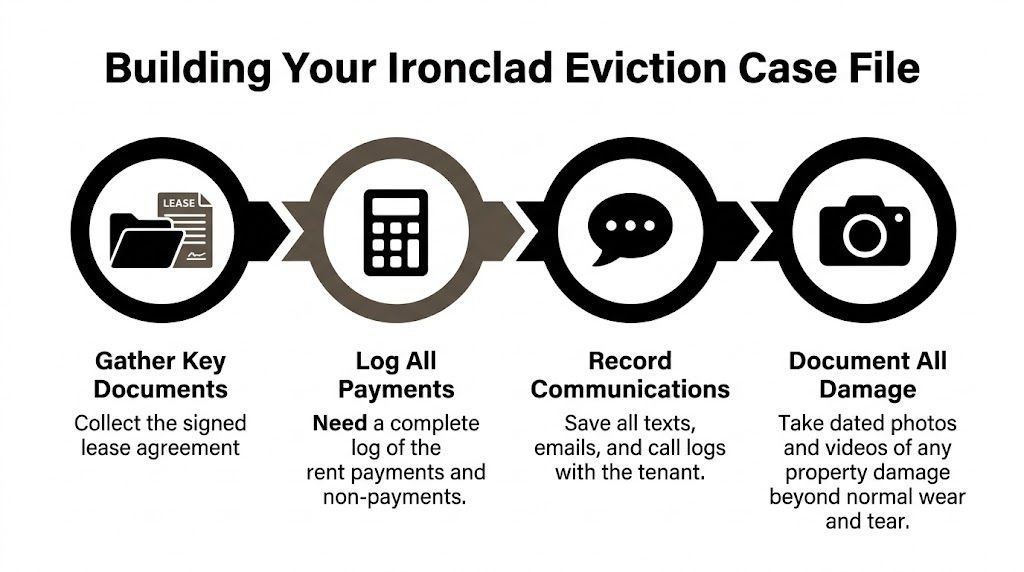
A judge wants to see proof, not just hear your story. Having every piece of evidence ready to go is what separates a successful eviction from a frustrating delay.
What to Expect at Your Court Hearing
This is it—your day in court. All that prep work is about to pay off. You’ll be in front of a magistrate judge, and you need to bring your entire file: the lease, payment records, a copy of the notice, photos, emails, text messages… everything.
When your case is called, you’ll present the facts. No emotion, no drama. Just clearly explain how the tenant violated the lease, show the judge your proof for each claim, and state that you are requesting possession of the property and a judgment for the money owed.
The tenant gets their turn to talk, too. They might argue you failed to make repairs or that you served the notice improperly. This is precisely why your meticulous records are your best weapon. You can calmly and confidently shut down false claims with hard evidence.
After hearing both sides, the magistrate will rule right then and there. If you've laid out a clear, well-documented case, the judgment will almost certainly be in your favor.
These filings are more common than you might think. In 2026, landlords filed over one million eviction cases in major US cities. That’s an eviction filing rate of 7.8%, or almost eight filings for every 100 renters. For landlords in Fayetteville and the surrounding North Carolina communities, these stats show why acting quickly is so important to stop the financial bleeding. Selling "as is" to a cash buyer like DIL Group is a way to sidestep the whole legal mess, protect your credit, and get out from under a bad tenant situation without the drama. You can dig into these eviction trends in this detailed 2024 report.
The Final Step: The Writ of Possession
Winning in court is a huge relief, but you can't go change the locks just yet. The tenant legally has a 10-day period to appeal the judge's decision.
If they don't appeal within that window, you can take the final step.
You'll head back to the Clerk of Court and file for a Writ of Possession (Form AOC-CVM-303). This is the official court order that gives the Sheriff the authority to physically remove the tenant. Filing this writ will cost you another fee, usually around $25.
Once the writ is issued, the Sheriff's office schedules the lockout, typically within a week. You'll need to meet the deputy at the property, and you absolutely must have a locksmith with you. The deputy will supervise as the tenant is removed. Once they are out, your locksmith changes the locks on the spot. At that moment, the property is officially and legally yours again.
Common Mistakes That Can Derail Your Eviction
Trying to evict a tenant is like walking through a legal minefield. One wrong move, and your entire case can go up in smoke. It’ll send you right back to square one, costing you thousands in lost rent and attorney fees.
Even when you’re 100% in the right, a judge has no choice but to throw out your case if you don't follow the rules to the letter.
Learning how to evict someone successfully is really about learning what not to do. Too many landlords, fed up and frustrated, make impulsive decisions that come back to haunt them. The absolute worst of these are "self-help" evictions, and in North Carolina, the consequences are brutal.
The Fatal Error of a Self-Help Eviction
A self-help eviction is any move you make to force a tenant out without an official court order. It's illegal. Full stop.
It doesn’t matter if they’re months behind on rent or have trashed the place. Until a judge and the sheriff get involved, the tenant has a legal right to occupy the property.
I get it—the frustration is real. But these actions, which might seem like common sense at the moment, will backfire spectacularly. Illegal self-help tactics I see all the time include:
- Changing the locks: Even if you’re convinced they’ve abandoned the property, you cannot legally lock a tenant out.
- Shutting off the utilities: Cutting the power, water, or heat is a classic illegal move that carries heavy fines.
- Removing the tenant's belongings: Don't even think about tossing their stuff on the curb. This can be treated as theft and open you up to a whole separate lawsuit.
- Harassment and intimidation: Calling them constantly, showing up without notice, or making threats will only give them ammunition to use against you in court.
In North Carolina, a tenant who has been illegally evicted can sue you for damages. A judge could force you to pay them money—even if they haven't paid you a dime in rent. It’s a costly mistake that flips the script and puts you on the losing side.
The Legal Trap of Accepting Partial Rent
This mistake is far more subtle, but it can be just as damaging to your case.
Let's say you've served the 10-Day Demand for Rent. On day nine, your tenant hands you half the money and promises to pay the rest next week. It's tempting to take it, right? After all, some money is better than no money.
Wrong.
When you accept any amount of rent after starting the eviction, you legally "waive" your right to continue. From the court's perspective, taking their money means you've forgiven the original violation and reinstated the lease.
Just like that, your eviction case is dead in the water. If they fail to pay the rest as promised, you have to start the entire process over again with a brand-new 10-Day Demand. Problem tenants know this loophole well and are masters at exploiting it.
Other Costly Oversights to Avoid
Beyond those two major blunders, several other slip-ups can sink your eviction. I see this happen a lot with out-of-state owners who can't be on-site to manage every detail.
- Serving an Improper Notice: Using the wrong form or delivering it incorrectly can invalidate your entire case before it even begins.
- Neglecting Maintenance: If you've been ignoring repair requests, the tenant can countersue, claiming the property isn't habitable. A judge might see this as retaliation and rule against you.
- Sloppy Paperwork: Showing up to your hearing with a messy file or incomplete records looks unprofessional. It makes it harder for the judge to see things your way and rule in your favor.
Each of these mistakes gives the tenant a legal advantage to fight the eviction, drag out the process, and cost you even more money. The key is to follow the law precisely, no matter how aggravating the situation gets.
The Smart Alternative to Eviction Headaches
You've read the steps. You know the long, frustrating road an eviction can be. The court dates, the lost rent, the constant stress—it’s a battle that can drain your finances and your will to even be a landlord.
But what if you could just… stop? What if you could sidestep that entire nightmare?
Instead of learning how to evict a bad tenant through a months-long legal fight, you can sell the property. Tenant and all. For many landlords, this isn’t just an alternative; it’s the only move that makes sense.

You walk away, free and clear. You never have to set foot in a courtroom or deal with that hostile tenant again.
Bypass the Pain of Eviction
Let's be real. A problem tenant is more than a financial headache. The mental toll is enormous, especially for out-of-state owners who feel completely helpless.
Selling to a cash buyer cuts right through the frustration.
- No More Lost Rent: The second you accept our cash offer, your financial losses stop. You’re not waiting months for an eviction to play out while the rent deficit grows.
- No Unexpected Repair Bills: Did the tenant punch holes in the walls? Ruin the carpet? We don't care. DIL Group Buyers purchases properties “as-is.” You’re not stuck with a huge bill before you can sell.
- No Hostile Confrontations: You make one call. We handle everything else. We take on the difficult tenant, so you don't have to.
- No Endless Court Dates: Forget navigating the legal system. You avoid the entire summary ejectment process, from serving notices to coordinating with the Sheriff.
The eviction process is not only a personal struggle but also reflects deeper societal issues. For landlords in North Carolina communities like Raeford, Dunn, or Eastover, the mounting costs of dealing with a bad tenant are a pressing reality. Learn more about the demographic trends in eviction filings from research conducted by the Eviction Lab.
How Our Cash Sale Process Works
We designed our process to be the exact opposite of an eviction—it's fast, simple, and certain. We buy houses with tenants in them all the time. We get it.
Here’s how you turn your problem property into cash.
- You Make One Call: Reach out by phone or text. No long forms. Just a simple conversation about your property and situation.
- We Make a Fair Cash Offer: We give you a fair, no-obligation cash offer. There are no hidden fees, no commissions, and no closing costs. The number we offer is the number you get.
- You Choose the Closing Date: You pick the closing date. We can close in just a few days, not months. You get paid, and we take over the property—and the tenant.
That’s it. You move on from the property that’s been causing you sleepless nights. If you're in this exact spot, our guide on selling a house with a tenant still inside breaks it down even further.
Your Top NC Eviction Questions Answered
When you're dealing with a bad tenant, you don't have time for vague answers. You need to know your options now. Here are the straight answers to the most common questions landlords ask when facing a North Carolina eviction.
How Long Does an Eviction Take in North Carolina?
This is the big one. And the honest answer is: it depends.
In a perfect world, where the tenant doesn't fight back for non-payment of rent, you might get your property back in 4 to 6 weeks. That includes the 10-day notice, filing with the court, getting a hearing, and waiting out the tenant's 10-day appeal window.
But that’s the best-case scenario. If the tenant appeals, your case gets kicked up to District Court. That move alone can add several months to the process. Months where you’re not getting paid. Months of stress and legal headaches.
Can I Evict a Tenant Without a Written Lease?
Yes. You absolutely can. Don't let the lack of a formal paper lease stop you. In North Carolina, this usually creates a month-to-month tenancy, or a "tenancy-at-will."
The process is just a bit different:
- Serve a 7-Day Notice to Quit: You must give the tenant a written notice to leave within seven days to end a month-to-month agreement.
- File for Eviction: If they're still there after seven days? You head to the courthouse and file the "summary ejectment" paperwork to get the ball rolling.
Having no written lease is not a roadblock, but you have to use the correct notice.
CRITICAL MISTAKE: Accepting any rent—even a single dollar—after a notice expires can kill your eviction case. A judge will see it as you forgiving the problem and restarting the tenancy. You’ll have to start the entire process all over again.
What if the Tenant Disappears but Leaves All Their Stuff?
This is a legal minefield. You can’t just throw their belongings in a dumpster and change the locks, no matter how tempting it is. North Carolina law is very specific about handling abandoned property.
You’re required to store their personal items for a certain period and provide them with a formal notice to come get them. Mess this up, and the tenant you just evicted can turn around and sue you for the value of their property. It’s a common and costly trap for landlords.
Is an Eviction Even Worth It?
After looking at the costs, the delays, and the legal risks, many landlords ask this exact question. A "simple" eviction can easily run you $3,500 or more when you factor in lost rent, court fees, and the inevitable repairs.
Weigh that cost against a fast cash sale. Instead of spending months fighting in court for a house that might be trashed, you can get a fair cash offer and be done in a matter of days. It’s the difference between uncertainty and a guaranteed closing.
If the stress of court dates, legal notices, and problem tenants is too much, DIL Group Buyers is your way out. Don’t fight to evict a bad tenant—sell the property "as is" and let us handle the problem. Contact us today for your no-obligation cash offer and turn that rental nightmare into cash in your pocket. Learn more at https://dilgrouphomebuyers.com.