
You’re probably here because someone told you a “quick claims deed” is the fastest way to get rid of a house problem.
Maybe you got PCS orders from Fort Bragg and the house in Fayetteville still needs work. Maybe you inherited a property in Cumberland County and you live hours away. Maybe there’s a divorce, late payments, code issues, or a tenant situation you’re tired of managing from another state.
You want simple. You want fast. You want out.
That goal makes sense. The problem is that “quick claims deed” isn’t the correct term. The proper term is quitclaim deed, and that small wording mistake usually points to a much bigger misunderstanding. People hear “quick” and assume safe, standard, and smart. It isn’t.
A quitclaim deed can be useful in a few narrow situations. But if you’re talking about selling a distressed property, especially to someone you don’t know well, it can create a mess that follows the property long after the paper gets signed.
That "Quick Claims Deed" Sounds Too Good to Be True
A Fayetteville owner calls in a panic. They’ve already moved. The house still has problems. The grass is getting notices from the city, a relative says, “Just do a quick claims deed,” and that sounds like relief.
It isn’t relief. It’s often a shortcut into confusion.
Why the name matters
When people say quick claims deed, they usually mean quitclaim deed. That mix-up matters because the word “quick” makes it sound like a speed tool for a normal home sale.
It’s not.
A quitclaim deed is a narrow legal instrument. It can transfer whatever ownership interest a person has. But it doesn’t promise that the interest is valid, complete, or free of problems.
Practical rule: If speed is the main selling point, stop and ask what protections you’re giving up.
Why stressed homeowners get pulled toward it
If you’re under pressure, the appeal is obvious:
- You want out fast: foreclosure pressure, job loss, divorce, inherited property headaches.
- You’re tired of repairs: the house may need work you can’t fund or supervise.
- You live somewhere else: distance makes every title issue and signature harder.
- You want less paperwork: and a quitclaim deed sounds like a stripped-down solution.
That instinct is understandable. It’s also where people get burned.
The underlying issue
Most homeowners don’t need “faster paper.” They need a clean transfer that won’t blow up later.
That’s especially true in Cumberland County, where many sellers are military families, remote landlords, or out-of-state heirs trying to solve a local problem from far away. If you can’t inspect records in person, meet contractors, or respond quickly to title questions, using a deed with almost no built-in protection is a bad bet.
A quitclaim deed isn’t magic. It doesn’t erase liens. It doesn’t fix ownership disputes. It doesn’t remove title problems just because everyone wants the deal done.
It only moves whatever claim exists from one person to another.
If that sounds thin, that’s because it is.
What a Quitclaim Deed Really Is and What It Is Not
A quitclaim deed is a transfer form with very limited promises. It lets one person transfer whatever ownership interest they may have to someone else. In deed language, the grantor gives up that interest, and the grantee receives it.
What matters is what the deed leaves out.

A quitclaim deed works like a handoff of claim, not proof of clean ownership. If the grantor owns the whole property, that interest can pass. If the grantor owns only part of it, only that part can pass. If the grantor has no valid interest at all, the grantee may receive nothing useful.
That is the part stressed owners miss.
In North Carolina, a deed still needs the basic legal pieces to be recorded properly, including the names of the parties, the legal description of the property, the grantor’s signature, and proper notarization. The North Carolina Judicial Branch glossary definition of a quitclaim deed also makes the core point plain. This kind of deed transfers whatever rights the grantor has, without warranties of title.
What a quitclaim deed does
It can transfer an ownership interest from one party to another.
That makes it useful for a narrow set of situations, such as cleaning up title between family members, removing an ex-spouse after a settlement, or shifting property into a trust or LLC when everyone already knows the title status. The deed itself is simple. The title problems behind the deed are not.
What a quitclaim deed does not do
It does not promise that:
- the grantor owns clear title
- there are no liens or unpaid taxes
- the legal description is correct
- no heir, co-owner, or creditor can raise a claim later
- the mortgage goes away
- the transfer solves a bigger property problem
That last point matters a lot in Cumberland County.
If you are in another state, deployed, handling an inherited house, or trying to get rid of a property that needs work, a quitclaim deed can feel like the fastest exit. It is not an exit strategy by itself. It is just paperwork. If title is messy, the mess stays.
The mistake homeowners make
Owners under pressure often assume signing a quitclaim deed means they are done with the property in a practical sense. That is wrong.
If there is still a mortgage, your loan does not disappear because you signed over your interest. If there is a title defect, the defect does not disappear because the deed got recorded. If the person on the other side stops paying taxes or lets the house fall apart, you may still be dealing with fallout, especially if your name remains tied to debt or unresolved ownership records.
A quitclaim deed has one job. It transfers whatever interest exists. It does not verify that the interest is clean, marketable, or free of trouble.
For a trusted internal transfer, that can be fine. For a distressed sale, especially when you are remote and cannot keep chasing paperwork, contractors, and title questions from afar, it is often the wrong tool.
Quitclaim Deed vs Warranty Deed A Key Comparison
You are in another state, the house in Cumberland County needs work, and a buyer says, “Just sign a quitclaim deed and we can be done.” Slow down. If this is a real sale, that shortcut usually helps the buyer more than it helps you.
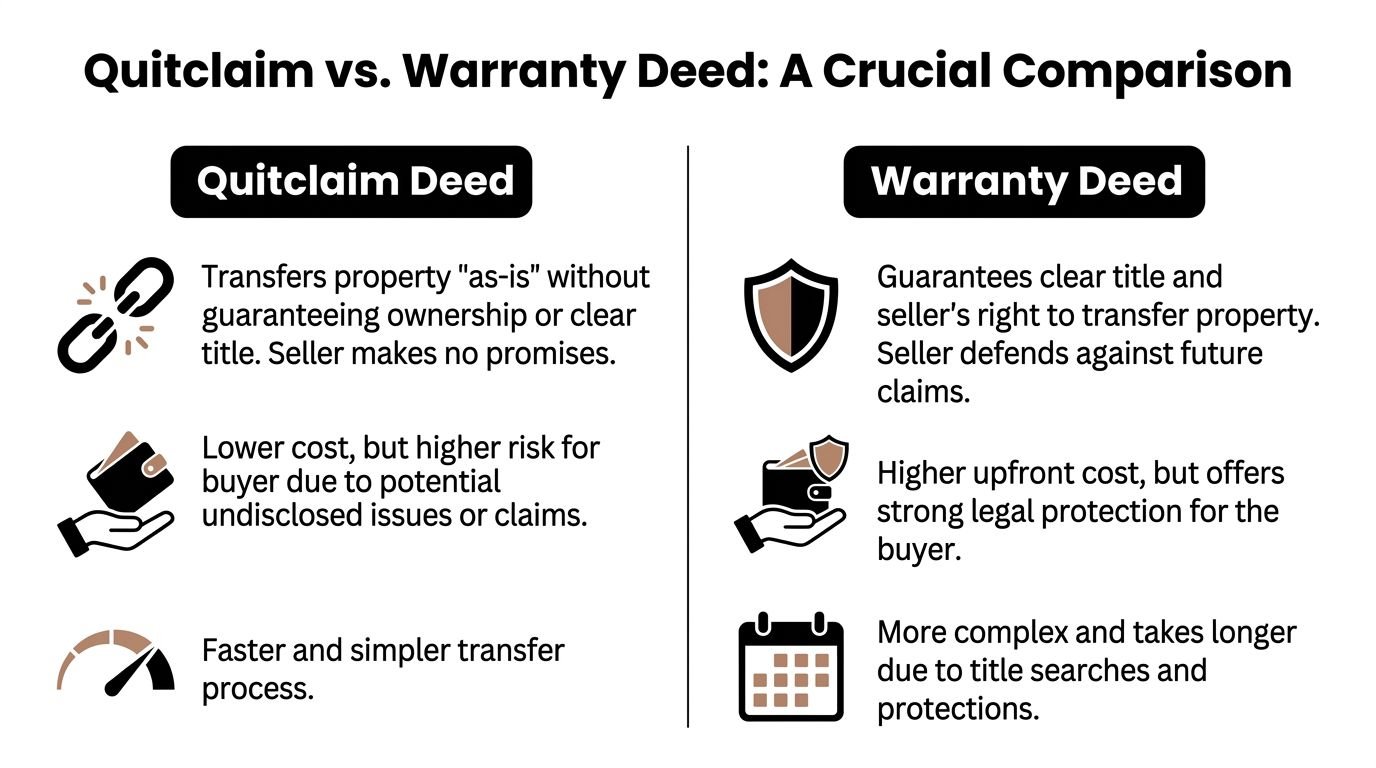
A quitclaim deed transfers whatever ownership interest the signer has, if any. A general warranty deed does more. It says the seller owns the property, has the right to transfer it, and will stand behind the title if a covered problem shows up later. The Legal Information Institute’s explanation of general warranty deeds lays out that difference clearly.
The practical difference
For a normal sale, a warranty deed is the standard because buyers, title companies, and lenders want a transfer they can trust.
A quitclaim deed is usually for limited situations between people with an existing relationship, not for an arm’s-length sale of a problem property.
| Feature | Quitclaim Deed | General Warranty Deed |
|---|---|---|
| What the seller is saying | “I transfer any interest I may have” | “I own it and I back the title” |
| Protection for the buyer | Very little | Much stronger |
| Use in a standard sale | Usually a poor fit | Usually the expected choice |
| Title review pressure | Problems often surface later | Problems are more likely to be addressed before closing |
| Resale and financing | Can raise more questions | Easier for later buyers and lenders to accept |
| Best use | Family transfers, divorce terms, trusts, internal ownership changes | Ordinary home sales |
Why Cumberland County owners get tripped up
Sellers under pressure focus on speed. Buyers focus on exposure. Those are not the same thing.
If you are dealing with inherited property, an outdated deed, a co-owner issue, or you have been managing the house from another state, the right first step is usually a title search for the property, not a rushed signature on the wrong deed form. That review tells you what is sitting on title before you promise the house to anyone.
My recommendation
Use a quitclaim deed only when the transfer is internal, the parties already trust each other, and everyone understands that the deed gives no title warranty.
If you are selling to a third party, especially a distressed house, use the deed type that fits a real sale. In plain English, that usually means a warranty deed at a proper closing, or a direct cash sale with a buyer who can close fast without asking you to gamble on DIY paperwork.
That is the point many stressed owners miss. Fast and safe are not the same thing. In a clean family transfer, a quitclaim can be fine. In a remote or distressed sale, it is often the wrong tool.
The High-Stakes Financial Risks of Using a Quitclaim Deed
A quitclaim deed looks cheap and easy until the property carries a problem no one caught.
That’s when the risk stops being legal jargon and turns into money, delay, and stress.

The biggest financial danger
The person receiving the property can inherit title defects without warning.
That can include:
- Unpaid taxes: which stay attached to the property
- Old liens: including judgments or contractor-related claims
- Ownership defects: where the grantor didn’t fully own what they transferred
- Clouds on title: errors, missing interests, or record problems that block a later sale
- Financing issues: future buyers may struggle to get a lender or title company comfortable
A quitclaim deed doesn’t screen those problems out. It carries them forward.
Fraud is not a minor side issue
Real estate fraud is a genuine threat, not a niche concern. Between 2019 and 2023, the FBI documented 58,141 victims who lost more than $1.3 billion to real estate-related fraud, according to Tower’s discussion of quitclaim deed risk and fraud exposure.
That matters here because quitclaim deeds offer no title guarantees or warranties. They leave the recipient exposed if the ownership claim is weak, manipulated, or flat-out fraudulent.
A cloud on title can trap the property
“Cloud on title” sounds abstract. It isn’t.
It means there’s something in the ownership record that makes the property harder to sell, insure, or finance. That might be a name error, an unresolved prior claim, a missing heir, or a document problem in the chain of title.
If you want a plain-English breakdown, this guide on what a title search for property checks is worth reading.
Once a cloud exists, a future buyer may walk. A title company may refuse to insure. A lender may reject the deal. Suddenly the “fast” solution becomes the reason the property sits unsold.
Why title issues get expensive fast
The cost isn’t just one bill. It stacks up:
- carrying costs while the property can’t close
- legal help to fix record defects
- delayed relocation plans
- tax and lien payoffs that surface late
- buyer concessions when confidence drops
Here’s a short explainer if you want to hear the risk from another angle.
My opinion on this
If the property is distressed, inherited, vacant, or remotely managed, a DIY quitclaim deed is usually the wrong tool. You are taking the one part of the transaction that needs clarity, title, and stripping out the protection.
That’s backwards.
People use quitclaim deeds because they want fewer problems. In messy property situations, they often get the opposite.
Why Out-of-State and Military Owners Are at Greater Risk
Distance makes every property problem worse.
If you live in another state and own a house in Cumberland County, you already have less visibility. You’re relying on phone calls, texts, online records, neighbors, relatives, and guesswork. That’s a bad setup for a deed that transfers problems without guarantees.
Remote owners miss what local owners catch
A local owner may notice:
- a city notice taped to the door
- a contractor dispute getting ugly
- a tax issue that needs immediate attention
- a title problem raised during early sale prep
A remote owner often learns about those issues late. Sometimes very late.
That delay matters because quitclaim deeds are especially risky when hidden issues are sitting in the background. For out-of-state owners selling distressed properties as-is, quitclaim deeds are exceptionally risky because they transfer all title flaws, while cash home buyers can reduce that risk by conducting professional title searches and using sale proceeds to clear liens at closing, as explained in Orchestrate’s discussion of quitclaim deed issues for remote sellers.
Military timelines make bad shortcuts more tempting
PCS pressure changes how people make decisions.
When you have orders, family logistics, school transitions, and move deadlines, “just sign this and move on” sounds attractive. That’s exactly when you need to slow down on the deed choice.
A quitclaim deed can look like the fastest escape hatch. For military owners, it’s often the fastest way to create a title issue from another state while trying to settle into a new duty station.
The less access you have to the property, the less you should rely on a transfer method that gives you almost no protection.
Why absentee owners need process, not shortcuts
If you’re selling from a distance, your best protection is a structured closing process:
- title work gets done before closing
- liens are identified
- payoff issues are handled through settlement
- signatures can be coordinated remotely
- the transfer is documented in a way the next buyer, title company, and county records can work with
That’s what remote owners need. Not bare-minimum paper.
The common trap
A relative, investor, or casual buyer may say a quitclaim deed is “easier.”
Easier for whom?
Usually easier for the person asking you to sign it. Not easier for you if the ownership history is bad, the property has a claim attached, or the transfer gets questioned later.
If you’re out of state, your margin for error is smaller. You can’t drive over and sort it out. That’s why your standard should be higher, not lower.
When a Quitclaim Deed Is a Safe and Smart Choice in NC
You do not need to swear off quitclaim deeds completely. You need to keep them in the right lane.
In North Carolina, a quitclaim deed is usually a cleanup tool, not a selling tool. It works best when ownership is already clear, both parties know exactly what is being transferred, and no one is relying on the deed itself for protection.
The North Carolina Judicial Branch includes quitclaim deeds among deed forms used to transfer whatever interest a person has in real estate, which fits narrow situations like family transfers and title cleanup, not risky third-party sales. See the North Carolina court system deed forms and real property resources.
Where a quitclaim deed makes sense
I recommend a quitclaim deed only in a few situations:
- Family transfers with no money changing hands. Parent to child. Sibling to sibling. One family member is passing along their interest.
- Divorce or separation follow-through. One spouse is coming off title after the larger settlement is already handled.
- Trust transfers. You are moving the property into or out of your own revocable trust or another entity you control.
- Minor title cleanup between known parties. Everyone already understands the ownership history, and the goal is to clear up the record, not create a new sale.
Those are controlled situations. The people involved know each other, know the property, and know why the transfer is happening.
The rule I give Cumberland County owners
Use a quitclaim deed to rearrange ownership among trusted parties.
Do not use it as a shortcut sale document for a distressed house, inherited property, vacant rental, or long-distance property headache. If a buyer is pushing you toward a DIY quitclaim because it is “faster,” slow down. Fast for them can get expensive for you.
That matters even more if you live out of state or you are active-duty military trying to wrap this up from a new duty station. In those cases, a structured closing is usually the safer answer. If your real goal is speed without loose ends, review a simple 3-step home sale process before you sign away your interest on bare paperwork.
My practical test
A quitclaim deed is a smart choice when all three are true:
- You trust the other party.
- You already know the title history.
- You are not counting on deed warranties to protect the transfer.
If even one of those is missing, stop and choose a safer path.
If this is a real sale and real money is involved, use a process that checks title and closes the transfer correctly.
That is the standard I would follow for my own family.
The Safer Fast-Track A Cash Sale with DIL Group Buyers
If your real goal is speed, there’s a better route than a DIY quick claims deed.
A professional cash sale can move fast without stripping away title protection.
Speed without the quitclaim risk
In cash home-buying transactions for distressed properties in Cumberland County, NC, a professional buyer can close in as little as 7 to 14 days using a warranty deed and title search, which avoids quitclaim deed risk. That same process can eliminate title insurance costs for the seller that average $1,000 to $2,500, based on data from over 150 local property purchases, as described in this local video explanation of fast cash closings and title process.
That’s the key point. You can move fast without relying on a quitclaim deed.

What a better process looks like
A solid cash sale process usually looks like this:
- You disclose the situation plainly. Inherited house, code issues, tenants, deferred maintenance, divorce, probate, job loss, whatever it is.
- The buyer orders title work. That’s where real problems get identified.
- Closing handles the mess. Liens, payoffs, and paperwork get worked through the transaction instead of dumped on the next person.
- You close on your timeline. Especially important if you’re relocating or trying to avoid a deeper financial problem.
If you want a clean outline of how that kind of transaction typically works, review this simple 3-step home sale process.
Why this is better for distressed owners
A professional cash buyer is often a better fit when the property has baggage:
- No repair requirement: you don’t need to update the house first
- No listing drama: no showings, open houses, or buyer financing delays
- Remote-friendly closing: important for military and absentee owners
- Title problems get addressed: instead of ignored
- Less guesswork: you know whether the deal can close before wasting more time
My recommendation
If you own a distressed house in Cumberland County and you’re considering a quick claims deed because you think it’s the only way to move fast, stop.
Fast is available. You just need the right process.
A proper cash closing with title review is usually the smarter play because it protects the transfer instead of pretending the risk isn’t there.
NC Filing Checklist and Critical Quitclaim FAQs
If you still need a quitclaim deed for a legitimate family transfer, keep it simple and do it correctly.
Cumberland County filing checklist
- Get the right form: Use a North Carolina quitclaim deed form that matches the county recording requirements.
- Fill in the core details carefully: grantor, grantee, legal property description, transfer date, and consideration amount.
- Check the legal description against prior records: mistakes here create title trouble later.
- Sign before a notary: don’t skip this.
- Record it with the Register of Deeds: in the county where the property sits.
- Keep a stamped copy: you may need it later for estate, trust, or title cleanup work.
If you want a practical walkthrough, this guide on how to file a quitclaim deed is a useful starting point.
Critical FAQs
Does a quitclaim deed remove me from the mortgage
No.
The deed changes title ownership. It usually does not remove your name from the loan. If your mortgage is still in your name, the lender still expects you to pay.
Can a quitclaim deed fix title problems by itself
No.
It can transfer an interest. It does not automatically clear liens, cure probate defects, or erase a cloud on title.
Can a quitclaim deed be reversed
Usually not by simple request.
Once it’s signed, notarized, delivered, and recorded, undoing it often requires a new deed or a legal fight. Don’t sign first and figure it out later.
Is a quitclaim deed good for selling a house to a regular buyer
Usually no.
For a normal sale, you want a cleaner process with title review and stronger transfer protection.
If you’re dealing with a house problem in Fayetteville, Hope Mills, Spring Lake, Raeford, Dunn, or anywhere around Cumberland County, DIL Group Buyers offers a straightforward option. They buy houses as-is, work with inherited and distressed properties, handle many remote-owner situations, and can help you avoid the risk of trying to solve a serious title or sale problem with the wrong deed.