
The call usually comes after a bad week. A roof leak turned into ceiling damage. A tenant moved out and left the place wrecked. A house you inherited outside Fayetteville has been sitting too long, and now every visit uncovers one more problem. For military families around Fort Bragg, it often gets worse when PCS orders hit and the house problem becomes a long-distance problem overnight.
In Cumberland County, damaged houses show up in every form. Storm damage in Fayetteville. Deferred maintenance in Hope Mills. Older rural properties with soft floors, bad wiring, or water intrusion in Eastover, Stedman, and beyond. The hard part usually isn't deciding whether the house has issues. The hard part is figuring out how to sell it without sinking more money, time, and stress into a property you no longer want to carry.
That decision gets even tougher for remote owners. According to Opendoor's overview of selling disaster-damaged homes, 20-30% of U.S. investment properties are held by non-local owners, and 15% of Fort Bragg sales involve out-of-state military families. The same source notes that virtual cash offers can enable 7-14 day closings without travel, while traditional listings can take 60-90 days.
A Homeowner's Guide to Selling a Damaged House in NC
If you're trying to figure out how to sell a damaged house, you probably aren't dealing with just one issue. You're dealing with the house, the bills, the timeline, and the uncertainty of what a buyer is going to say once they see the condition.
What damaged sellers in Cumberland County are usually facing
Around Fayetteville, the situations repeat themselves. A seller inherits a property with years of deferred maintenance. A landlord has a vacant house with code problems and no appetite for rehab. A service member moves out of state and can't keep flying back to meet contractors, agents, and inspectors.
Those situations don't all call for the same solution. In practice, most sellers end up choosing between three paths:
- List it as-is with an agent: This can work if the damage is manageable and the house still appeals to financed buyers.
- Fix it first, then list it: This makes sense when the repairs are straightforward, affordable, and likely to widen the buyer pool.
- Sell directly for cash: This is usually the cleanest route when the property has serious condition issues, legal complications, or a seller who needs certainty.
Local reality: A damaged house in Cumberland County doesn't just sell based on square footage. It sells based on condition, financing risk, repair scope, and how quickly the seller needs to be done.
Why local conditions matter
A generic national article won't tell you much about selling a damaged farmhouse outside the city limits, or handling a Fayetteville property while you're already stationed somewhere else. Local buyers look at things that matter here: whether the systems are functional, whether the lot has value, whether the repair scope is realistic, and whether the title issues can be cleared.
Military relocations also change the math. If you're leaving on orders, you may not have time to manage repairs, repeat showings, and buyer inspection demands. If you inherited a property in the county but live elsewhere, even getting a clean-out done can become a project of its own.
The right move depends on two questions. First, how bad is the damage really? Second, what kind of sale can your timeline and finances support?
First Step Honestly Assessing Your Property's Condition
Before you talk price, talk condition. Sellers get into trouble when they lump everything together as "needs work" and hope the market will sort it out. Buyers don't price houses that way. They break problems into categories, assign risk, and lower offers accordingly.
Separate the damage into three buckets
Start with a simple property review. Walk the house, take photos, and sort what you see into these groups:
Cosmetic issues
Peeling paint, old flooring, damaged cabinets, stained carpet, and worn fixtures live here. These problems matter, but they don't usually scare off every buyer.System issues
Electrical, plumbing, HVAC, water heater, septic, and roof problems belong in this bucket. These are the items that often trigger inspection objections because buyers know they're expensive and urgent.Structural or health-related issues
Foundation movement, sagging floors, roof framing problems, mold, major water damage, fire damage, and wall cracks that signal deeper movement go here. Such significant issues frequently deter many retail buyers.
Get documentation before you get opinions
You don't need to renovate before you understand the house. But you do need a clear picture of what you're selling. A strong starting package usually includes:
- A recent walkthrough record: Photos of every room, exterior elevations, crawl space access points, and visible damage.
- Basic repair notes: Contractor estimates if you have them, even if you don't plan to do the work.
- Known history: Insurance claims, prior repairs, leak history, and any past remediation.
Buyers handle bad news better than uncertainty. A documented problem is easier to sell than a vague one.
Understand value loss before setting expectations
Condition directly affects what your house will bring. According to Locqube's analysis of selling a house as-is, homes sold as-is typically sell for 10% to 40% less than comparable homes in good condition. The same source notes that properties with major issues like structural damage, mold, or foundation problems can lose up to 25% or more of their value, and a home worth $300,000 in good condition could sell for as low as $225,000 if it has serious flaws.
That doesn't mean every damaged house should be fixed first. It means you need realistic expectations.
Think in terms of after-repair value
Investors and experienced buyers often use after-repair value, or ARV. That's the value of the property after the needed work is complete. If the finished value looks strong and the repairs are manageable, the house may still attract serious buyers. If the repair list is heavy and the finished value doesn't leave enough room, expect lower and fewer offers.
A fast self-check helps:
| Damage type | What buyers usually think |
|---|---|
| Cosmetic only | Manageable, easier to price |
| One or two major systems | Expensive, but still solvable |
| Structural, mold, or extensive water damage | High risk, smaller buyer pool |
If you skip this step, you risk overpricing the property, losing time, and chasing buyers who were never a fit.
Your Three Selling Options in Cumberland County
Once you know what you're dealing with, the next decision is how to sell. In Cumberland County, damaged-property sellers usually choose between a traditional listing, a direct cash sale, or an auction. Each path solves a different problem.
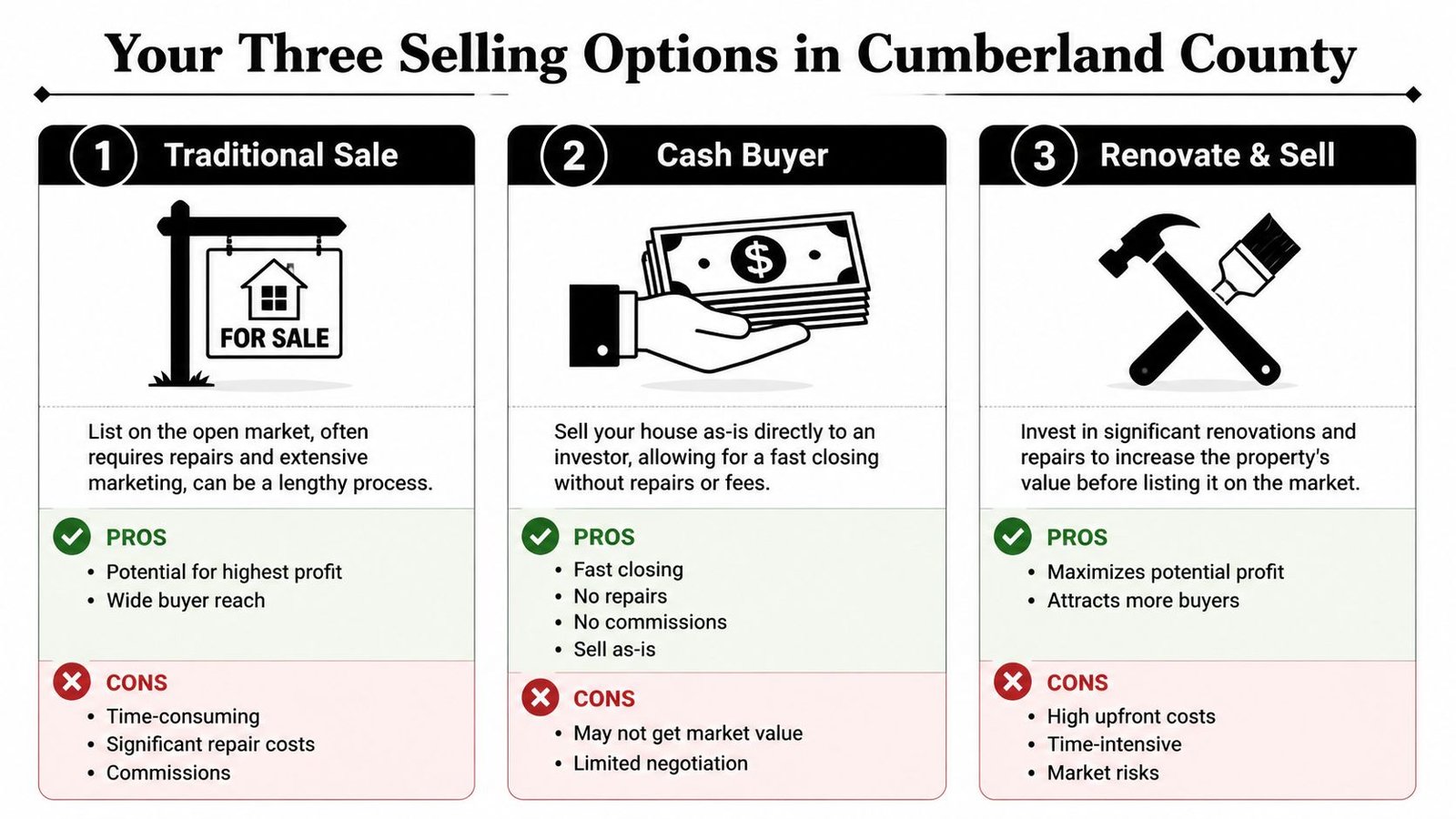
Option one list with an agent
This works best when the house still has broad appeal and the seller can handle the normal retail process. Even an as-is listing through an agent usually involves cleaning, photos, showings, negotiations, inspections, and buyer financing risk.
The upside is obvious. You expose the property to the largest buyer pool. If the house only needs moderate work, that can help.
The downside is fit. Serious condition problems tend to choke off financed offers, and many sellers underestimate how much prep is still expected in an "as-is" listing.
Option two sell directly to a cash buyer
This is the practical route when speed, certainty, and simplicity matter more than stretching for the highest possible retail number. It can make sense for inherited houses, vacant properties, storm-damaged homes, rental properties in rough shape, and houses owned by out-of-state sellers.
A direct buyer isn't shopping for a move-in-ready house. They're pricing the lot, the structure, the repair burden, and the resale margin. If that's the lane you need, it's worth understanding how local companies buy houses in any condition before you compare offers.
Option three sell at auction
Auctions can work when the seller wants speed and is comfortable with price uncertainty. They're more common when the property is unusual, highly distressed, or difficult to value through a standard listing process.
But auctions aren't magic. If the right bidders don't show up, the final number may disappoint. This route tends to suit sellers who care more about immediate disposal than control over the process.
A side by side comparison
| Factor | List with Agent | Sell to Cash Buyer (DIL Group) | Sell at Auction |
|---|---|---|---|
| Best for | Houses with manageable damage | Serious damage, remote owners, urgent timelines | Sellers prioritizing speed over price control |
| Repairs | Often expected, even if limited | Usually sold as-is | Usually sold as-is |
| Showings | Yes | No traditional showings | Limited buyer access depends on setup |
| Financing risk | High | Low | Buyer terms vary |
| Timeline | Longer and less predictable | Shorter and more predictable | Fast if bidding activity is strong |
| Price potential | Highest in the right condition | Lower than top retail in many cases | Uncertain |
| Seller effort | Highest | Lowest | Moderate |
The best option isn't the one with the highest theoretical price. It's the one that still works after you factor in time, repairs, financing, and stress.
What tends to work in real life
For a house with cosmetic wear and decent systems, listing can work. For a house with layered problems, delayed maintenance, title complications, or a seller who lives out of town, direct sale often lines up better with reality. Auctions sit in the middle. Useful in some cases, but not usually the first recommendation for an owner who wants clarity and control.
The Cash Buyer Process A Stress-Free Alternative
Many sellers hesitate on the cash option because they don't understand how the process works. They assume it's vague, rushed, or impossible to evaluate fairly. A legitimate direct sale should feel plain, not confusing.

How the process usually unfolds
A straightforward cash sale often looks like this:
- Initial contact: The seller shares the address, condition, occupancy status, and timeline.
- Property review: The buyer evaluates the house, either in person or through a remote process if the owner is out of town.
- Offer calculation: The buyer estimates the finished value, subtracts repairs, carrying costs, and their needed margin.
- Closing choice: The seller picks a closing date that fits the situation.
If you want a better sense of the mechanics, this breakdown of what a cash offer on a house means is useful background.
Why the offer comes in below retail
This is the part sellers need explained clearly. According to Fanis' guide to selling a fixer-upper, investors typically offer 50-70 cents on the dollar of a home's after-repair value. That pricing accounts for repair costs, holding costs, and profit margin. The same source says this structure can allow a close in 2-4 weeks, compared with 4-8 months often required for a retail sale of a damaged property, where 80% of conventional loans may be rejected due to condition.
That doesn't mean every cash offer is good. It means every cash offer should be understood in context. If the house needs major work, the buyer isn't valuing it as if those problems don't exist.
Practical rule: Compare the net outcome, not the headline offer. A higher retail price can still leave the seller worse off if repairs, delays, concessions, and failed contracts pile up.
What sellers like about this route
The value is mostly operational. You can often skip repairs, skip open houses, avoid repeated negotiations, and close on a timeline that fits a move, probate matter, or financial deadline.
For Cumberland County sellers, that matters most in a few recurring situations:
- Military relocation: You need the property gone before or soon after a move.
- Inherited property: The heirs want resolution, not a rehab project.
- Vacant damaged house: Every extra week creates more risk and more carrying cost.
- Tenant damage: The house isn't in showing condition and you don't want to prep it for market.
A short video can help if you want to see the process explained visually.
What to verify before signing
Not all buyers operate the same way. Ask direct questions. Will they buy it as-is? Are they using their own funds or assigning the contract? Who handles title work? What happens if liens or code issues show up?
A serious buyer should answer those questions without dancing around them.
Navigating Financial Liens and Legal Headaches
Condition problems are hard enough. Title and legal issues are what usually freeze sellers in place. People assume they can't sell until every problem is cleaned up first. In many distressed sales, that isn't true.

Liens and back taxes
Liens scare sellers because they sound like a full stop. They usually aren't. Tax issues, contractor liens, judgment liens, and utility balances can often be addressed through the closing process rather than paid off long before the sale.
According to Zillow's discussion of selling a house as-is when it needs repairs, 40% of distressed property sales involve encumbrances like liens or back taxes. The same source states that a cash buyer can resolve these issues at closing without upfront payment from the seller, and that repair-first approaches fail in 60% of lien-heavy cases.
If that's your issue, it helps to understand whether you can sell a house with a lien on it before assuming the property is unsellable.
Foreclosure pressure and missed mortgage payments
When someone is behind on payments, time matters more than debate. The wrong move is denial. The right move is getting the payoff amount, understanding the timeline, and finding out whether a sale can close before the lender advances the process further.
A traditional listing can work if the house is financeable and the timing is generous. A damaged property under pressure often doesn't have either advantage. In those cases, a fast direct sale can be less about convenience and more about preserving options.
If the property has both condition issues and debt problems, waiting for a perfect buyer usually makes the outcome worse.
Inherited houses and out-of-state owners
Inherited properties around Cumberland County often come with two layers of difficulty. The house needs work, and the heirs don't live nearby. One person is handling documents from another city. Another is trying to find a junk removal company. Nobody wants to spend weekends coordinating access for estimates.
For remote owners, the practical checklist usually includes:
- Authority to sign: Make sure the estate, heirs, or appointed representative can legally sell.
- Access planning: Decide who can meet inspectors, title reps, or buyers if the property is occupied or locked.
- Document gathering: Pull tax records, death certificates, probate paperwork, and any prior title documents early.
- Disclosure prep: Be honest about what you know and equally honest about what you don't know.
Code violations and open property issues
Code notices, junk and debris complaints, unsafe structures, and long-deferred maintenance often chase owners into action. These problems rarely get cheaper with time. If the house is vacant, they also invite more scrutiny.
The key point is simple. A damaged house with legal complications is still a property, not a dead end. The sale strategy just needs to match the reality on paper and on site.
Your Next Steps and Common Questions Answered
If you're trying to decide how to sell a damaged house in Cumberland County, don't start with hope. Start with facts. What condition is the house in, what debts or title problems are attached to it, and how much time do you really have?
For some owners, listing is still the right move. For others, especially those dealing with inherited property, major repairs, military relocation, liens, vacancy, or distance, a direct as-is sale is usually the cleaner path. The best decisions come from matching the sale method to the actual problem instead of chasing the most optimistic scenario.
A simple next-step checklist
- Walk the property thoroughly: Separate cosmetic issues from system failures and structural concerns.
- Gather your paperwork: Tax records, mortgage payoff information, repair estimates, insurance documents, and any notices tied to the property.
- Decide your priority: Highest possible price, fastest close, least hassle, or most certainty.
- Talk to the right buyer type: Not every damaged house belongs on the retail market.
A house can be damaged, inherited, occupied by problem tenants, or tied up with liens and still be sold. The method matters.
Common questions sellers ask
Can I sell if I'm behind on my mortgage
Yes, in many cases you can. The important part is moving quickly enough to understand the payoff and the timeline. A delayed decision is usually what causes the worst outcome.
Do I have to fix anything before selling
No. You can sell a damaged house as-is. Whether that is smart depends on who the likely buyer is and how severe the condition problems are.
What if I live out of state
You can still sell remotely. The process usually depends on document handling, title coordination, and access to the property. Remote sales are common when military families relocate or heirs live elsewhere.
Should I clean the place out first
Not always. For a retail listing, usually yes. For an as-is sale, often no. At minimum, remove anything you need to keep and any obvious hazards if you can do so safely.
Is it worth getting repair estimates if I don't plan to fix it
Usually yes. You don't need a full renovation plan, but even rough numbers help you evaluate offers and understand what buyers are seeing.
If you need a direct solution, DIL Group Buyers is a local Cumberland County home buyer that works with damaged houses, inherited properties, military PCS situations, liens, code issues, and out-of-state owners. You can reach out for a straightforward cash offer, sell the property as-is, and choose a closing timeline that fits your situation without listings, showings, or repair work.