
The phone call usually comes at a bad time. A parent has passed. A relative left behind a house in Fayetteville, Hope Mills, or Spring Lake. Maybe you live nearby and can check on it. Maybe you’re states away because of work, retirement, or a military move. Then someone says the word probate, and everything suddenly feels heavier.
Most families aren’t confused about the house itself. They’re confused about what they’re allowed to do with it, who has authority to sign, whether bills still need to be paid, and how long the process will drag on. That uncertainty is what makes inherited property feel so stressful.
Buying homes in probate and selling probate homes both follow a legal path. It’s slower than a normal sale, but it isn’t random. There are documents, deadlines, notices, and approvals. Once you understand the order of the steps, the situation starts to feel manageable.
In Cumberland County, that matters a lot. Many inherited homes sit empty while families juggle travel, property upkeep, contents inside the house, and pressure from taxes, insurance, or an existing mortgage. Military families and absentee owners often feel that pressure even more because they can’t just drive over after work and deal with it.
Inherited a House in Fayetteville? Understanding Your First Steps
A common Fayetteville situation goes like this. A son stationed somewhere else inherits his mother’s house near town. He has paperwork in a folder, a house key, and a dozen unanswered questions. Can he clean it out? Can he sell it now? Does the will automatically give him the right to sign? What if his sister also inherited part of the estate?
That early stage is where people make the mistake of treating the house like any other property. It isn’t, at least not yet. An inherited house usually has to move through probate before a full sale can happen. That doesn’t mean you’re stuck. It means the estate has to be handled in the right order.
What to do first
Before talking price, repairs, or listing options, focus on control and paperwork.
- Secure the property: Change or verify access, collect mail, and make sure the house is locked. If the home is vacant, ask the insurer what they require.
- Find the core documents: Look for the will, death certificate, mortgage statements, tax notices, insurance details, and utility information.
- Identify who will act for the estate: If there’s a named executor, that person usually takes the lead. If there isn’t one, the court may appoint an administrator.
- Hold off on promises: Don’t promise a buyer, tenant, or family member anything until the estate authority is clear.
Practical rule: Owning an interest in the estate is not the same as having legal authority to sell the house.
If you’re still sorting out what inherited property means in practical terms, this guide on how to sell inherited property in North Carolina can help you frame the big picture.
What usually worries families most
People rarely start by asking about market value. They ask about time, access, and responsibility.
A daughter in another state wants to know whether she has to empty the whole house first. A nephew wants to know if the mortgage must still be paid. A sibling wants to know what happens if one heir wants to sell and another wants to wait. Those are probate questions as much as real estate questions.
If that’s where you are right now, you’re not behind. You’re at the beginning.
What Exactly is a Probate Sale
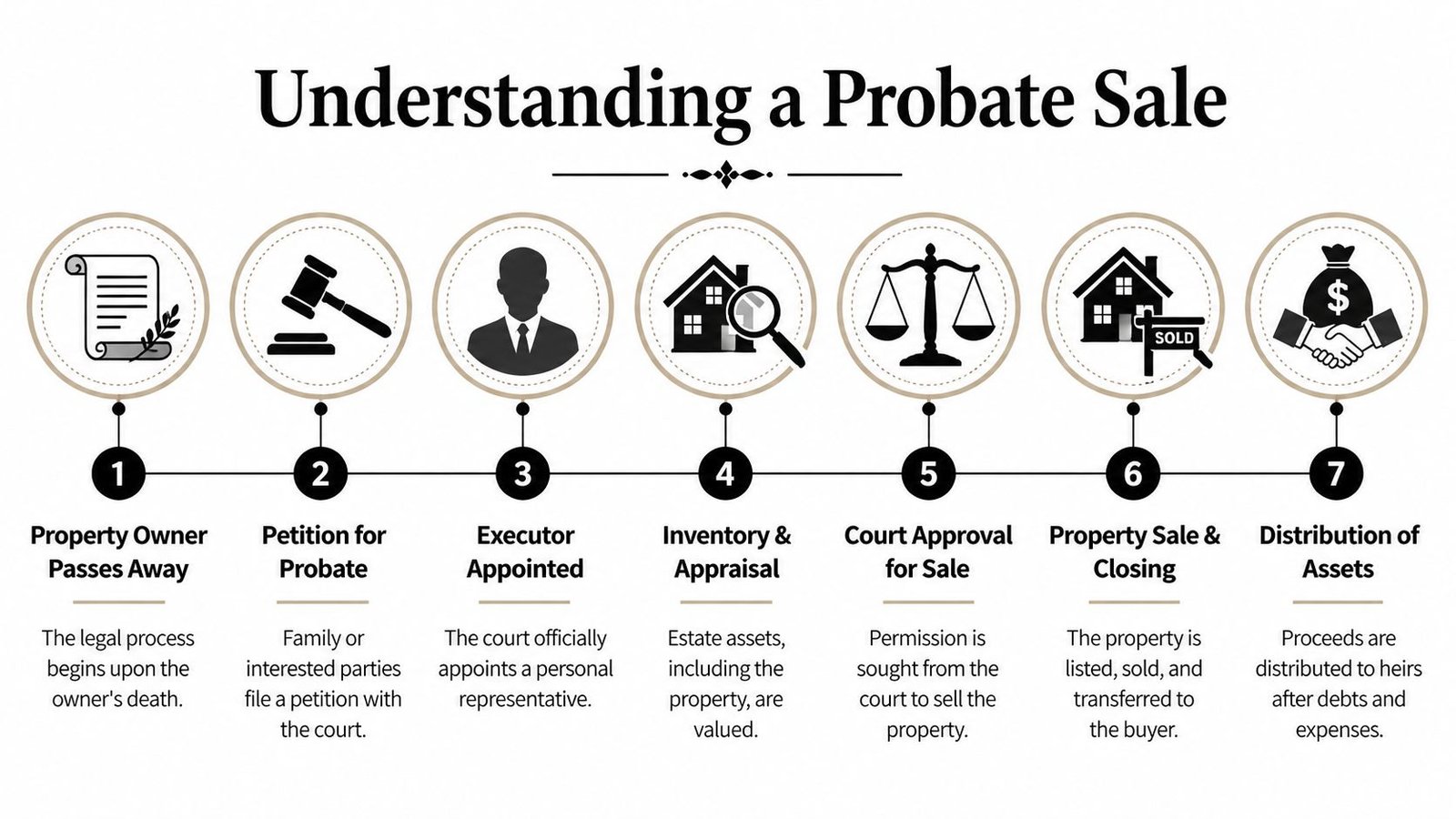
Probate is the court-supervised process for wrapping up a person’s legal and financial affairs after death. Think of it as the estate’s official financial checkout. The court helps make sure debts are addressed, assets are identified, and whatever remains goes to the right heirs.
When a house is part of that estate, the sale may become a probate sale. That means the property can’t always be sold with the speed and freedom of a standard transaction. The executor or administrator has duties to the estate, to the heirs, and sometimes to the court before the sale can close.
Who the main players are
Two roles confuse people most.
- Executor: Named in the will and later recognized by the court to manage the estate.
- Administrator: Appointed when there isn’t a will or when no executor is available to serve.
That person doesn’t get to act like a normal homeowner. They’re managing property on behalf of the estate. Their job is to preserve value, follow legal procedure, and avoid harming the heirs or creditors.
Why a probate sale feels different
A regular home sale usually starts with one owner deciding to move. A probate sale starts with legal authority. That’s the difference.
The house may still have personal property inside. The executor may not know the home’s condition well. There may be several beneficiaries. There may also be debts that need to be settled before sale proceeds are distributed.
Probate isn’t just about transferring a house. It’s about settling an estate correctly so the house can be transferred without creating new problems.
That’s also why buying homes in probate attracts a different kind of buyer. Some buyers walk away because the process is slower and more technical. Others look closely because probate properties can be priced below market when condition, delay, and complexity narrow the buyer pool.
Why the timeline surprises people
One of the biggest differences is time. The probate timeline averages 6 to 12 months from the date of death to the final sale closing, compared with a typical 30 to 45 day closing for a standard real estate transaction, because of required petitions, notices, and court scheduling, as explained in this overview of how to buy a house in probate.
That doesn’t mean every probate sale drags. Some move more smoothly than others. But it does mean families should expect legal steps before they expect speed.
Why the house may not sell like a polished retail listing
Many probate properties are older homes or houses that were lived in for years without major updates. The family may not want to repair them. The estate may not have cash to repair them. The executor may not even know all the defects.
That’s why people often hear the phrase as-is with probate property. It tells buyers that what they see is what they get.
If you’ve never dealt with any of this before, the process can sound intimidating. In practice, it becomes easier once you separate the legal job from the estate decision. First, the estate gets authority. Then the estate decides how to sell.
The North Carolina Probate Process Step-by-Step
In North Carolina, probate usually runs through the clerk’s office, and in Cumberland County that means dealing with the Clerk of Superior Court. Families often expect one big court hearing at the start. In reality, the work is more administrative. Forms get filed, authority gets issued, notices go out, and the estate is documented over time.
Step one: open the estate
The first real step is filing the estate with the court. If there’s a will, the person named in it asks to be recognized as executor. If there isn’t a will, someone eligible asks to be appointed as administrator.
Once the court approves that appointment, the estate has a legal representative. That’s the point where the process starts to move from family discussion to formal authority.
Step two: gather and protect the property
The executor or administrator has to identify what belongs to the estate and keep it from losing value. For a house, that often means practical work before any sale strategy is chosen.
Some examples include:
- Checking insurance coverage: A vacant inherited house may need special attention from the carrier.
- Managing utilities: Enough service should stay on to protect the property and allow inspections or cleanout.
- Preventing avoidable damage: A leaking pipe, overgrown yard, or unsecured window can create bigger problems later.
This part sounds simple, but it matters. A house that sits unattended during probate can become harder to sell.
Step three: inventory assets and debts
The estate representative has to identify what the estate owns and what it owes. That includes the home, bank accounts, vehicles, personal property, and known debts tied to the deceased.
For the house, paperwork becomes important. Gather mortgage statements, tax records, HOA notices if any apply, utility bills, and anything showing liens or unpaid balances. You can’t choose a sale strategy wisely if you don’t know what claims may need to be paid.
Step four: notify creditors and interested parties
This is one point where families often realize probate is a formal legal process, not just family paperwork. The estate must give notice so creditors and heirs have a chance to respond.
The probate process includes posting public notices in local newspapers to alert potential creditors and heirs, and in many cases the court appoints an appraiser who may undervalue the property by not fully accounting for needed repairs, which can affect the final sale price, as discussed in this article on probate real estate market trends and challenges.
If an appraisal comes in lower than the family expected, don’t assume the house is worthless. It may reflect condition, limited information, or a conservative court process.
Step five: determine whether and how the home should be sold
Sometimes heirs want to keep the property. Sometimes one heir wants to buy out the others. Often, though, the cleanest answer is to sell the home and distribute the remaining proceeds after valid estate expenses are paid.
At this point, the executor has to think in two directions at once:
- Legal direction: What authority is required for the sale?
- Practical direction: What type of sale makes sense for this house?
For some estates, that means preparing the home for a traditional market listing. For others, especially when the house needs work or the family lives out of town, a direct as-is sale may be simpler.
If you want a focused overview of that niche process, this page on probate property sales in North Carolina gives a practical summary.
Step six: review offers and satisfy sale requirements
Once the property is marketed or offered for sale, the executor reviews offers through the lens of the estate’s duty. Price matters, but so do terms. A higher offer with repair demands, financing delays, or uncertain closing terms may not be the easiest path for the estate.
Many families get frustrated at this stage. They think getting an offer means the hard part is over. In probate, accepted terms may still have to fit whatever authority and approval the estate is operating under.
Step seven: close and account for the proceeds
At closing, the house transfers to the buyer and the estate receives proceeds. Those funds don’t immediately become inheritance checks. The estate still has to account for debts, costs, and distributions.
That final administrative piece is easy to underestimate. The sale may feel emotionally final for the family, but the estate still has to be wrapped up correctly.
Two Paths for Selling Your Probate Home Traditional vs Cash Sale
When a Fayetteville family reaches the point of selling, the decision usually comes down to two paths. They can list the home on the open market with an agent, or they can sell directly to a cash buyer. Neither path is automatically right for everyone. The better choice depends on the home’s condition, the family’s timeline, and how much complexity they can realistically handle.
Path one: traditional listing
A traditional listing is a commonly understood route. The house goes on the market, buyers schedule showings, offers come in, negotiations happen, and the contract moves toward closing.
That path can work well if the home is clean, updated, easy to access, and the family has time. It may also fit better when the heirs want broad market exposure and are willing to manage cleanout, prep work, and buyer questions.
But probate adds friction. The executor may need to coordinate with multiple heirs. The house may be full of furniture and personal belongings. The property may need repairs that no one wants to fund. A financed buyer may also hesitate if the process feels uncertain.
Path two: direct cash sale
A direct cash sale is less public and usually simpler. Instead of preparing the home for the market, the estate asks a cash buyer to evaluate the property in its current condition and make an offer.
This option often appeals to:
- Out-of-state heirs: They don’t want repeated trips back to Cumberland County.
- Military families under PCS pressure: They need a clean solution that fits a move.
- Executors handling rough-condition homes: The house may have deferred maintenance, old contents, or code concerns.
- Families who want certainty: They’d rather avoid a long cycle of showings, repair requests, and financing delays.
The pricing reality in probate
One truth families need to hear early is that probate homes don’t always command polished retail prices. Probate homes often sell for 10% to 40% below market value because of their as-is condition and the complexity of the process, according to this guide on what buyers should know about probate sales.
That number isn’t a guarantee for any one house. It’s a reminder that condition, delay, and uncertainty affect value. If the property needs work and the estate wants convenience, a lower but cleaner offer may be more realistic than aiming for a top-dollar scenario that requires months of prep and risk.
Comparing the two side by side
| Factor | Traditional Real Estate Listing | Direct Cash Sale (DIL Group Buyers) |
|---|---|---|
| Property condition | Usually easier when the home is cleaned out and presentable | Often works well even if the home needs repairs or still has contents |
| Showings | Multiple showings and buyer walkthroughs are common | Usually limited property access and a simpler review process |
| Repairs and prep | Families often feel pressure to clean, stage, or fix issues | Home is typically sold as-is |
| Buyer financing risk | Financed deals can stall over appraisal or loan approval | Cash avoids lender-driven contingencies |
| Timeline pressure | Can feel longer because marketing and contract uncertainty come first | Often better for estates that want a straightforward closing path |
| Best fit | Heirs seeking broad exposure and willing to manage the process | Heirs prioritizing speed, convenience, and less hands-on work |
For readers wondering whether probate sales always involve cash, this explanation of whether probate sales are cash only clears up a common misconception.
How to decide without overcomplicating it
Ask three practical questions.
What shape is the house in?
If the answer is “dated, full of belongings, or in rough repair,” a direct as-is sale becomes more attractive.How available is the family?
If no one is local, the labor of managing a listing becomes much harder.What matters more right now, top possible price or least friction?
That question helps most families faster than any spreadsheet.
Local reality: In Cumberland County, convenience often matters more than theory. A family living in another state may prefer a simpler sale even if they could possibly chase a higher number with more work.
Traditional listing is not wrong. It’s just not automatically practical for every probate home. A vacant inherited house with deferred maintenance creates a very different decision than a move-in ready home with one local heir.
Common Pitfalls in Probate Sales and How to Avoid Them
Most probate sales don’t fall apart because families don’t care. They fall apart because something hidden shows up late. The title search finds a lien. One heir disagrees with the plan. The buyer discovers damage after going under contract. Or the house is so full of belongings that no one can even assess it clearly.

Pitfall one: underestimating as-is condition
Probate property is commonly sold as-is, which sounds simple until a buyer starts looking closely. The executor usually isn’t required to repair the property, but buyers know that uncertainty carries risk.
Because probate properties are sold as-is, buyers must budget an added 3% to 8% of the purchase price for post-closing costs when inspections uncover issues like structural damage or outdated systems the executor may not have known about, according to this breakdown of buying a house in probate.
That affects sellers even though the buyer pays those costs later. Why? Because buyers lower their offers to account for what they think they’ll have to fix.
How to avoid it:
Get clear about visible issues early. Roof stains, soft floors, old HVAC systems, moisture smells, and foundation cracks change how buyers price risk. You don’t need to renovate everything, but you do need realistic expectations.
Pitfall two: hidden liens and estate debts
A house can look free and clear from the driveway while still carrying legal baggage. Mortgage balances, unpaid taxes, judgment liens, and other claims may need to be resolved before or during closing.
Many out-of-state heirs get blindsided. They assume selling the home solves everything, but the sale proceeds may need to satisfy debts before heirs receive distributions.
A few ways to reduce surprises:
- Order title work early: Don’t wait for a late-stage buyer to discover a problem.
- Collect mail and old statements: They often reveal debts the family didn’t know about.
- Ask direct questions: If the deceased had financial trouble, assume the property paperwork deserves extra review.
Pitfall three: family disagreement
A probate home can be legally sellable and emotionally unsellable at the same time. One sibling wants to keep it. Another wants cash now. A third lives out of state and wants the issue finished quickly.
Disagreement slows everything down because every practical decision starts requiring negotiation. Even small choices become loaded. Should the family clean the house out? Spend money on repairs? Accept an offer below what everyone hoped for?
Best move: Put the decision criteria in writing. Agree on what matters most before you start evaluating offers.
That doesn’t remove emotion, but it gives the executor something solid to work from.
Pitfall four: contents inside the home
Inherited homes often come with more than walls and a roof. They come with furniture, paperwork, tools, clothes, keepsakes, and sometimes entire rooms no one has touched in years.
That creates two problems. First, the family has to decide what matters emotionally. Second, the contents make the property harder to show, inspect, clean, or price.
This short video gives a useful visual reminder that probate sales are often delayed by real-world logistics, not just legal theory.
Pitfall five: absentee ownership in the Fayetteville area
This is especially common around Fort Bragg and the broader Cumberland County market. The heir may live in another city or another state. They can’t easily coordinate yard work, meet contractors, monitor the property, or sort through personal items room by room.
That distance tends to magnify every problem. A small leak becomes major damage. A simple paperwork request becomes a week of mailing and scanning. A buyer who wants repeated access becomes a scheduling headache.
How to avoid it:
Choose a sale path that matches your availability, not the idealized version of what a sale could be. If no one can manage the home actively, a simpler as-is transaction often reduces risk.
Your Actionable Probate Home Sale Checklist
When families are under stress, they don’t need more theory. They need a list they can follow. Use this as a practical working checklist for an inherited house in Fayetteville or anywhere in Cumberland County.
Start with control
- Secure the house
- Locate the will and death certificate
- Identify the person who will act for the estate
- Gather mortgage, tax, insurance, and utility records
Protect the estate
- Confirm insurance status on a vacant property
- Keep basic utilities on if needed for access and preservation
- Prevent obvious damage such as leaks, lawn neglect, or unsecured entry points
- Set aside personal items and documents before any cleanout begins
Open the legal process
- File the estate with the appropriate court
- Obtain the authority needed for the executor or administrator to act
- Track notices, deadlines, and creditor communication carefully
- Document the home’s condition with photos and written notes
Understand the property before choosing a sale route
- Accurately estimate the condition
- Check for liens, debts, or title issues
- Decide whether the family has the time and energy for a traditional listing
- Compare that option against an as-is cash sale
Make the sale decision based on reality
Use this quick lens:
- Choose a listing approach if the property is in decent shape, the family can manage showings, and no one minds a longer process.
- Choose a direct cash route if the house needs work, the family is remote, the property still has contents, or speed and simplicity matter more than maximizing exposure.
A no-obligation cash offer can be useful even if you haven’t decided how to sell. It gives the estate a baseline option.
Finish cleanly
- Review offers based on terms as well as price
- Coordinate closing documents carefully
- Make sure sale proceeds are handled through the estate properly
- Keep records for beneficiaries and final accounting
If you want the least hands-on option, getting a direct local cash offer can be a practical final step. It doesn’t commit you to a sale. It gives you one clear path forward.
Frequently Asked Questions About Selling a Probate Home
Can I sell a probate house if I live out of state?
Yes, but distance changes the difficulty level. The biggest challenges are usually access, contents inside the house, paperwork, and keeping up with any hidden debts or title issues. For absentee owners, an as-is sale is often easier because it reduces the need for repeated trips, prep work, and buyer coordination.
A source discussing probate challenges for absentee owners notes that handling property contents, hidden liens, and debts is a major issue, and that cash buyers can simplify the process by purchasing the home fully furnished or as-is. It also states that heir disputes complicate over 70% of traditional probate sales, based on the material in this probate discussion video.
What happens if the house still has a mortgage or lien?
The house can often still be sold, but those obligations usually have to be addressed through the estate and closing process. The presence of debt doesn’t automatically stop a sale. It does mean the executor should understand the payoff amounts and title status before choosing a buyer or accepting terms.
This is why early title review matters. Families make better decisions when they know what the property must clear before proceeds can go to heirs.
Do I need to fix the house before selling it?
Not necessarily. Many probate homes are sold as-is. That can be a relief when the property is dated, damaged, or full of belongings. The tradeoff is that buyers will factor condition into their offers.
If the home needs substantial work and no heir wants to manage contractors, repairs may create more stress than value. In those cases, a direct as-is sale can be the cleaner option.
Is a real estate agent better than a cash buyer for probate property?
They solve different problems. A real estate agent helps market the property to a broad set of buyers. A cash buyer usually helps reduce friction by accepting the home in its current condition and simplifying the transaction.
If the house is in strong condition and the family is patient, listing may fit. If the home needs work, has contents, or the executor wants less uncertainty, a cash sale may fit better.
Can multiple heirs sell a probate house without conflict?
They can, but clear communication matters. The executor needs authority, and the family needs a practical agreement on what they want from the sale. Most disputes don’t start with legal theory. They start with different expectations about timing, price, and effort.
A short written agreement about goals can prevent a lot of friction later.
If you’ve inherited a house in Fayetteville, Hope Mills, Spring Lake, or anywhere in Cumberland County and want the simplest next step, DIL Group Buyers can give you a direct cash offer for the property as-is. That means no showings, no repairs, no commissions, and no guessing about whether the house is “market ready.” For many families, especially out-of-state heirs and military owners dealing with a PCS, that kind of straightforward option makes probate feel manageable again.