
You’re probably here because this isn’t a casual move.
Maybe you just got PCS orders and need to sell before you report. Maybe you inherited a house in Fayetteville and don’t live anywhere near it. Maybe the mortgage is behind, the repairs have piled up, or you’re tired of dealing with a tenant who’s wrecking the place and dodging your calls. When people ask how do i sell my house, what they usually mean is something more urgent: How do I get out of this situation without losing more time, money, or sleep?
That’s the right question.
Most real estate advice is written for clean, updated homes owned by people with flexible timelines. That’s not real life for a lot of homeowners in Cumberland County. Real life is messy. Roof leaks happen. Families split up. Job transfers come fast. Probate drags on. Houses sit vacant. And once you need certainty, generic advice stops being useful.
Navigating the Fayetteville Market When You Need to Sell Now
A Fayetteville homeowner gets orders to move. Another owner in Hope Mills is dealing with a property left behind after a family death. A landlord in Spring Lake has had enough of late rent, damage, and excuses. Different stories, same pressure. They need the house sold, and they need a path that works in the actual world, not just on a real estate blog.

Here’s the market reality that matters most. In late 2025, the U.S. housing market had 37.2% more home sellers than buyers, creating a surplus of over half a million listings, according to Redfin’s November 2025 market report. For sellers in places like Cumberland County, that means more competition, longer time on market, and more pressure to cut the price.
That matters if your house is average. It matters even more if your house needs work.
What that means for a Fayetteville seller
In a softer market, buyers get pickier. They don’t want mystery repairs. They don’t want foundation concerns, old HVAC systems, inherited clutter, tenant damage, or code issues unless the price is low enough to absorb the hassle. If your property isn’t turnkey, the open market becomes less forgiving.
That doesn’t mean you’re stuck. It means you need to choose the right selling method for your situation.
Practical rule: If your timeline is tight, your property needs work, or your life is already chaotic, don’t pick your selling method based on tradition. Pick it based on certainty.
The first decision you actually need to make
Most sellers think the first step is cleaning, repairing, or calling an agent. It isn’t. The first step is deciding what matters most to you:
- Top dollar potential: You may lean toward a traditional listing.
- Fast exit: You may need a direct buyer.
- Minimal effort: You probably don’t want showings, repairs, and back-and-forth negotiations.
- Guaranteed timeline: You need a buyer who can close when you need to move.
If you need speed in Cumberland County, start by looking at your fastest route, not your most familiar one. A direct sell my house fast option in Fayetteville can make more sense than forcing a distressed property into a retail sale.
Comparing Your Top 4 House Selling Options in North Carolina
You’ve got four main ways to sell a house in North Carolina. They are not equal. They differ on speed, workload, certainty, and how much risk stays on your shoulders after the sign goes in the yard.
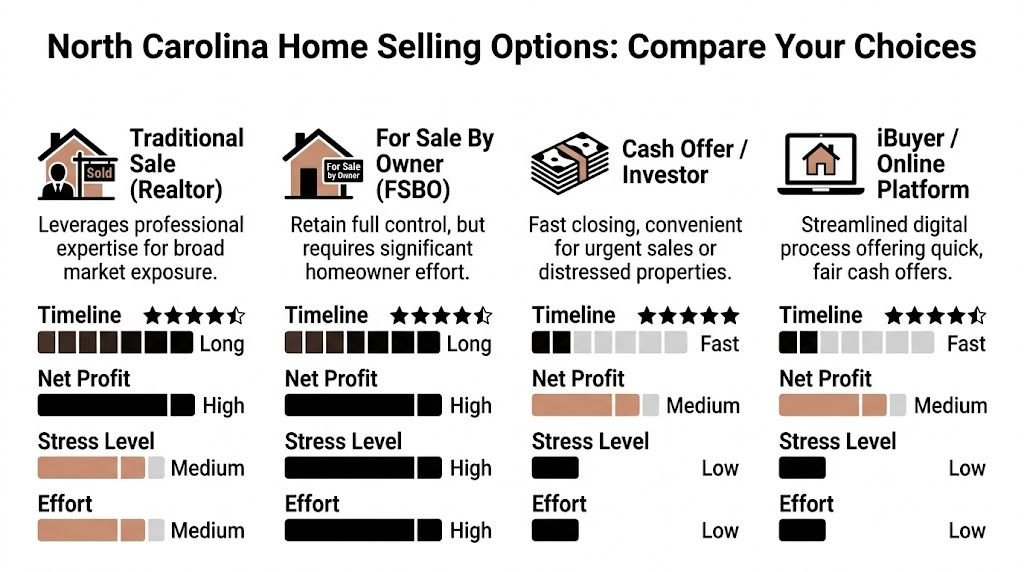
Home Selling Options in NC At a Glance
| Selling Method | Typical Timeline | Average Cost to Seller | Certainty of Sale | Best For |
|---|---|---|---|---|
| Traditional Sale with Realtor | Often longer because prep, showings, inspections, and financing all have to line up | Usually higher because of commissions, repairs, cleaning, staging, and closing costs | Moderate | Updated homes and sellers who can wait |
| For Sale By Owner | Unpredictable | Lower direct commission cost, but owner handles marketing, pricing, and negotiation mistakes | Low to moderate | Experienced sellers with time and confidence |
| Distressed Sale or Short Sale | Often slow because lender approval can control the process | Varies, and the process can be complicated | Low | Owners with serious debt issues and limited alternatives |
| Direct Cash Buyer | Fastest and most predictable in many distressed situations | Usually fewer out-of-pocket selling expenses because houses sell as-is | High | Foreclosure, inheritance, repairs, bad tenants, PCS, divorce |
Traditional sale with an agent
This is still the best fit for a clean, market-ready house when the seller has time. You get MLS exposure, professional marketing, and an agent who handles buyer communication. For some people, that’s the right move.
But this route works best when the home shows well and the seller can tolerate uncertainty. If the house needs work, if you’re behind on payments, or if you can’t keep the place spotless for repeated showings, the process gets rough quickly.
For Sale By Owner
FSBO sounds appealing because it looks cheaper on paper. You avoid hiring a listing agent, keep more control, and decide how to market the house.
In practice, most owners underestimate the work. You have to price it, photograph it, field calls, coordinate showings, screen buyers, review contracts, and manage the deal through inspection and closing. If you already feel overwhelmed, FSBO usually adds stress, not savings.
Selling your own house only makes sense if you have time, patience, and enough market knowledge to avoid expensive mistakes.
Distressed sale or short sale
This option usually shows up when the debt situation is bigger than the property itself. If the mortgage balance, arrears, liens, or other obligations make a normal sale difficult, a distressed sale may be necessary.
The problem is control. Once lenders, servicers, or multiple claimants are involved, your timeline may no longer be your timeline. That’s a dangerous position if foreclosure pressure is already building or you need to relocate fast.
Direct cash buyer
This path is the least glamorous and often the most practical. No staging. No open houses. No waiting on a buyer’s mortgage approval. No pretending your problem property is a lifestyle listing.
It’s built for situations like these:
- Urgent move: PCS, job relocation, divorce, or family emergency.
- Property distress: Fire damage, old systems, structural concerns, or heavy deferred maintenance.
- Ownership complications: Inheritance, absentee ownership, title issues, or problem tenants.
- Financial stress: Late payments, foreclosure pressure, or a house you can’t afford to carry.
My blunt advice on choosing the right option
Ask one question first: Do I need the highest possible upside, or do I need the cleanest exit?
If your house is in strong condition and your life is stable, listing makes sense.
If your house needs work and your timeline matters, convenience and certainty usually beat chasing a theoretical top price.
If you’re in serious distress, stop thinking like a retail seller. Start thinking like someone solving a deadline-driven problem.
That mindset saves people a lot of grief.
What a Traditional Home Sale Really Costs in Time and Money
A Fayetteville homeowner lists on Friday, spends the weekend scrubbing baseboards, leaves for three showings during the week, gets an offer, then loses the buyer after inspection. Two more mortgage payments go out while the house sits. That story is common in Cumberland County, and it is why “listing for top dollar” is not always the cheapest option.

A traditional sale can work. It can also drain time, cash, and patience fast. Sellers usually focus on commission because it is easy to see. The bigger problem is everything around it: prep work, inspection fallout, holding costs, and a significant chance that your first contract never closes.
The visible costs
The normal listing process is simple on paper. Hire an agent. Price the house. Prepare it. Put it on the MLS. Show it. Negotiate. Make it through inspection and financing. Get to closing.
As summarized in HAR’s guide to the home-selling process, sellers often spend about 6% to 10% once agent fees, repairs, and staging are counted together, and agent compensation alone is commonly around 6%. For a homeowner under pressure, that is only the starting line.
Pricing mistakes get expensive fast
Overpricing is one of the most expensive mistakes I see.
HAR’s summary cites NAR data showing that overpricing can lead to 50% longer days on market and 6% lower sale prices. It also notes that pricing a home 10% or more above a comparative market analysis can add 20 to 30 days and lead to later 5% to 10% price cuts. That pattern shows up all over Fayetteville. A stale listing attracts bargain hunters, not strong buyers.
An overpriced house does not look premium. It looks like trouble.
Prep work costs money, and skipping it costs leverage
If you list, the house has to compete with every clean, updated, move-in ready property around it. Buyers compare your home to the best option in the price range, not to your stress level.
HAR’s guide also notes that staging can lead to 1% to 5% higher sale prices and 73% faster sales, and that professional photos can help homes sell 32% faster. That is why serious listing prep usually includes work like this:
- Remove clutter and excess furniture
- Fix visible defects
- Touch up paint and flooring issues
- Clean hard enough that the house feels cared for
- Use professional photos, not phone pictures
That prep is manageable for some sellers. It is a bad fit for others, especially if the property has inherited contents, deferred maintenance, or title complications tied to an estate. If that is your situation, this guide on selling a probate house in North Carolina will save you time.
Inspections are where deals start to unravel
The first accepted offer is not the finish line. It is the start of due diligence.
Once the inspection report lands, buyers push for repairs, credits, or a lower price. Some use the report to renegotiate. Some use it as an exit ramp. HAR’s summary says skipped repairs cause 73% of deals to fail inspections in the industry stats it references. Whether your house needs minor updates or major work, condition affects your bargaining power.
This is the part traditional real estate advice glosses over. A seller in a tough spot does not need a prettier spreadsheet. A seller in a tough spot needs certainty.
The hidden monthly costs add up quietly
While the house is listed, life keeps billing you.
You may still be paying for:
- Mortgage payments
- Utilities
- Property taxes
- Insurance
- Lawn care
- Trash service
- Vacancy checks
- Travel costs if you live out of town
Those carrying costs matter in Cumberland County because time matters. If you are relocating from Fort Liberty, dealing with an inherited property, or trying to avoid foreclosure, an extra month on market is not a small inconvenience. It is more money out of pocket and more uncertainty hanging over you.
A quick explainer helps if you’re weighing that route:
When a traditional sale still makes sense
Choose the listing route if your house shows well, you have time, and you can absorb the prep and carrying costs without stress.
A traditional sale is usually a good fit if:
- Your home is in solid condition
- You can wait for the right retail buyer
- You have cash for cleanup, repairs, and presentation
- You can keep the property show-ready
- You are not facing a hard deadline
If those conditions are not true, forcing a retail sale usually backfires. For many Fayetteville and Cumberland County homeowners in difficult situations, the fastest and most certain path is the one with fewer moving parts, fewer surprises, and a closing date you can count on.
Selling Solutions for Unique Homeowner Situations
Most sellers in tough spots don’t need theory. They need a plan that fits the mess they’re in right now.

The standard advice to deep clean, stage, repaint, host open houses, and wait for offers assumes you live nearby and have the time and energy to manage all of it. That breaks down fast in the situations below.
If you live out of state
This is one of the most overlooked seller problems in real estate. Mainstream guidance largely ignores absentee owners even though they account for an estimated 5% to 6% of U.S. home sales, and the usual in-person tasks create major friction, according to HomeLight’s discussion of location-related selling problems.
If you’re in another city or another state, every simple task becomes annoying. Every serious problem becomes expensive.
Your checklist if you’re an absentee owner
- Confirm access: Make sure someone can legally enter the property for photos, walkthroughs, or inspections.
- Secure documents: Pull tax records, mortgage details, insurance information, and any repair invoices you still have.
- Stop guessing about condition: If the house has been vacant or tenant-occupied, get clear eyes on what’s there.
- Avoid a showing-heavy process if travel is difficult: Remote sellers usually suffer most from repeated scheduling demands.
- Choose certainty over activity: More buyer traffic doesn’t help if you can’t manage the process from afar.
For probate-related remote sales, getting the paperwork and authority lined up matters early. If that’s your situation, learn more about probate property sales in North Carolina.
Remote ownership turns ordinary listing tasks into project management. If you don’t want a second job, don’t choose a selling method that creates one.
If you inherited a house
Inherited properties come with emotional weight and practical headaches. The house may still be full of furniture, family papers, old tools, or decades of deferred maintenance. Siblings may not agree. The title may still need attention. Meanwhile, the property keeps generating bills.
Start with these decisions
Figure out authority to sell
Make sure the estate, probate, or ownership transfer issues are clear before you commit to a sale path.Decide whether clearing the house is worth it
Don’t spend weeks sorting low-value belongings if your main goal is to settle the property and move on.Be honest about condition
Older inherited homes often need more than cosmetic work. Roof, plumbing, electrical, HVAC, and moisture issues add up fast.Choose based on family tolerance for delay
If heirs want closure, a long listing process can create more conflict, not less.
If you’re facing a military PCS
Fayetteville sees this all the time. Orders don’t care whether your house is ready for the MLS. They don’t care whether a buyer’s lender drags its feet. And they definitely don’t care if your closing gets bumped because of an inspection issue.
A practical PCS sale plan
- Set your move date first: Your housing plan at the next duty station matters more than maximizing listing drama here.
- Calculate overlap risk: Two housing payments can get ugly fast.
- Don’t over-improve for a move you can’t delay: Convenience often beats squeezing every dollar from a rushed listing.
- Protect your timeline: If certainty matters, avoid methods that rely on multiple outside approvals.
If you have bad tenants or a rental headache
Landlords usually wait too long. They hope the tenant improves, the repairs stay manageable, or the next lease cycle solves everything. It rarely gets better on its own.
Ask yourself these questions
| Question | Why it matters |
|---|---|
| Is the tenant cooperative? | Showings and inspections become much harder if the occupant resists |
| Is the house damaged? | Retail buyers often get spooked by visible neglect |
| Are code issues involved? | Traditional buyers and lenders don’t like unresolved property problems |
| Are you done being a landlord? | If the answer is yes, optimize for exit, not future upside |
If foreclosure pressure is building
You do not need more denial. You need speed and clean information.
Call your lender. Open every notice. Know the reinstatement amount if one is available. Know whether there are junior liens or other claims. Then choose a selling path that matches the deadline in front of you.
The worst foreclosure strategy is waiting for clarity while the clock keeps moving.
If you’re behind, a slow listing can become a trap. You may spend money prepping a house you no longer have time to market properly. In that situation, a direct sale often works because it strips out the repairs, buyer financing, and repeated delays that kill deals.
Your Simple Path to a Guaranteed All-Cash Offer
If your priority is speed, simplicity, and knowing the deal will close, the direct cash route is the cleanest option.
Here’s how it works in plain English. You reach out. The property gets reviewed. You receive an offer. If you want to move forward, you pick a closing date that fits your life. That’s the appeal. No drawn-out listing cycle. No parade of strangers walking through your house. No repair checklist hanging over your head.
Step one: make contact
You call, text, or submit a form with the property details. At this stage, the key is honesty. Tell them if the house has damage, liens, tenant issues, title complications, or missed mortgage payments. Hiding problems doesn’t help. A serious buyer needs the full picture to make a real offer.
Step two: get the property evaluated
A real cash buyer doesn’t need polished finishes and fresh staging. They need to understand location, layout, condition, and the scope of work. That’s why this route is so useful for inherited homes, deferred maintenance, fire damage, outdated interiors, and landlord situations.
The offer should be straightforward. No obligation. No pressure to clean first. No expectation that you spend money before the sale.
Step three: choose your closing date
This is the part stressed-out sellers usually care about most. Flexibility.
If you need to move quickly, a direct buyer can often close fast. If you need a little time to relocate, sort belongings, or coordinate family matters, the closing can often be scheduled around that. That control matters when life is already crowded with other problems.
What you avoid with a direct sale
A direct all-cash sale isn’t just about speed. It’s about removing the parts of the process that usually create failure points.
- No repairs: You sell the property in its current condition.
- No cleaning marathons: You don’t have to prepare it like a retail listing.
- No showings: No repeated interruptions.
- No agent commissions: That removes a major traditional selling cost.
- No attorney fees from the buyer model described by the publisher: The process is built to reduce surprise charges.
- No lender delays: Cash removes the mortgage approval hurdle that often derails retail deals.
Who this path fits best
This route is usually strongest for sellers dealing with a deadline or a difficult property. That includes foreclosure pressure, probate, divorce, military relocation, inherited homes, code issues, vacant properties, and out-of-state ownership.
If that sounds like you, your next move should be simple. Request a cash offer for your home in Fayetteville and nearby areas, compare it against your other options, and decide based on what leaves you in the strongest position.
Take Control of Your Home Sale Today
If you’ve been asking how do i sell my house, the answer depends on what you can afford to risk.
If you have time, money for prep, and a house in good condition, the traditional market may work. If you don’t, then chasing the “perfect” sale can create bigger problems than it solves. Sellers in Cumberland County get in trouble when they confuse the familiar route with the right route.
The core choice is simple. You can accept uncertainty and hope the market, the buyer, the inspection, and the financing all cooperate. Or you can choose a path built around speed and certainty.
That’s why distressed sellers, absentee owners, military families, and landlords in Fayetteville often do best when they stop trying to force a retail outcome onto a non-retail situation. The fastest path isn’t always the one with the biggest promise. It’s the one that gets you to closing so you can move on.
Common Questions About Selling Your House As-Is in NC
What does selling a house as-is actually mean
It means you’re selling the property in its current condition. You’re not agreeing to make repairs, upgrade finishes, or spend weeks getting it market-ready first. Buyers still evaluate the house, but the point is that you’re not taking on the rehab burden before the sale.
Can I sell if the house needs major repairs
Yes. Houses with roof issues, water damage, old systems, structural wear, or heavy cosmetic problems still sell. The bigger question is which type of buyer makes sense. Retail buyers usually want financeable, move-in-ready homes. Distressed houses often fit better with direct buyers who purchase based on current condition.
Can I sell with liens or title problems
Often, yes. But you need clarity before closing. Liens, unpaid taxes, probate complications, or ownership disputes can usually be identified and addressed during the transaction process. Don’t assume the problem makes the property unsellable. It just means the buyer and closing team need to know what they’re dealing with.
What if I’m behind on mortgage payments
You still may have options, but delay makes everything harder. Open your mail, know your loan status, and act early. If foreclosure pressure is building, speed matters more than presentation. A fast sale can sometimes protect your credit better than waiting and hoping the situation somehow improves.
How is a fair cash offer determined
A serious buyer usually looks at the property’s location, condition, needed repairs, resale potential, and the risk involved in taking it on. A fair offer is one that reflects the house as it sits today, not a fantasy version after cleanup and renovation. It should also be transparent enough that you understand why the number is what it is.
Do I need to clean out the house first
Not always. Many as-is buyers will work with properties that still have unwanted furniture, boxes, debris, or leftover personal property. Ask that question early so expectations are clear.
Is as-is selling only for distressed homes
No. It’s also useful for sellers who value convenience more than squeezing every possible dollar from the transaction. That includes busy owners, remote owners, families settling estates, and people who want a clean exit without a long sales cycle.
If you need a fast, straightforward way out, DIL Group Buyers offers Cumberland County homeowners a simple option: sell your house as-is, skip the repairs and showings, get a guaranteed all-cash offer, and choose a closing date that works for you. If your situation is stressful, complicated, or time-sensitive, that kind of certainty is worth looking at.