
If you're reading this from another state, or from base housing while orders are already in motion, the problem usually hits all at once. You get photos from a neighbor, a call from the city, or keys to an inherited house in Fayetteville, Hope Mills, or Spring Lake, and the place is far worse than anyone admitted. Rooms are packed. The smell is obvious before the front door fully opens. You can't picture listing it, and you definitely can't picture cleaning it yourself from hundreds of miles away.
That feeling is normal. A hoarder property doesn't create one problem. It creates a stack of them at the same time. Safety concerns, cleanup decisions, family conflict, possible code issues, holding costs, and the pressure to make the right call before the house gets even more expensive to keep.
There are usually two paths. One is the long route: sort, clear, clean, repair, disclose, list, show, and hope a buyer sticks. The other is the direct route: sell the house as-is to a cash buyer who knows how to underwrite a distressed property without asking you to empty it first. For many absentee owners and military families in Cumberland County, the second option is the one that fits real life.
Navigating the Challenge of a Hoarder House
A hoarder house can make even an experienced owner freeze up. The clutter is the first thing people see, but it isn't the only issue. Hidden leaks, rotted flooring, pests, blocked exits, dead appliances, damaged drywall, and city complaints often sit underneath what looks like "just a lot of stuff."

For out-of-state owners, the hardest part is distance. You can't easily meet cleaners, contractors, agents, or inspectors. Military families have a similar problem. If PCS orders are active, the house becomes one more urgent file to manage while the rest of life is already in motion.
Why this problem shows up more often than people think
The broader housing picture matters here. The market for these properties overlaps with a larger supply squeeze. Baby Boomers are estimated to hold about 32 million homes and sit on over $17 trillion in equity, contributing to a 60% decline in single-family inventory compared to 2019 levels across major U.S. regions, according to this housing market discussion on YouTube. That doesn't mean every older owner is hoarding. It does mean aging-in-place, delayed moves, and deferred cleanup are affecting the supply of homes that eventually come to market.
That matters in Cumberland County because low usable inventory doesn't magically make a severely cluttered house easy to sell. It just means distressed properties attract a very different kind of buyer than clean retail listings.
The first decision is simpler than it feels
Start by asking one question. Are you trying to maximize a theoretical top price, or are you trying to solve a real problem with the least risk?
If the house already has deferred maintenance, blocked access, or possible municipal issues, waiting usually doesn't improve the situation. If you're worried the property may already be on the city's radar, learn how owners deal with selling a house with code violations.
Practical rule: A hoarder house isn't judged by what it could look like cleaned out. It's judged by what it costs, risks, and takes to get there.
Your First Assessment Beyond the Clutter
Don't start by deciding whether to keep or throw away anything. Start by assessing risk. Your first visit should work like triage, not a cleanup day.

What to check first
Walk the exterior before you step inside. Look at roof lines, gutters, siding, foundation exposure, crawlspace vents, broken windows, porch settling, and signs that animals have been getting in.
Inside, focus on what could hurt someone or destroy value fast:
- Blocked exits: Front door, back door, bedroom windows, and hallway access matter more than anything cosmetic.
- Fire hazards: Extension cords buried in piles, overloaded outlets, space heaters, and items stacked near the stove.
- Water signs: Ceiling stains, soft spots under sinks, buckled floors, and peeling paint.
- Air quality clues: Heavy odor, visible mold, ammonia smell, and stale air that suggests long-term moisture.
- Pest evidence: Droppings, nesting, insect wings, chewed wiring, and dead bugs around sills.
If you see ceiling staining or unusual wall damage, it also helps to understand how hidden infestation can spread. This page on termite tubes in ceiling is worth reviewing before you assume the issue is minor.
Document like an investor, not a family member
When owners are emotionally tied to the property, they tend to photograph sentimental details and miss the expensive ones. Take wide shots first, then close-ups of mechanical and structural concerns.
Make a folder with:
- Photos of every room from the doorway.
- Photos of the HVAC unit, water heater, electrical panel, and visible plumbing.
- Photos of stains, sagging areas, damaged flooring, and broken fixtures.
- Exterior photos from all four sides.
- Any mail, notices, tags, or warnings posted on the property.
That file helps with valuation. It also helps if multiple heirs, siblings, or co-owners are involved and not everyone agrees on condition.
Separate clutter from damage
This distinction matters. Some houses are packed but structurally decent. Others have clutter hiding major failure.
A quick field guide:
| Condition | Usually manageable | Usually expensive |
|---|---|---|
| Contents | Boxes, furniture, general accumulation | Biohazard debris, animal waste, soaked materials |
| Floors | Dirty but level | Soft, sagging, stained, or unstable |
| Walls | Surface marks | Moisture damage, bulging, mold, missing sections |
| Systems | Old but running | Shut off, leaking, unsafe, or nonfunctional |
If you can't safely reach a room, don't guess what's inside. Price uncertainty as a risk, because buyers will.
The Hidden Risks Legal and Financial Drains
The biggest mistakes with hoarder houses for sale usually happen before the property is ever marketed. Owners wait. They assume they'll "deal with it next month." Meanwhile the house keeps costing money, and the legal exposure gets worse.
Out-of-state ownership makes that worse. One underserved angle in this topic is the legal and financial risk carried by absentee owners, especially inherited-property owners and military families near Fayetteville and Fort Bragg, including code violations and even court-ordered sale pressure, as noted in this YouTube discussion of absentee-owner hoarder property issues.
What absentee owners often miss
A distant owner usually sees the property as inactive. The city doesn't. Neighbors don't. Insurance carriers don't.
Problems that become expensive fast include:
- Code notices: Overgrowth, unsafe access, trash accumulation, and exterior deterioration can trigger enforcement.
- Lien exposure: If local authorities step in for cleanup or abatement, that cost may attach to the property.
- Insurance trouble: A policy written for a normal occupied home may not fit a neglected or vacant one.
- Utility waste: Even minimal service bills add up while the house sits untouched.
- Tax pressure: County taxes don't pause because the house is hard to sell.
If a lien is already on title, the sale isn't automatically dead. Owners regularly ask whether they can close with title problems, and this guide on selling a house with a lien on it covers the issue directly.
Family conflict makes the holding period worse
Inherited hoarder houses create a second layer of drag. One heir wants top dollar. Another wants to donate contents. A third lives out of state and can't help in person. Nothing moves, and the property keeps sitting.
That delay has a real cost even when nobody sends an invoice labeled "delay." The house deteriorates. The city may escalate. Local complaints become more likely. Buyers who would have accepted the condition early may walk later if the property gets worse.
Inaction is usually the expensive option
Owners often focus on sale price and ignore carry cost. That's backwards with a distressed property.
A hoarder house can lose practical saleability faster than it loses theoretical value.
The longer the house sits, the more likely you are to face one of these outcomes:
- a compliance issue that must be cured before closing
- a title complication tied to unpaid charges
- a buyer pool that shrinks because condition worsens
- an insurer or lender asking questions you don't want to answer late in the process
For an absentee owner in Cumberland County, the cleanest solution is often the one that stops the legal and financial bleed first.
How to Value a Hoarder House for Sale
Valuing a hoarder house starts with one hard truth. The price is based on what a buyer can take on, not what the property might have sold for if it were empty, repaired, and easy to finance.
That mistake shows up all the time with absentee owners and military families around Cumberland County. Someone compares the house to a clean sale in Haymount, Jack Britt, or Hope Mills, then assumes the gap is just a little cleanup. It usually is not. If the house has blocked access, damaged subfloors, active pests, or rooms nobody can fully inspect, the value drops fast because the buyer is pricing uncertainty, time, and cash out of pocket.
Start with ARV, not emotion
ARV means the likely resale value after the property is fully cleaned out, repaired, and ready for the open market. That is the benchmark serious buyers use. It gives you a starting point, then further deductions begin.
According to this hoarder-house valuation overview, hoarder houses for sale often move at steep discounts from ARV because of cleanup costs, hidden damage, pest issues, and appraisal problems. That same source notes that severe cleanouts alone can run into the $10,000 to $20,000 range.
In Cumberland County, ARV still matters, but it does not control the final as-is price by itself. Local demand helps clean, financeable homes. It does much less for a packed house that needs dumpsters, remediation, and a buyer willing to close without asking the seller to solve everything first.
The math buyers actually use
A practical as-is value usually comes from a simple formula. Start with ARV. Subtract cleanup, repairs, carrying costs, resale costs, and a risk margin.
Here is what that looks like in plain English:
| Valuation step | What it means |
|---|---|
| ARV | What the house might sell for after full rehab |
| Less cleanup | Removal, disposal, sanitation, access clearing |
| Less repairs | Roof, HVAC, plumbing, electrical, flooring, drywall, windows |
| Less risk margin | Unknown damage, timeline risk, buyer capital at stake |
| Result | Realistic as-is value |
That risk margin matters more with hoarder properties than sellers expect. Once crews can finally reach the walls, floors, bathrooms, attic, crawlspace, or panel box, new problems often show up. I have seen sellers focus on visible clutter and miss the primary cost drivers underneath it, soaked subfloor, broken plumbing, animal damage, mold, and code issues from years of deferred maintenance.
For an out-of-state owner, there is another discount factor. Distance slows decisions. Every extra trip, contractor bid, and cleanup delay adds friction and holding cost. Buyers know that, especially in a market like Cumberland County where many sellers are balancing inherited property, deployment, relocation, or a house sitting vacant longer than it should.
A short video can help make that pricing logic easier to visualize.
Why online estimates fail
Online estimates miss the very things that drive the discount. They cannot see blocked rooms, unsafe flooring, odors, biohazards, pest activity, or whether an appraiser and contractor can even move through the house.
That is why a Zestimate-style number can do more harm than good here. It sets an expectation based on average neighborhood data, while a hoarder house is priced on condition, access, risk, and who is willing to close as-is.
The right price for a hoarder house is the number a real buyer will close on in its current condition.
For many absentee owners and military families, that is the clearest way to value the property. Skip the fantasy retail number. Get an as-is number from a buyer who has handled these houses before, knows the Cumberland County market, and can explain the deductions without sugarcoating them.
Deciding Your Path Cleanup and List vs Sell As-Is
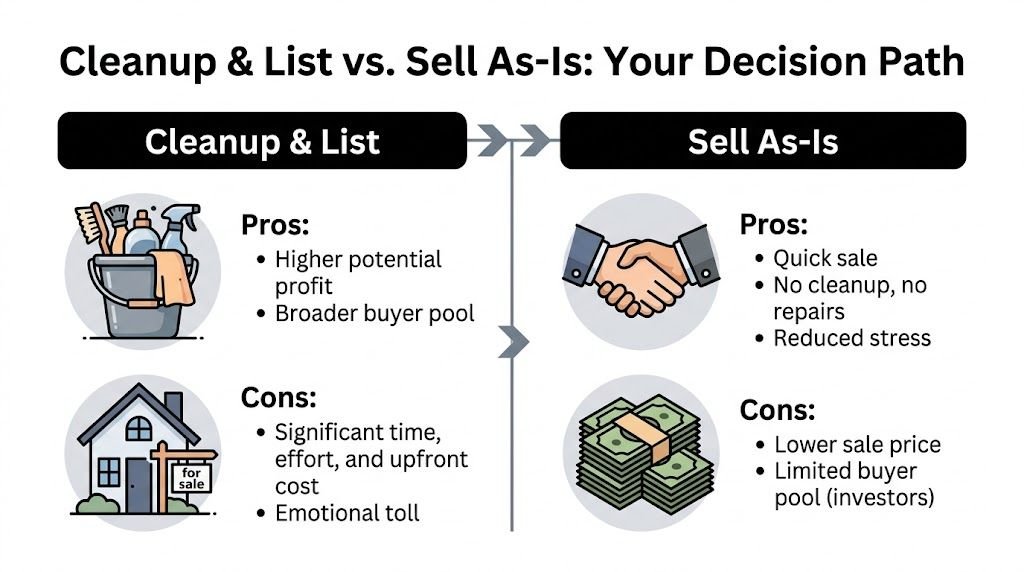
This choice comes down to money, time, stamina, and certainty. Some owners do have the bandwidth to empty the house, coordinate repairs, and list it. Many don't. Absentee owners and military families usually need a path that works without repeated trips, contractor wrangling, and open-ended delays.
What the cleanup-and-list route really requires
The traditional route can work, but it asks a lot from the seller. According to this guide to listing hoarder homes, the traditional methodology takes 3 to 9 months to close, cleanup can cost $5,000 to $15,000 per room, and about 30% of these efforts still fail to sell. That same source says the cash-buyer path is about 4x faster with nearly 100% certainty, though often at a 20% to 30% lower price.
Those trade-offs are real. So are the demands.
Cleanup and listing usually means:
- Managing crews: Junk haulers, cleaners, exterminators, contractors, and agents all need scheduling.
- Paying upfront: The property has to be made showable before most retail buyers even consider it.
- Handling disclosures: Once walls and floors are exposed, the defect list often grows.
- Accepting buyer fallout: Even serious buyers can leave after inspection.
When listing makes sense
The listing route usually fits best when the owner has these advantages:
| Factor | Cleanup and list may fit | As-is sale may fit |
|---|---|---|
| Time | You can wait months | You need a fast exit |
| Cash | You can fund cleanup and repairs | You don't want out-of-pocket cost |
| Access | You live nearby | You're out of state or constantly traveling |
| Condition | Hoarding is mild | Damage or access issues are severe |
| Stress tolerance | You can manage moving parts | You want a simple handoff |
A mildly cluttered home with strong bones and cooperative family members can justify the long route. A remote inherited house with odor, pests, code notices, or blocked access usually doesn't.
What usually doesn't work
Owners get into trouble when they try a half-measure. They clear one room, pay for a dumpster, stop halfway, list bad photos, and hope someone will "see the potential." Retail buyers rarely do. Investors see a project that hasn't been properly priced. The house ends up stale in the market and even harder to sell.
Mild mess can be marketed. Severe hoarding usually has to be solved or transferred.
The cleanest decision rule
If your biggest problem is convenience, compare options carefully.
If your biggest problem is urgency, distance, legal exposure, or emotional overload, selling as-is tends to be the more practical move. You give up some upside, but you cut off the downside.
Selling to a Cumberland County Cash Buyer The Simple Process
A lot of out-of-state owners hit the same wall. The house is in Fayetteville or Spring Lake, you are two states away, and every option seems to require more time, more trips, and more money than the property justifies.
A direct cash sale cuts out most of that friction. The buyer is not looking for a house that can impress retail buyers next weekend. They are judging whether they can take on the condition, the contents, the title issues, and the cleanup without asking you to solve those problems first.
For military families facing a PCS, and for heirs trying to manage a house from outside Cumberland County, that difference matters. You are not trying to squeeze every last dollar out of a perfect listing. You are trying to stop the drain, hand off the problem, and close cleanly.
Step one is a straight first conversation
The process usually starts with a call, text, or short form. Give the property address, whether anyone is still inside, and what you know about the condition. Mention probate, tax trouble, code notices, liens, or family conflict up front.
That first conversation should feel simple.
A serious buyer does not need a polished story. They need enough information to decide whether the property fits their buying criteria and whether they can help you from a distance.
Step two is a real evaluation of the house
The walkthrough is about condition and logistics, not appearance. A buyer who works on hoarder houses in Cumberland County knows blocked rooms, odor, pest activity, and deferred maintenance often hide the bigger costs.
They usually check:
- roof, siding, and exterior access
- visible plumbing, electrical, and HVAC issues
- floor damage, water intrusion, or soft spots
- how much personal property is left inside
- whether every room can be accessed safely
- title, probate, tenant, or occupancy complications
If you live out of state, the showing can often be handled through a lockbox, a relative, a neighbor, or your attorney. That is common with inherited houses and military owners who have already relocated.
Step three is the offer
A real cash offer should be specific and easy to understand. If the number feels low, ask why. A credible buyer should be able to explain the repair risk, cleanup cost, holding cost, and resale risk in plain language.
Look for terms that reduce your burden:
- Sell as-is
- Leave unwanted contents behind if needed
- No repair demands
- No agent commissions
- No last-minute junk fees
- Remote signing options
- A closing date that fits your situation
That last point matters more than people think. Some sellers want out fast because the county is sending notices or the property is sitting vacant. Others need a week or two to pull out documents, family photos, firearms, or anything with personal value.
Step four is closing without the usual chaos
This process works well for absentee owners because it removes the parts that are hardest to manage from far away. No repeated showings. No cleaning crews you have to supervise. No waiting on a retail buyer's financing while the property keeps deteriorating.
In Cumberland County, that matters even more around Fort Liberty. Military timelines change fast. Family members get transferred, deployed, or pulled in three directions at once. A direct sale gives you a defined exit instead of a project that keeps expanding.
What to watch for before you sign
Some buyers make an offer before they really understand the property, then try to cut the price later. Others put the house under contract and go looking for another investor to take it over. That creates delays you do not need.
Ask direct questions:
- Are they buying the property themselves or assigning the contract?
- Have they handled hoarder houses and inherited properties before?
- Can they close if the house still has contents inside?
- Can they work with remote signatures, estate paperwork, or a military seller who is already gone?
- Will they explain the price clearly, without dodging?
I have seen owners waste months with buyers who talked big and never closed. A straightforward local cash buyer is not always the highest number on paper, but for a hoarder house, especially when you live elsewhere, certainty has real value.
If you need a direct solution in Fayetteville, Hope Mills, Spring Lake, Grays Creek, Eastover, Stedman, Raeford, Parkton, Dunn, or nearby areas, DIL Group Buyers buys hoarder houses as-is. No cleaning, no repairs, no commissions, no hidden costs. If you're an absentee owner, handling an inherited property, facing code issues, or trying to sell before a military PCS, their team can make a fair cash offer and help you close on a timeline that works for you.