
If you’ve inherited a property in North Carolina, one of the first questions on your mind is probably about taxes. It's a valid concern. So let's get right to it: Does North Carolina have an estate tax?
The answer is a straightforward no.
The Good News About North Carolina Estate Tax
When you're sorting out a loved one's affairs, the last thing you need is another complicated tax to worry about. Fortunately, here in North Carolina, the news is good. You can breathe a huge sigh of relief because the state will not be taking a cut of the estate's value before it gets to you.
It wasn't always this simple. The game changed back in 2013 when the state made the decisive move to get rid of its estate tax for good. Governor Pat McCrory signed House Bill 998 into law, repealing the tax and making it retroactive to the beginning of that year.
This was a major shift that simplified the inheritance process for families all over the state, especially for those of us here in Cumberland County dealing with properties in Fayetteville, Hope Mills, and the surrounding areas.
Key Takeaway: Because North Carolina has no state estate tax, the process is much simpler. You don't have to worry about the value of the assets you receive being chipped away by a state-level tax bill.
No Estate Tax and No Inheritance Tax
It's also really important to know the difference between an estate tax (paid by the estate itself) and an inheritance tax (paid by you, the person inheriting).
And the good news just keeps coming.
Let's quickly summarize where things stand with property taxes for heirs in North Carolina.
North Carolina Estate and Inheritance Tax Status
| Tax Type | Status in North Carolina | What This Means for You |
|---|---|---|
| Estate Tax | None. Repealed in 2013. | The deceased's estate does not owe any tax to the State of North Carolina. |
| Inheritance Tax | None. | You, as the heir, do not owe any special tax to the state for receiving the property. |
This clear-cut status makes North Carolina one of the friendliest states for heirs.
So what does this all mean for you? It means whether you've just inherited a family home in Spring Lake or a rental property in Stedman, you can focus on what to do with the asset itself, not on paying extra taxes to the state. This is especially helpful if you live out-of-state and are trying to manage everything from a distance.
You can learn more by checking out our detailed guide on North Carolina's inheritance tax laws.
Understanding the Federal Estate Tax Exemption
So, just because North Carolina doesn't have an estate or inheritance tax, don't close the book just yet. We still have to talk about Uncle Sam. The federal government has its own estate tax, but right off the bat, you should know it’s designed to affect only the absolute wealthiest estates in the country.
Think of the federal estate tax exemption as a giant "free pass" from the government. It's a huge number, and your loved one's estate has to be worth more than this amount before any tax is even considered. For the vast majority of folks inheriting a house in Cumberland County, this tax will never, ever be a factor.
How the Exemption Works
The exact exemption amount can change with new laws, and we're expecting a big adjustment in the coming years. For anyone planning ahead, the number to keep in mind for 2026 is around $7 million per individual.
That’s a massive buffer. It’s set that high on purpose so that only a tiny fraction of a percent of Americans ever have to worry about paying it.
The federal estate tax only kicks in on the value of an estate that goes over the exemption amount. If the total value is below that $7 million mark, you owe nothing. Period.
Let's say a person passes away and their entire estate—house, bank accounts, everything—is valued at $6 million. Since that's less than the projected $7 million exemption, the federal government gets zero. The entire inheritance passes to the heirs tax-free.
An Example of a Taxable Estate
Now, let's look at a much larger estate to see how the math actually works. It's not as scary as it sounds.
- Total Estate Value: $9 million
- Federal Exemption: $7 million
- Taxable Amount: $2 million ($9 million – $7 million)
Here's the key takeaway that most people miss: the tax is only applied to the $2 million that's over the limit. The government doesn't tax the full $9 million. The tax rate on that extra amount can be as high as 40%, but again, this only applies to multimillion-dollar estates.
For married couples, there are even more ways to protect assets, including a rule called "portability" that essentially lets them combine their exemptions.
Navigating the Probate Process in Cumberland County
So you've inherited a house. While the good news is that North Carolina doesn't have a state estate tax, it’s not as simple as just getting the keys and moving in.
Before any property can officially change hands, it usually has to go through a court-supervised legal process called probate. This isn't just a suggestion; it's the required path for estates all across the state, including right here in Cumberland County.
Think of probate as the official checkpoint for a will. The court’s job is to make sure the will is legit, put an executor in charge, and oversee the payment of all the deceased’s final bills and debts. Only after every last obligation is settled can the remaining assets—like a family home in Fayetteville—be legally handed over to the heirs.
This system makes sure everything is done by the book, but it’s rarely fast or free. Even a simple, straightforward estate can take months to get through the courts. If there are any complications, you could easily be looking at a year or more.
The Real Costs of Probate
The waiting is only part of the story. The probate journey comes with real-world costs. You're often looking at attorney's fees, court filing costs, and paying to keep the house running—things like utilities, insurance, and property taxes—all while the estate is tied up.
These expenses slowly chip away at the estate's value before the heirs see a dime.
For an heir, especially one who lives out of state, this can turn into a massive headache. Imagine trying to manage a property in Hope Mills while you’re hundreds of miles away, juggling legal deadlines and watching bills pile up. It’s a stressful situation, to say the least.
Probate is a public process. Every document filed with the court, from the will itself to a full list of assets and debts, becomes public record. For many families, this lack of privacy is a major concern.
The chart below shows how an estate's total value is determined for federal tax purposes. This happens before any assets are actually distributed through probate.
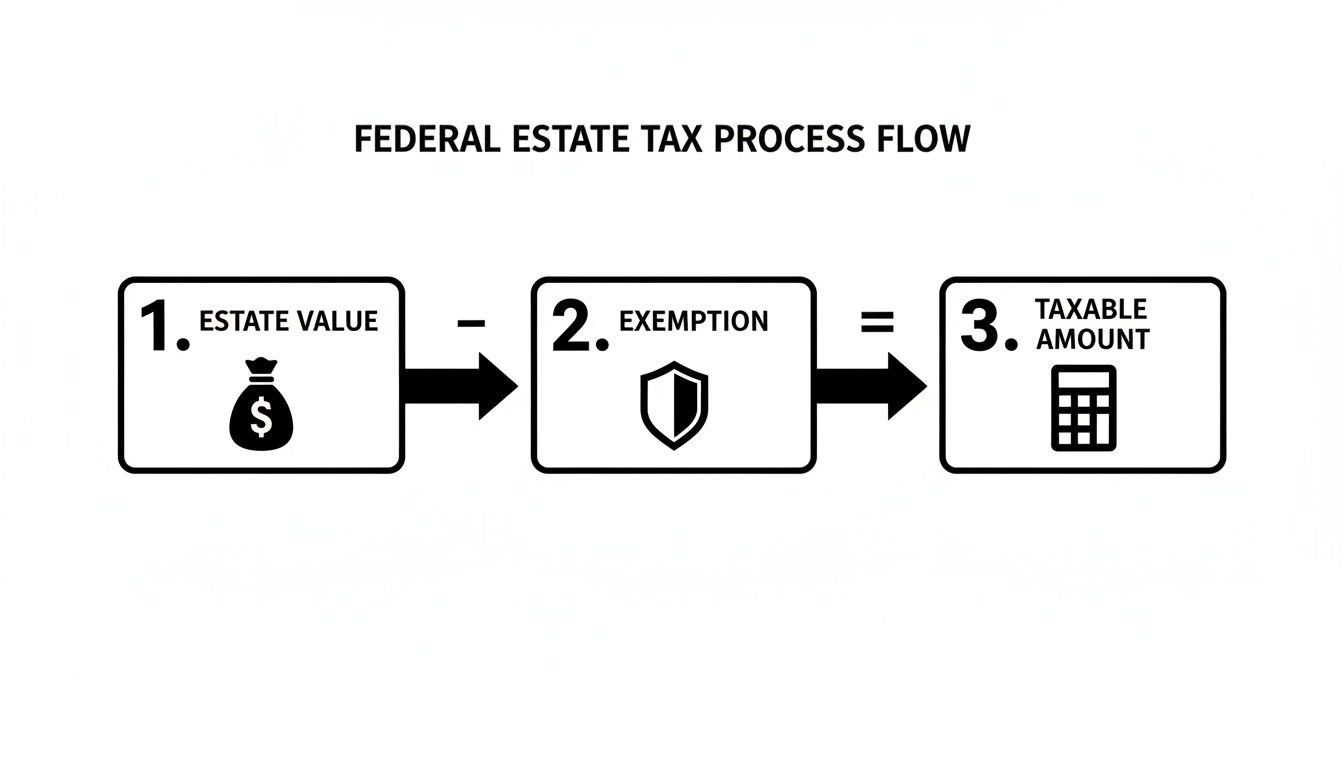
As you can see, the taxable amount is only what’s left after subtracting the very large federal exemption from the estate's total value.
An Alternative Path for Heirs
Facing long delays and mounting costs, many heirs start asking a very practical question: is there a faster way to handle this?
For those who inherit a property and would rather have its cash value without the wait, selling the house is often the smartest move. But a traditional sale on the open market means you're still on the hook for the house during the entire probate process.
That’s why so many heirs in Cumberland County decide to work with a cash home buyer like DIL Group Home Buyers. We can give you a fair cash offer and let you pick a closing date that works for your timeline. This approach gives you certainty and speed, turning a complicated, stressful asset into cash without the usual months of hassle.
How Stepped-Up Basis Can Eliminate Your Tax Burden

It's great that there’s no North Carolina estate tax, but that’s not the only tax people worry about. The big fear for most heirs is capital gains. You inherit a house that's been in the family for decades, its value has shot up, and now you’re worried the IRS is waiting to take a huge chunk when you sell.
This is where you need to know about a rule called stepped-up basis. Honestly, it's the single most important concept for an heir to understand because it can save you a fortune. Think of it as the government hitting a "reset button" on the value of the property for tax purposes.
The Power of the Reset Button
So, what is a "basis"? In simple terms, it's the starting point for calculating profit or loss. If you buy a stock for $100, your basis is $100. Sell it for $150, and you’ve got a $50 gain to pay taxes on. The same idea applies to a house.
The magic happens when you inherit property. You don't get stuck with the original purchase price as your basis. Instead, the basis is "stepped up" to the home's fair market value on the date the person who left it to you passed away.
Key Insight: Stepped-up basis essentially wipes the slate clean. All the appreciation that happened while the previous owner was alive is no longer your problem. Your tax liability starts from the value on the day you inherited it.
A Real-World Example
Let's break this down with a real Fayetteville scenario.
- A parent buys a house back in 1985 for $50,000. That's their original cost basis.
- They pass away today, and after a market appraisal, the house is now worth $250,000.
- You inherit this house.
Thanks to the stepped-up basis rule, your new cost basis isn't the original $50,000. It's now $250,000.
So what happens when you sell? If you sell the house right away for its current value of $250,000, the math is incredibly simple.
- Sale Price: $250,000
- Your Stepped-Up Basis: $250,000
- Your Taxable Gain: $0
That's right. You walk away owing nothing in capital gains tax. The entire $200,000 increase in value over the years is forgiven from a tax perspective. This is a massive financial break for heirs and makes the decision to sell much simpler. If you want to dig deeper into the strategy, you can learn more about how to avoid capital gains tax on inherited property in our other guide.
So, You've Inherited a House in NC. What's Next?

Once you've worked through the first wave of legal paperwork and personal grief that comes with an inheritance, you’re usually left with one big, practical question: what do we do with the house?
For most families, selling is the cleanest answer. It turns a complicated asset into cash that can be used to pay off estate debts or be distributed fairly among the heirs. It lets everyone move forward without the headache of becoming a long-distance landlord or property manager.
But selling an inherited home isn't like putting your own house on the market. You’re often dealing with a property that's miles away, full of a lifetime of belongings, and maybe in need of some serious repairs you just don't have the time or money for.
Getting Your Ducks in a Row
Before you can even think about listing the property, you need the legal green light to sell. This means getting the right paperwork from the probate court. Without these documents, you simply can't sign a sales contract or legally transfer the title to a new owner.
Here's the short list of what you'll absolutely need:
- The Original Death Certificate: This is the official proof that starts the entire process.
- Letters of Testamentary: If there's a will, the court gives this document to the executor. It’s the golden ticket that grants you the power to manage the estate’s assets, including the house.
- The Will (if it exists): This document spells out who gets what and names the person in charge (the executor).
Gathering these papers is your first, non-negotiable step. They are the keys to the kingdom when it comes to selling the property.
CRITICAL: You have zero legal authority to sell the house until the probate court officially appoints you as the executor or administrator. Trying to jump the gun and make a deal can create a legal and financial mess that’s incredibly hard to untangle.
The Two Paths for Heirs: Traditional Sale vs. Cash Sale
Once you have the legal right to sell, you've got a big decision to make. Do you go the traditional route, or do you opt for a quick cash sale? Your choice really boils down to what you value most: getting the absolute highest price, or getting it done fast and with zero hassle.
A traditional sale is what most people picture: you hire a realtor, fix up the house, stage it, and wait for a buyer with a mortgage to come along. This process can drag on for months. It also means you’ll be spending money out-of-pocket on repairs, commissions, and staging—all before you see a dime. If you're out of state or the house is in rough shape, this can feel like a second job you never signed up for.
Then there's the cash sale. This is the fast-track option. Companies like DIL Group Home Buyers specialize in buying inherited properties "as is."
"As is" means exactly what it sounds like. You don't fix anything. You don't clean anything out. You don't even have to show up. We can often close the deal in just a few days or weeks, putting cash in your hands so you can settle the estate and move on. You can see a full breakdown of how it works in our guide on how to sell an inherited property.
For many heirs, that speed and certainty are a complete game-changer, especially if bills are starting to pile up. A cash sale takes a complicated, stressful situation and makes it simple. No showings, no negotiations, and no worrying about a buyer’s loan falling through at the last minute.
Your Top Questions About Inherited NC Property, Answered
Alright, we've covered a lot of ground. But when you're dealing with an inheritance, a few nagging questions always pop up. We get it.
Let's cut through the confusion and tackle the questions we hear most often from families right here in Cumberland County.
What’s the Deal with Estate vs. Inheritance Tax?
This one trips people up all the time, but the answer for North Carolina is simple and it’s good news.
First, an estate tax is what the government takes from the deceased person's total assets before anything gets handed down to the family. On the other hand, an inheritance tax is paid by the person receiving the property.
Here’s the bottom line: North Carolina has neither. The state got rid of its estate tax back in 2013 and it doesn't have an inheritance tax. This is a huge relief, meaning you won’t owe the state a dime just for inheriting a house.
Does a Will Let Me Skip Probate Court?
You'd think so, but no. In nearly every case, even a perfectly valid will has to go through the probate process.
Don't think of a will as a magic key that bypasses the courts. Think of it as a set of instructions for the court.
The court's job is to:
- Make sure the will is the real deal—legal and authentic.
- Officially appoint the executor (the person named in the will to be in charge).
- Supervise the whole process of paying off any debts and making sure the right people get their inheritance.
A will makes the process clearer, but it doesn't let you sidestep it. Only specific setups like a living trust can do that.
I Don’t Live in NC. Can I Still Sell the House?
Absolutely. We work with out-of-state heirs all the time. Managing a sale from hundreds of miles away sounds like a nightmare, but it doesn't have to be.
Honestly, this is where working with a cash buyer is the simplest solution. You don't have to travel to Fayetteville to coordinate repairs, clean-outs, or showings. The entire deal, from the first call to the money hitting your bank account, can be handled remotely with secure e-documents and wire transfers.
You can sell the house completely "as is" and move on.
If you’ve inherited a house in Fayetteville, Hope Mills, or anywhere nearby, you don't have to go through it alone. DIL Group Home Buyers will give you a fair, guaranteed cash offer. No repairs, no commissions, no stress. We handle the headaches so you can close this chapter and move forward.
Contact us today to get your no-obligation offer at https://dilgrouphomebuyers.com.