
When you see a house for sale with that little 'as is' sign out front, it’s a pretty straightforward message. It means the seller is offering the property in its exact current state—no repairs, no updates, no credits for that leaky faucet.
What you see is what you get.
Understanding an As Is Home Sale
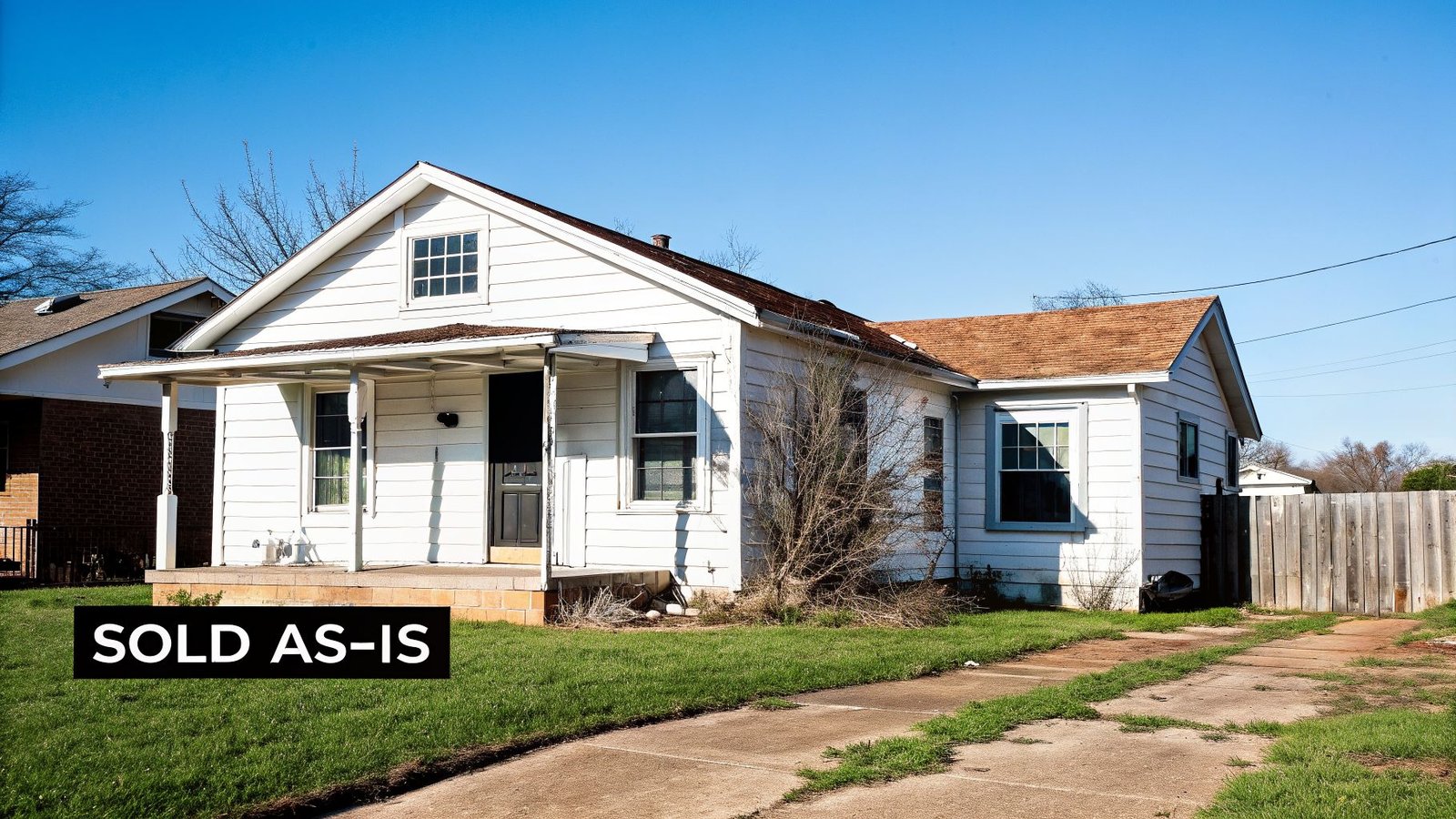
Deciding to sell your home 'as is' tells buyers that you aren't going to sink another dime into the property. Whether it's a few cosmetic scuffs or a major foundation issue, the price reflects the home's condition, warts and all. It’s a clear signal that the ball is in the buyer’s court.
Now, this isn't a "get out of jail free" card for hiding problems. In North Carolina, you’re still legally required to disclose any significant issues you know about. The real difference is that you're drawing a line in the sand: there will be no back-and-forth negotiations over inspection reports. A traditional sale almost always involves a buyer asking for repairs or cash back, but an 'as is' sale cuts that entire stressful process out of the picture.
Why Choose to Sell As Is
For many homeowners here in Cumberland County, selling 'as is' isn't just an option; it's a lifeline. If you're trying to avoid foreclosure, dealing with a divorce, or have inherited a property you can't manage from afar, you might not have the time, money, or energy for a big renovation project.
We see it all the time with military families at Fort Bragg. A sudden PCS order doesn't leave room for a six-month home improvement ordeal. Selling 'as is' gives them a quick, clean break so they can move on to their next post without the baggage of a lingering property.
Selling 'as is' lets you sidestep the headache and expense of repairs. It's a massive relief for sellers who need to move quickly or simply don’t have thousands of dollars for a new roof or HVAC system. You get to close the chapter without the hassle of hiring contractors and living in a construction zone.
As Is Sale vs Traditional Sale at a Glance
So, what are the real, tangible differences between these two paths? To make it crystal clear, let's put them side-by-side. This table breaks down what you can expect when you sell 'as is' versus going the traditional route with a real estate agent.
| Feature | Selling As Is | Traditional Market Sale |
|---|---|---|
| Repairs & Renovations | Seller makes no repairs; property is sold in its current state. | Seller often completes repairs or offers credits after inspection. |
| Sale Timeline | Typically much faster, often closing in a few weeks. | Can take months due to listings, showings, and buyer financing. |
| Negotiations | Focused primarily on price, with little to no repair negotiations. | Involves extensive back-and-forth on inspection items and costs. |
| Buyer Pool | Attracts cash buyers, investors, and flippers. | Targets conventional buyers who often need mortgage financing. |
As you can see, the 'as is' process is built for speed and simplicity. It's a direct route designed to get you from "for sale" to "sold" with the fewest possible obstacles.
Your Legal Duties in an NC As Is Sale

Let's clear up one of the biggest myths about selling a house "as is": it is not a free pass to hide problems from your buyer. That's a dangerous and expensive assumption to make.
Here in North Carolina, "as is" is all about repairs, not secrets. You're still legally required to be upfront about any major issues you know about. The law protects everyone by making sure the buyer understands exactly what they’re getting—even if you have zero intention of fixing it.
Understanding Material Defects in North Carolina
The most important term you need to know is material defect. This isn’t a small cosmetic issue like a scuff on the wall or a sticky doorknob. A material defect is a significant problem that would likely make a buyer rethink their offer or the price they’re willing to pay.
Think of it this way: if a problem is big enough to give someone second thoughts about buying your house, it’s probably a material defect. The courts in North Carolina see it as any issue that seriously hurts the property's value or creates a safety hazard.
Here are some classic examples of material defects you absolutely must disclose:
- Structural Problems: Things like a cracked foundation, serious termite damage, or wood rot that compromises the home's structure.
- System Failures: A dead HVAC unit, bad electrical wiring, or plumbing leaks that have caused water damage.
- Environmental Hazards: Known problems with lead-based paint, asbestos, radon gas, or underground oil tanks.
- Roof and Water Issues: An actively leaking roof or past flooding, even if you’ve already made repairs.
By law, "as is" doesn’t mean "buyer beware." It simply means "I’m not fixing this." You must still disclose any known material defects. Being honest is your best defense against getting sued after you’ve already closed the deal.
The NC Residential Property Disclosure Statement
To make this all official, North Carolina uses the Residential Property and Owners' Association Disclosure Statement. This is the standard form where you, the seller, check "Yes," "No," or "No Representation" for a list of questions about your house's condition.
You can technically check "No Representation" for many items, but if you do that to knowingly hide a huge problem, you're asking for legal trouble. If you know the basement gets water every time a big storm rolls through Fayetteville, you have to say so. If you’re aware of foundation cracks, they need to be on that form.
This document is your proof that you were transparent. For homeowners dealing with a property that has lots of problems, it's helpful to understand what happens when you're selling a house with code violations, as those are almost always material defects you have to disclose.
The True Financial Impact of Selling As Is

When you start thinking about what does selling a house as is mean, it’s easy to get hung up on the initial offer. Many homeowners assume the number will be way lower than what they'd get on the open market, and they stop right there.
But focusing only on that "sticker price" means you're missing the most important part of the equation: your true net profit. Selling your house as-is isn’t about taking a loss. It’s about cutting out all the expenses that drain your bank account during a typical sale.
Think of a traditional sale like a bucket with a dozen small leaks. By the time you get to closing, a shocking amount of your equity has just dribbled away. An as-is sale plugs every single one of those leaks, so you're the one who actually keeps the money.
The Major Costs You Avoid
The first and biggest expense you completely sidestep is realtor commissions. These fees usually run 5-6% of the final sale price, which is a massive chunk of change. On top of that, sellers are often expected to cover 2-5% of the buyer's closing costs. That's another huge hit to your bottom line.
But the savings don't stop there. You also get to skip a whole avalanche of other costs:
- Surprise Repair Demands: A traditional home inspection can turn into a nightmare, with buyers demanding thousands of dollars in repairs you never saw coming.
- Holding Costs: Every single month your house sits on the market, you’re bleeding money on mortgage payments, insurance, taxes, and utilities.
- Staging and Curb Appeal: Getting a house "market-ready" means spending your own money on painting, new landscaping, and maybe even professional staging.
The real financial power of selling 'as is' comes from dodging those steep traditional sale costs. With median existing-home prices around $398,000, agent commissions alone can cost you anywhere from $19,900 to $23,880, not even counting closing costs. When you sell as-is to a cash buyer, those fees disappear entirely. That’s a game-changer. You can explore more about these market trends and see the numbers for yourself.
A Real-World Financial Comparison
Let’s run the numbers. Imagine you’re selling a house in Fayetteville valued at $250,000. If you go the traditional route, you could easily pay $15,000 in realtor commissions and another $7,500 toward the buyer’s closing costs.
Then the inspection report comes back—the HVAC system is on its last legs. The buyer wants it replaced. That's another $8,000 out of your pocket. Just like that, more than $30,000 of your profit has vanished before you even get to the closing table.
Now, let's look at an as-is cash offer. The offer itself might be less than the top market value, but look at what you save: zero commissions, zero repair costs, and often, the buyer pays all the closing costs.
For a homeowner in Hope Mills facing a sudden job loss, or a military family in Fayetteville on a tight PCS timeline, the certainty of a fast cash sale without all those deductions isn't just a relief—it’s the smartest financial decision you can make. You walk away with a clear, predictable net profit in a fraction of the time. No surprises, no headaches.
Who Buys Houses in As Is Condition
When you decide to sell your house "as is," you're not marketing to the typical family looking for their move-in-ready dream home. Let's be clear about that from the start. You’re targeting a completely different kind of buyer—one who sees an opportunity where others might only see a project.
Knowing who these buyers are is the key to getting your house sold. They really fall into two main groups, and your experience will be drastically different depending on which one you're dealing with.
Individual Flippers and Budget Buyers
On one hand, you have individual investors and house flippers. These are the folks who watch renovation shows on TV and are looking for a diamond in the rough to fix up and sell for a profit. They love the idea of unlocking a home's hidden value.
You'll also find handy, budget-conscious buyers in this group. They're willing to trade their own sweat equity for a lower price tag, hoping to get into a neighborhood they couldn't otherwise afford.
The problem? Financing. Traditional mortgage lenders get very nervous about houses that need a lot of work. This is a huge risk for you, because a deal can easily fall apart weeks into the process if the buyer's bank won't approve the loan.
The biggest challenge with individual buyers is uncertainty. Their financing might get rejected post-inspection, or they might underestimate the cost of repairs and try to back out, sending you right back to square one.
Professional Cash Home Buying Companies
This brings us to the second, and frankly, more reliable group: professional cash home buying companies. These are legitimate businesses, like our team at DIL Group Home Buyers, that have the cash on hand to buy properties outright.
Their entire business is built on one simple idea: buying houses in any condition. They have crews who can accurately assess a property in a single visit and make a fair, all-cash offer without ever needing to ask a bank for permission.
This completely removes the risk of a loan falling through. It also makes the closing process incredibly fast. If you're in a tough situation—maybe facing foreclosure, dealing with a sudden PCS from Fort Bragg, or inheriting a property you can't manage—that speed and certainty are everything. A professional cash home buyer offers a guaranteed way out.
You get to skip the sleepless nights waiting on mortgage approvals and the frustrating negotiations over every little item on an inspection report. They buy your house exactly as it stands, you get your cash, and you can finally move on.
Your Guide to Selling As Is in Cumberland County
Trying to sell your house "as is" here in Cumberland County can feel like a maze, but it doesn’t have to be. We get it. Whether you're dealing with a last-minute military PCS or an inherited property you weren't expecting, you need a clear path forward.
This guide will break down exactly how it works, step-by-step.
First things first: you need a realistic view of your property's condition. You don't need to pay for a formal inspection. Just be honest with yourself about what’s working and what isn’t—from the solid foundation to that leaky faucet or the kitchen that hasn't been updated since the 90s.
Find a Reputable Local Buyer
Once you know what you’re working with, it's time to find the right buyer. Instead of the headaches of listing on the open market, selling "as is" is usually fastest with a direct buyer. Focus on finding local cash home buying companies with a real footprint in the Fayetteville area.
A good buyer will be totally transparent about how they work, with no pressure or confusing language. We specialize in houses that need a little—or a lot—of work, so we know exactly what we’re looking at and can give you a straightforward solution.
This chart shows just how different the process is when you work with a professional cash buyer versus trying to find an individual to buy your house.
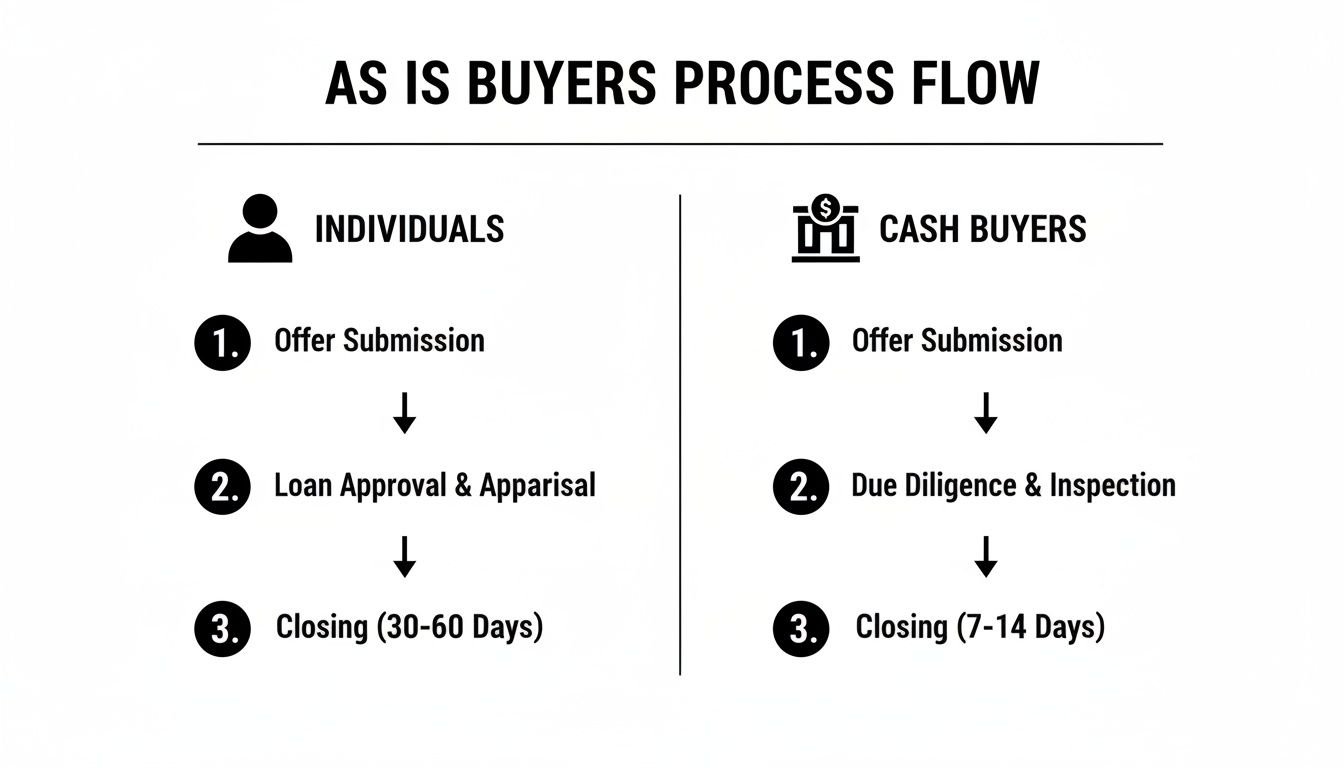
As you can see, we cut out the typical delays from bank financing and the endless back-and-forth negotiations you get with traditional buyers.
Review Your Cash Offer and Close
After you reach out, we'll schedule a quick walkthrough of your home. From there, we’ll give you a no-obligation, all-cash offer. That number is the exact amount you’ll walk away with. No hidden fees, no commissions, and no surprise repair bills.
The best part of selling this way is the speed and certainty. A cash offer is a sure thing. You don't have to worry about a buyer's loan falling through at the last minute, which is a lifesaver if you're facing foreclosure or have to move fast.
Selling a house "as is" cuts right through the usual market delays. Here in Cumberland County, military PCS moves and inherited homes are a fact of life. An "as is" cash sale means no realtor commissions and closing in as little as 7-14 days. This is the perfect answer for tough situations like foreclosures, liens, or major property damage.
If our offer works for you, just say the word and pick your closing date. Need to close next week? We can do that. Need a month? You’re in control. The whole thing is designed to be simple, and you can see a breakdown of our streamlined 3-step home sale process.
Your Top Questions About Selling a House As Is
Deciding to sell your house "as is" is a big step, and it's smart to have questions. It’s a different path from a traditional sale, and you need to know exactly what you’re getting into.
Let’s cut through the noise and give you straight answers to the most common questions we hear from homeowners right here in Cumberland County.
Can a Buyer Still Do an Inspection on an As-Is House?
Yes, and they absolutely should. Selling "as is" doesn't mean the buyer has to go in blind. In fact, any serious buyer, especially an experienced investor, is going to insist on an inspection.
But here’s the key difference: the inspection isn't for them to build a honey-do list for you. It’s for their own knowledge. They need to see exactly what they're buying so they can budget for repairs and confirm the property's real condition. It’s all about making sure their offer makes sense.
Can the Buyer Back Out After an As-Is Inspection?
They might be able to, and it all comes down to the contract. Most agreements have something called an inspection contingency or a "due diligence period."
This gives the buyer a set amount of time, usually 7-14 days, to look over the property. If they find something during that window that they can't live with, they can legally walk away and get their deposit back. This is where deals with regular buyers fall apart all the time. An unexpected problem spooks them.
A professional cash buyer, on the other hand, knows what to look for from the start. They’ve seen it all before and are far less likely to get cold feet over issues that are common in older homes.
Will I Lose a Ton of Money Selling My House As Is?
This is the biggest worry for most people, but it’s usually not how it plays out. While the offer you get for an as-is sale will be lower than a home's "market value," you have to look at what you actually put in your pocket.
Selling the traditional way means your profit gets eaten up by endless costs. Think about it:
- Realtor Commissions: A huge 5% to 6% chunk of the final price.
- Closing Costs: Another 2% to 5% you’re expected to pay.
- Repair Demands: Thousands of dollars spent fixing things the buyer’s inspector found.
- Holding Costs: You’re still paying the mortgage, insurance, and utilities every single month it sits on the market.
When you subtract all that, the "higher" offer doesn't look so high anymore. A fair cash offer is a net offer—it’s the exact dollar amount you walk away with. No surprises, no deductions.
Do I Really Have to Fix Anything Before I Sell?
Nope. Not a single thing. That’s the entire point of selling "as is."
Whether you’ve got a leaky faucet or a roof that needs a complete replacement, it’s not your problem to fix. That responsibility transfers completely to the new owner.
This is a lifeline for sellers who don't have the time, money, or energy for a big renovation project. If you're facing foreclosure, got sudden PCS orders, or inherited a property you can't manage, selling as is lets you cash out and move on.
If you're in Cumberland County and need a guaranteed, hassle-free sale, DIL Group Home Buyers is ready to help. We buy houses in any condition, pay all the closing costs, and close on your schedule. Get your fair, no-obligation cash offer today by visiting us at https://dilgrouphomebuyers.com.