
When you hear the term quitclaim deed in Kansas, think of it as the simplest, no-frills way to hand over property rights. It's like giving someone a set of keys to a house and saying, "Whatever claim I have to this place is now yours, but I'm not making any promises that I'm the true owner or that these keys even open the front door."
A quitclaim deed is a quick and straightforward tool for transferring property, but it comes with a major catch: it offers zero protection to the person receiving it.
What a Quit Claim Deed Does in Kansas

At its heart, a quitclaim deed is all about release. The person signing away their rights—the grantor—is simply transferring their ownership stake, whatever it may be, to the new person, the grantee. Once the deed is signed and recorded, that transfer is official.
But the real story of a quitclaim deed is what it doesn't do. It offers no warranties, no guarantees, and no promises about the property's title history.
The "As Is" Nature of Property Transfer
You've probably seen "as is" listings for used cars. The seller isn't guaranteeing a perfect engine or a clean accident report; you're just buying the car in its current condition, warts and all. A quitclaim deed is the real estate version of that.
The grantor is not legally promising that:
- They actually own the property in the first place.
- The title is clean and free from debts, liens, or other claims.
- Someone else won't show up later with a better claim to the property.
This is exactly why it's a risky move for a typical home sale between strangers. If a hidden problem like an old mortgage, a tax lien, or a property line dispute pops up down the road, the buyer has absolutely no legal comeback against the seller.
A quitclaim deed only transfers the interest the grantor currently has—which could be 100% ownership, a 50% share, or even nothing at all. The grantee gets exactly what the grantor owned, with no extra security.
Quit Claim Deed vs General Warranty Deed at a Glance
So if a quitclaim deed is so risky, why would anyone use one? The truth is, in many situations, those iron-clad guarantees just aren't necessary. This is especially true when property is changing hands between people who already know and trust each other.
On the flip side, a general warranty deed is the gold standard for most real estate sales, giving the buyer the strongest possible protection.
Here’s a quick breakdown of how these two deeds stack up.
| Feature | Kansas Quit Claim Deed | Kansas General Warranty Deed |
|---|---|---|
| Title Guarantee | None. The grantor makes zero promises about the title. | Full. The grantor guarantees the title is clear of any claims. |
| Buyer Protection | Low. The grantee takes on all the risk of title problems. | High. The grantee is legally protected from future title claims. |
| Common Use Cases | Family transfers, divorces, clearing up title issues. | Traditional home sales between a buyer and a seller. |
| Simplicity | Simple and fast to prepare and file. | More complex, almost always needs a full title search. |
Ultimately, the general warranty deed is built for formal sales where you need complete assurance. The quitclaim deed is a tool for simple transfers where trust already exists and legal guarantees aren't the top priority.
Meeting the Legal Requirements for a Kansas Quit Claim Deed

You can't just scribble "I give my house to Jane" on a piece of paper and call it a day. A quitclaim deed in Kansas is a formal legal document, and if you don't get it right, the whole transfer can be invalid. That can cause massive headaches and title issues years from now.
Think of it like a recipe from a master chef—if you skip an ingredient or a step, the whole dish is ruined. You have to follow the rules precisely.
The state lays out these rules in Kansas Statutes § 58-2204. This law specifies the exact language you need, essentially stating that 'A.B. quitclaims to C.D. (here describe the premises), for the sum of (here insert the consideration).' It must then be properly signed and acknowledged. You can find the nitty-gritty details by looking up the official legal documents and forms for Kansas online.
Essential Components of a Valid Deed
A solid quit claim deed Kansas document has a few key pieces of information that are absolutely non-negotiable. If you miss even one, the county recorder will likely reject it, or it could open the door to legal challenges for the new owner.
Here’s what you absolutely must include:
- Grantor’s Information: The full legal name and address of the person giving up their interest in the property.
- Grantee’s Information: The full legal name and address of the person receiving the interest.
- Consideration: This is what's being exchanged for the property. Even if it's a gift between family members, you'll typically see language like "$10 and other good and valuable consideration" to make it legally sound.
- Vesting Language: The deed needs to use the right words. It has to clearly state that the grantor "quitclaims" their interest over to the grantee.
The Legal Property Description
This is where so many people mess up. The legal description is not the street address. It's the formal, detailed description you'll find on the existing deed—it might include lot and block numbers, subdivision names, or metes and bounds.
Getting this description right is critical. An error here creates a "cloud" on the title, which can make it incredibly difficult to sell or even refinance the property later on. There can be no confusion about exactly what piece of land is being transferred.
A valid deed is a chain, and each link must be strong. The grantor’s signature, the grantee’s name, the legal description, and the notarization are all essential links that, if broken, can compromise the entire transfer.
The final steps are just as important. The grantor has to sign the deed in front of a notary public. The notary then adds their official seal, which proves the signature is authentic. This notarization is mandatory for the deed to be officially recorded.
And here’s a nice bonus: Kansas has no state transfer tax. This makes using a quitclaim deed a very cost-effective way to transfer property compared to what you’d face in many other states.
Navigating the Risks and Protections of a Quit Claim Deed
When you use a quitclaim deed, you're making a classic trade-off: speed for security. For the person signing away their interest (the grantor), it’s a quick and simple way to get off the title. But if you’re the one receiving the property (the grantee), a quit claim deed Kansas document is loaded with risks you absolutely need to understand.
Think of it like this: someone hands you the keys to a car. No service history. No title guarantee. And no promise it wasn't just used as collateral for a sketchy loan. That’s what a grantee gets—the property completely "as is." The deed offers zero warranty against any problems hiding in the property’s past.
The Grantee's Biggest Risks
The biggest gamble falls squarely on the new owner. Because the grantor isn't making any promises about having a clean title, the grantee inherits every single problem attached to that property. This can get expensive fast.
Some of the most common nightmares include:
- Undisclosed Liens: An old owner might have an unpaid tax bill, or a contractor could have slapped a mechanic's lien on the property years ago.
- Mortgage Claims: Even if the grantor’s name is off the title, they might still be on the mortgage. If they stop paying, the bank can and will foreclose on your property.
- Boundary Disputes: The property’s legal description could be wrong, or a neighbor might have a legitimate claim to a slice of your land.
- Ownership Challenges: A long-lost heir or a previous owner could pop up with a valid claim that trumps your quitclaim deed.
Without the safety net of a warranty deed, the new owner is left holding the bag, responsible for fixing—and funding—all of these headaches.
The Surprising Protection of Recording Your Deed
While the risks are very real, a quitclaim deed in Kansas isn't totally without protection. You just have to take one critical step: recording the deed. This is where a little-known but powerful legal rule kicks in, giving the grantee a crucial shield.
In Kansas, a properly recorded quit claim deed gives the new owner legal priority over any previous but unrecorded claims on the property. This means if someone else has a deed from an earlier date but never filed it, your recorded deed takes precedence.
This isn't just theory; it's backed by years of Kansas case law. The courts have consistently held that while a quitclaim deed doesn't promise the grantor has anything to give, a recorded quitclaim is superior to prior unrecorded documents. You can dig into the statutes that govern real estate transfers in Kansas to see the legal framework for yourself.
This "first to file" rule is exactly why you must get your signed and notarized deed down to the County Register of Deeds office immediately. It’s your best defense against surprise claims from the past and the only way to officially cement your ownership in the public record. While the process varies a bit by state, the need to record is a universal truth. For comparison, you can see how the process works with a quit claim deed in North Carolina.
How to File and Record Your Kansas Quit Claim Deed
So you’ve got a fully signed and notarized quitclaim deed in your hands. Great! But the job is only half done.
Think of an unrecorded deed as a secret handshake—it’s a private agreement, but it’s not part of the official public record. This leaves the new owner in a seriously vulnerable position. To truly seal the deal and make the transfer legally solid, you have to file and record it with the right county office.
This is the step that turns your private piece of paper into a public fact. It’s how you put the world on notice that the property has a new owner.
Your Step-by-Step Filing Roadmap
Filing a quit claim deed in Kansas isn't rocket science, but you absolutely have to be precise. Getting the details right now will save you from massive headaches later. Just follow these steps to get it done correctly.
- Get the Right Form: First things first, you need a blank Kansas quitclaim deed form. You can find templates online, or an attorney can provide one.
- Fill It Out Perfectly: Be meticulous. Enter the full legal names and addresses for both the grantor (seller) and grantee (buyer). You'll also need the consideration amount (this is often a nominal sum like $10 for family transfers) and the full legal description of the property, copied exactly from the current deed.
- Get It Notarized: The grantor must sign the deed in front of a notary public. The notary’s job is to verify their identity and stamp the document with their official seal. Without that seal, the deed is dead on arrival at the recorder's office.
- Head to the Right County Office: The deed must be filed in the county where the property is physically located. Find the Register of Deeds office for that specific county.
- Submit and Pay: Take your original, notarized deed to the Register of Deeds. Be prepared to pay a recording fee, which is set by state law.
Why Recording Is Non-Negotiable
I can't stress this enough: recording the deed is the single most important thing you can do to protect the new owner. It creates a clean, public chain of title and establishes who has legal priority over the property.
This chart shows exactly what’s at stake and why an unrecorded deed is such a risk.
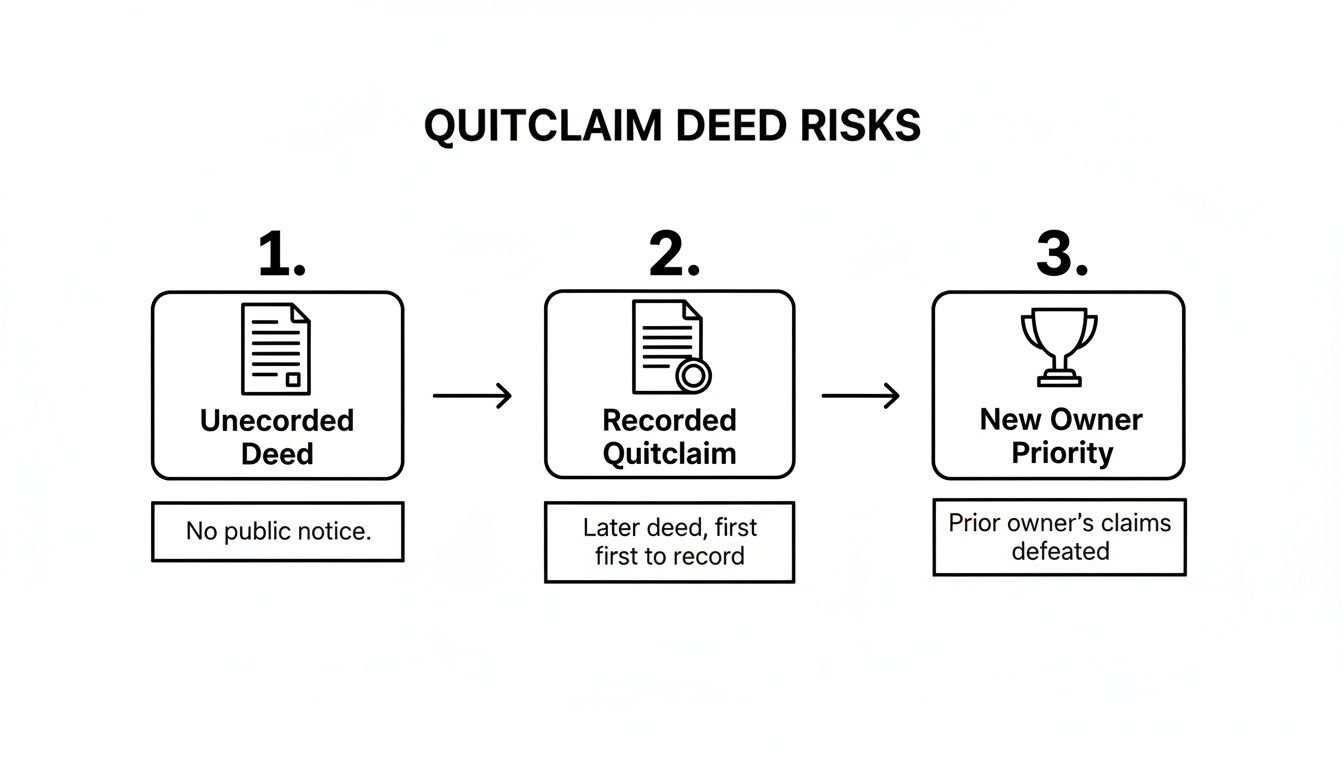
As you can see, getting that official stamp of approval from the county is what gives your ownership claim real teeth.
Every county in Kansas has its own Register of Deeds, and their specific rules can differ slightly. For instance, you might find that rural counties want you to file in person, while larger counties offer more flexible options. Don't skip this step—an unrecorded deed can make it nearly impossible to sell or refinance the property down the road. You can find your county's office through the Kansas Register of Deeds Association.
Recording a deed is not a suggestion; it's a fundamental step in securing property rights. An unrecorded deed leaves the door wide open for future disputes and can make the transfer practically invisible in the eyes of the law.
The whole process, from drafting the document to getting it filed, demands careful attention. For a more detailed breakdown, you can check out our guide on how to file a quit claim deed. A little effort now cements ownership and prevents major problems later on.
Common Scenarios for Using a Quit Claim Deed in Kansas

So, if a quitclaim deed is a risky move for a typical home sale, when would you ever use one? It’s a fair question. While you wouldn’t want to use it to buy a house from a stranger, it shines in situations where everyone already knows and trusts each other.
Think of it less as a one-size-fits-all tool and more like a specialized instrument in your toolbox. When you’re not worried about proving ownership history and just need to make a change, the simplicity and low cost of a quit claim deed in Kansas make it the perfect choice.
The secret sauce is the pre-existing relationship. Because the grantor and grantee are on the same page, you can skip the expensive warranties and title insurance. It’s all about formally documenting a change on paper, not about making promises you can't keep.
Transferring Property Between Family Members
One of the most common reasons to pull out a quitclaim deed is for family matters. The trust is already built-in, so there’s no need for the full-blown, expensive process of a traditional sale.
Here are a few ways families use them all the time:
- Gifting Property to a Child: Let's say parents want to give their home or a piece of land to their adult child. A quitclaim deed is a straightforward way to get the title out of their name and into their child's, no sale required.
- Adding a Spouse to the Title: When you get married, you might want to add your new spouse to the deed of the house you owned before the wedding. This is the simplest way to make it official and show the property is now jointly owned.
- Removing a Relative from the Title: Life changes. Maybe you and your sibling inherited a vacation home, but now you want to buy them out or they want to gift you their share. A quitclaim deed handles this transfer cleanly and efficiently.
Using a Quit Claim Deed in a Divorce
Divorce is messy enough without complicating the paperwork. This is another area where quitclaim deeds become absolutely essential. When a marriage ends, the house and other property have to be divided based on the divorce decree.
A quitclaim deed is the legal document that makes it happen.
If the court awards the house to one spouse, the other spouse must sign a quitclaim deed. This action formally removes their name from the title and gives up all their ownership rights, leaving the remaining spouse as the sole owner.
It's crucial to understand that a quitclaim deed only affects the property title—it does not remove a person's name from the mortgage. The departing spouse is still legally obligated to repay the loan unless the mortgage is refinanced or the lender approves an assumption.
Clearing Title Defects and Estate Planning
A quitclaim deed also acts as a handy "clean-up" tool for tidying up a property's title history. Think of it as patching small holes. For instance, if there's a nagging question about a possible heir's claim from fifty years ago, or a name was misspelled on a deed long ago, that person can sign a quitclaim to officially state they have no interest in the property.
It’s also a go-to document for smart estate planning.
- Transferring Property to a Living Trust: A lot of people put their home into a revocable living trust to help their family avoid the lengthy and public probate process. A quitclaim deed is the simple mechanism used to move the title from you, the individual, to you as the trustee of your trust.
In every one of these cases, the quitclaim deed offers a direct path to change ownership when everyone involved is already on the same team.
Selling Your Property After Using a Quit Claim Deed
So, you’ve used a quit claim deed in Kansas to take ownership of a property. That’s a common and effective way to get the title in your name. But what happens when it’s time to sell?
Here’s the reality: while your recorded deed shows you own the property, it makes zero guarantees that the title is clean. A traditional buyer, and especially their mortgage lender, won't just take your word for it and accept the property "as is."
Before any standard sale can move forward, the buyer’s title company will demand a full-blown title search. This is non-negotiable. They'll dig deep into the property's history to uncover any hidden problems—think old liens from a previous owner, forgotten mortgage claims, or messy property line disputes that a quitclaim deed simply doesn't protect you from. If you want to see exactly what they're looking for, check out our guide on what a title search for property involves.
If that search turns up unexpected issues, it can cause serious delays or even tank the entire deal.
For sellers who need a faster, more certain sale, there is another way. This is especially true if you're an out-of-state owner or inherited a house and just want to avoid the headaches of a traditional sale.
Working with a cash home buyer lets you bypass these hurdles entirely. A cash buyer purchases the property directly from you, often without the strict title requirements that traditional lenders impose. This means a quick, guaranteed closing, letting you move on without the stress.
Your Top Questions About Kansas Quit Claim Deeds, Answered
When you're dealing with property, you need straight answers. Here are the most common questions we hear about using a quit claim deed in Kansas and the no-nonsense truths you need to know.
How Much Does It Cost to File a Quit Claim Deed in Kansas?
The good news? It’s cheap. Filing a quit claim deed is one of the most affordable ways to transfer property in Kansas.
You’ll have a small recording fee paid to the County Register of Deeds and a minor fee to get the document notarized. That’s usually it. The biggest financial win is that Kansas has no state real estate transfer tax. This saves you a ton of money compared to other states where taxes can easily run into the hundreds or even thousands.
Can I Just Prepare a Kansas Quit Claim Deed Myself?
Technically, yes. You can find blank forms online and fill one out yourself. But this is where things get risky. One wrong move can cause major headaches down the road.
The deed needs exact legal language and a perfect legal description of the property to be valid.
A simple mistake—a typo in the legal description or incorrect wording—can make the deed worthless or create a “cloud on the title.” If you have any doubt, paying a real estate attorney for an hour of their time is a smart investment to avoid a future nightmare.
Does a Quit Claim Deed Get My Name Off the Mortgage?
No. This is the single most important thing to understand. A quit claim deed has zero effect on your mortgage loan.
Signing a quit claim deed only gives away your ownership rights to the property. It does not release you from your legal obligation to pay the bank. If your name is on that loan, you are still on the hook for the payments, even if you no longer "own" the house.
This is a huge deal in a divorce. To get your name off the mortgage, the person keeping the house must refinance the loan in their name only, or the lender has to formally approve a loan assumption. There are no other shortcuts.
If you're an out-of-state owner or dealing with an inherited property, you might just want to be done with it all. Forget title searches, realtor showings, and legal paperwork. DIL Group Home Buyers can help. We buy houses for cash, as-is. You get to close fast and just move on.
See how simple our process is at https://dilgrouphomebuyers.com.