
Let's be honest, nobody gets excited about having to replumb their entire house. The average cost to replumb a house in 2026 will land somewhere between $4,500 and $15,000. Most folks end up paying around $7,500.
That’s a wide range, I know. The final number really depends on your home's size, the materials you go with (like PEX vs. copper), and the going rate for labor in our area.
Your Guide to House Replumbing Costs in 2026

Getting a quote for a full repipe can feel like a gut punch. The truth is, it’s a big investment, but it’s one that protects the very bones of your house. Think of it like a necessary engine overhaul for your property; it’s messy and it costs real money, but it’s the only way to prevent a catastrophic failure down the road.
This guide gets right to the point. We're breaking down the real numbers you can expect to see in 2026 and explaining why one project can cost thousands more than another.
What to Expect in Fayetteville and Cumberland County
Here in the Fayetteville area, local factors really shape the final bill. Let's say you're in a standard 1,500-square-foot house in Cumberland County and you're just tired of dealing with constant leaks. For 2026, a full repipe is likely to run you anywhere from $4,500 to $12,000, with most jobs landing in the $6,500 to $7,500 range.
Why the big gap? Your choice of materials is the main reason.
- PEX piping is the modern, flexible option that keeps costs on the lower end, usually between $4,500 and $8,500.
- Traditional copper is a premium material, and that's reflected in the price, which often starts at $9,000 and can easily exceed $12,000.
Now, let's talk about the key cost drivers for a typical project in our area.
2026 Replumbing Cost Estimates for a 1,500 sq ft Home
This table gives you a quick snapshot of what you can expect to pay for a full replumb in the Fayetteville area, breaking it down by the two most common piping materials.
| Expense Category | Typical Cost Range (PEX) | Typical Cost Range (Copper) |
|---|---|---|
| Materials | $1,500 – $2,500 | $4,000 – $6,000 |
| Labor | $3,000 – $6,000 | $5,000 – $8,000 |
| Permits & Fees | $150 – $400 | $150 – $400 |
| Drywall & Paint | $800 – $1,400 | $800 – $1,400 |
| Total Estimated Cost | $5,450 – $10,300 | $9,950 – $15,800 |
Remember, these are just estimates. The actual price can change based on how easy it is for plumbers to get to your pipes and the specific rates of the contractor you hire. Labor is almost always the biggest chunk of the budget.
A whole-house repipe is more than just swapping out pipes. It’s a multi-stage project involving demolition, installation, system testing, and cosmetic repairs to restore your home to its original condition.
An Alternative Path for Overwhelmed Homeowners
But what if staring at a five-figure repair bill just isn't in the cards for you? For many homeowners, the cost, the mess, and the time involved are simply too much to handle.
This is especially true for:
- Military families getting sudden PCS orders from Fort Bragg.
- Folks who've inherited a property and are trying to manage it from out of state.
- Anyone needing to avoid a huge financial hit due to a job loss or other unexpected life event.
In these situations, you need to know that you have other options. Instead of pouring thousands into a massive repair project, you can take a different route—one that lets you sidestep the stress and expense completely and just move on.
Breaking Down the Bill: What You’re Really Paying For

When a contractor slides a replumbing quote across the table, it can feel like you’re trying to read a foreign language. It's a long list of charges and line items that don't always make sense at first glance.
Think of it this way: when you go to a great restaurant, you're not just paying for the steak and potatoes. You're paying for the chef's expertise, the prep time, the service, and the perfect atmosphere. Your repipe quote is the same deal. It’s a mix of materials, skilled labor, permits, and the crucial finishing work that makes your house a home again.
Let's pull back the curtain on that bill so you know exactly where every dollar is going.
The Four Main Parts of Your Replumbing Bill
No matter how big or small the job, every replumbing project boils down to four key cost centers. Getting a handle on these is the first step to setting a realistic budget.
- Materials: This is the easy part to understand. It’s all the physical stuff—the new pipes (PEX or copper), the fittings, valves, and connectors needed for the new system.
- Labor: This is the big one. Labor is almost always the largest piece of the pie, often making up 50% to 70% of your total invoice. You're paying for the plumber's time, skill, and sweat.
- Permits and Inspections: Your city or county requires permits to make sure the job is done right and to code. This protects you and the future value of your home.
- Post-Work Repairs: This is the cleanup crew. Think drywall repair, painting, and sometimes even replacing tile or flooring that had to be opened up to get to the old pipes.
These four pillars are the foundation of your project cost. While the price of materials is pretty fixed, the other three can vary quite a bit from one contractor to the next.
Labor: The Engine Driving the Cost
So why does labor eat up so much of the budget? A whole-house repipe is a seriously invasive and tough job. Plumbers aren't just snapping pipes together; they're navigating tight crawlspaces, cutting through walls, and performing a complex "surgery" on your home's circulatory system.
A plumber's hourly rate, which usually lands somewhere between $75 and $150, isn't just for their time on-site. That fee covers their license, insurance, expensive specialized tools, and the years of training it took to get good at what they do. A full repipe can take a team anywhere from 40 to 80 man-hours, so you can see how fast that adds up.
Material Costs: Copper vs. PEX
While labor is the wild card, your choice of materials sets the starting price for the whole project. The two main players are PEX and copper, and the price gap is huge.
- PEX (Cross-linked Polyethylene): This is the modern, flexible plastic tubing you see everywhere now. It’s a workhorse and very budget-friendly, costing around $0.40 to $0.50 per linear foot. Because it's flexible, it's also faster to install, which can trim down your labor bill.
- Copper: This is the old-school standard. It's incredibly durable and reliable, but it’s also much more expensive, running $2 to $4 per linear foot.
For a pretty average 1,500 sq. ft. house, the total material bill for a full PEX system might be $1,500 to $2,200. If you go with copper for that same house, you could be looking at $4,000 or more just for the pipes and fittings. You can dive deeper into how material choices affect the bottom line by checking national averages on how much it costs to repipe a house.
Keep in mind, the price per foot is just the beginning. The final materials bill includes dozens of little things like fittings, connectors, shut-off valves, and mounting hardware. They all add up.
The Hidden Costs People Forget About
Finally, let's talk about the expenses that blindside homeowners. These are necessary parts of the job, but they might not be spelled out in a simple, high-level quote.
- Permit Fees: Depending on where you live (some NC counties are pricier than others), permits can run from $100 to $300 or more.
- Drywall and Paint: Plumbers cut holes; they don't usually patch them. Fixing all that drywall and painting can easily add another $800 to $1,500 to the total project.
- Fixture Upgrades: With the walls open, it’s the perfect time to replace that old leaky faucet or shower valve. Many homeowners choose to do this, which adds to the cost.
- Demolition and Debris Removal: Those old galvanized or copper pipes are heavy. The cost to tear them out and haul them away is a real expense, even if it's just bundled into the labor line item.
When you understand all these pieces, you can look at any quote, ask smart questions, and feel confident that you’re getting a fair price for a job well done.
Key Factors That Drive Your Replumbing Costs
Ever wondered why your replumbing quote was thousands different from your neighbor's? It’s not just a random number. Think of it more like a base price that gets tweaked by a handful of major variables.
Each of these factors can push the final bill up or down, easily turning a $5,000 job into a $12,000 project. Knowing what they are is the key to understanding any contractor's estimate and budgeting without nasty surprises down the road.
Your Home's Size and Layout
This one's the most obvious. A bigger house means more pipe, more materials, and more labor hours. A sprawling 3,000-square-foot ranch will always cost more to replumb than a tight 1,200-square-foot bungalow. It's just simple math.
But square footage isn't the whole story. The layout matters, too. A two-story home with a bathroom stacked right over the kitchen is actually more efficient to work on. If your plumbing fixtures are scattered at opposite ends of the house, expect the plumber to spend more time—and your money—running all that new pipe.
Accessibility Is Everything
This is the real wild card. How easy is it for plumbers to get to the old pipes? The answer to that question can drastically change the amount of labor and demolition needed.
- Crawlspace or Basement: This is the best-case scenario. When pipes are exposed and easy to access, the job is faster and cleaner. This is your quickest and cheapest route.
- Concrete Slab Foundation: This is the job everyone dreads. If your pipes are buried under concrete, the only way to get to them is with a jackhammer. That means a ton of labor, a huge mess, and the extra cost of patching the concrete afterward. A slab foundation can easily tack on an extra 20-30% to your total bill.
Your home’s foundation is the single biggest variable when it comes to labor costs. Easy access through a crawlspace keeps the price down, while a concrete slab can add thousands to the final invoice due to the intensive demolition and repair work involved.
Number of Bathrooms and Fixtures
The more places you use water, the more complex the job gets. Every single sink, toilet, shower, and washing machine is another connection point that takes time, materials, and precision.
A simple one-and-a-half-bath home is a walk in the park compared to a house with three full bathrooms, a wet bar, and an extra utility sink. A good rule of thumb? Plan to add $1,000 to $2,000 for each full bathroom after the first one.
Partial vs. Whole-House Repipe
Finally, what are you actually fixing? Are you replacing every last supply line in the house, or are you just tackling one problem area?
A partial replumb is a targeted fix—you're only replacing the sections of pipe that are actively failing. This can be a smart, budget-friendly move if you have a newer home with one isolated issue. But be careful. If your whole system is old and corroded, a partial fix is just a band-aid. You're just waiting for the next section to fail.
A full whole-house repipe is a bigger investment upfront, but it gives you complete peace of mind. You're starting fresh with a brand-new system. Keep in mind that old, leaky pipes can sometimes lead to inspections that uncover other problems. To understand what that can entail, check out our guide on the challenges of selling a house with code violations and what to do about them.
Choosing Your Pipes in the PEX vs Copper Showdown
The biggest fork in the road you'll face during a replumb is choosing your pipe material. This is the classic PEX vs. copper debate, and it’s the single biggest decision you’ll make.
Think of it as the time-tested champion versus the modern challenger. On one side, you have copper, the rock-solid standard that has kept water flowing in homes for decades. On the other is PEX, a flexible, tough newcomer that has quickly become the favorite for most plumbers.
Your choice here directly steers the cost of replumbing a house, affecting everything from the price of materials to the final labor bill. It's like picking between a heavy-duty, old-school steel truck and a modern, efficient hybrid. Both get the job done, but their costs, benefits, and long-term upkeep are completely different.
The Case for PEX: The Modern Workhorse
PEX (which stands for cross-linked polyethylene) is a flexible plastic tubing that you'll find in most new home builds and repipes today. There’s a good reason for its popularity.
Its main advantage is flexibility. Unlike rigid copper pipes that need a fitting and a soldered joint for every single turn, PEX can literally bend around corners. This drastically cuts down on installation time and complexity.
Less time for the plumber means a lower labor bill for you—and labor is almost always the biggest chunk of the total cost. As a bonus, PEX is more forgiving in freezing temperatures and less likely to burst. For anyone who's dealt with a cold North Carolina winter, that’s a huge plus. The lower material cost is just icing on the cake.
The Case for Copper: The Time-Tested Standard
Copper is the old guard of plumbing. It has an incredible track record for durability, with many systems easily lasting 50 to 70 years or more.
It's also naturally biostatic, which means it resists bacterial growth, and it won't break down from UV light exposure. This means you can use it in exposed areas (like an unfinished basement or utility room) where PEX isn’t recommended.
But that premium quality comes with a premium price tag. Copper costs more upfront, and the meticulous installation process adds to the labor bill. Every connection has to be precisely cut and soldered by a skilled plumber, which adds significant time to the job.
The infographic below shows how the big-three cost factors—home size, pipe access, and the number of bathrooms—all play off each other.
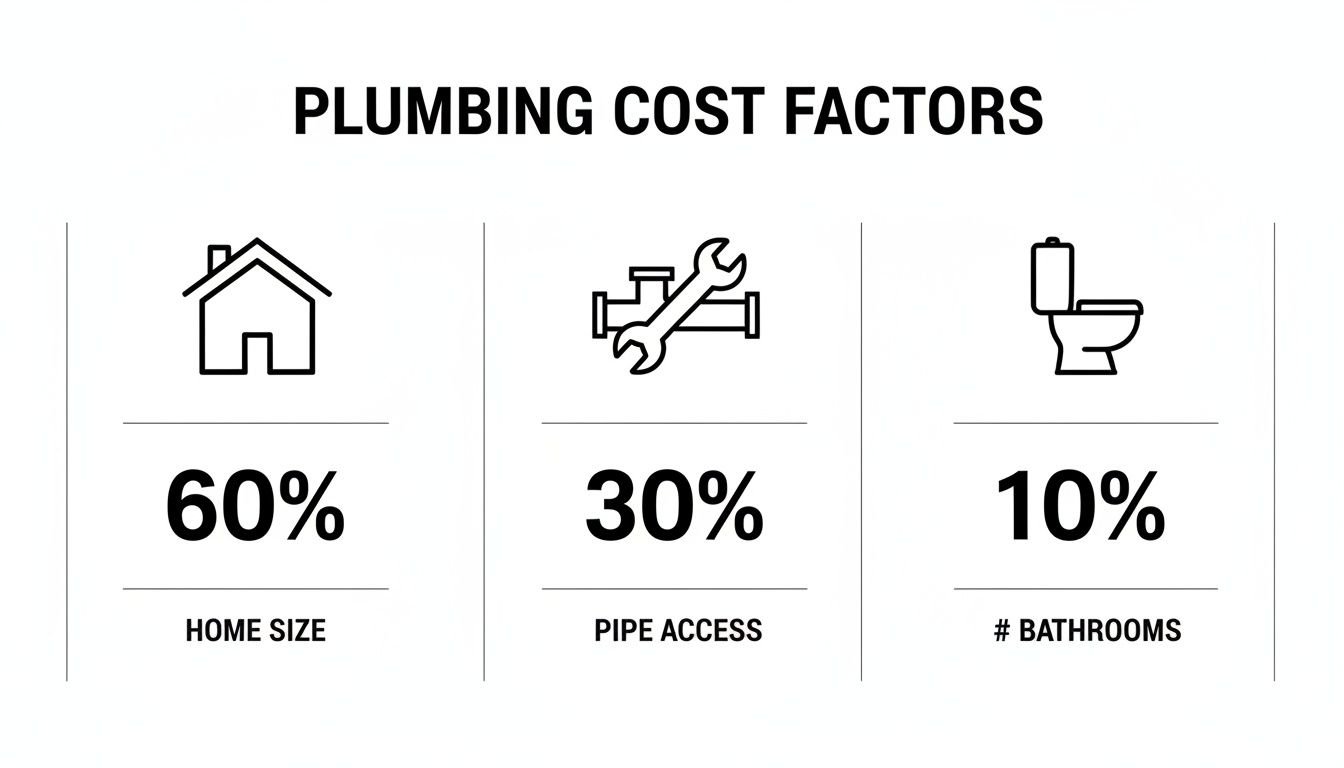
You can see how a tricky installation (poor pipe access) in a large house will make the labor cost difference between PEX and copper even more dramatic.
PEX vs Copper Piping: A Head-to-Head Comparison
Sometimes the best way to decide is to see the pros and cons laid out side-by-side. This table breaks down what really matters for your home and your wallet.
| Feature | PEX (Cross-linked Polyethylene) | Copper |
|---|---|---|
| Average Cost | Lower initial cost for materials and labor. | Higher initial cost for both materials and labor. |
| Installation Speed | Faster and easier to install due to flexibility. | Slower and more labor-intensive due to rigid nature. |
| Lifespan | Excellent, typically lasting 40-50 years. | Exceptional, often lasting 50-70+ years. |
| Freeze Resistance | More flexible and less likely to burst if frozen. | Rigid and highly susceptible to bursting when frozen. |
| Durability | Highly durable but can be damaged by UV light. | Extremely durable but can corrode with acidic water. |
So, what does this look like in real dollars?
For a standard 1,500 sq ft home, a full replumb with PEX usually lands somewhere between $4,000 and $6,000. That same job using copper could easily climb to $6,500 to $10,000. It’s no wonder that in 2026, an estimated 65% of jobs now use PEX, thanks to its great mix of affordability and a solid 50-year lifespan. You can find more about 2026 replumbing costs and trends to see where the industry is heading.
The Bottom Line: For the vast majority of homeowners, PEX hits the sweet spot. It delivers great performance, a long lifespan, and a much more budget-friendly price tag. Copper is still a fantastic, premium choice for those who want maximum durability and don't mind the higher upfront investment.
What If You Can't Afford a $10,000 Replumb?
We've talked a lot about the numbers and what goes into the cost of replumbing a house. But let's get real for a minute. What happens when that final quote—whether it's $7,000 or $15,000—is completely out of reach?
For many homeowners, this isn't a simple repair bill. It's a massive roadblock. When the money, the time, and the sheer stress of a full replumb are just too much, you need another way out. You need a different plan that puts you back in control.
When It's More Than Just a Leaky Pipe
The need to sell a home with bad plumbing usually comes from intense personal pressure. These aren't just maintenance problems; they're huge life events where a massive renovation is the absolute last thing you can deal with.
Here in the Fayetteville area, we see these situations all the time:
- Sudden PCS Orders from Fort Bragg: A military family gets unexpected orders. You have weeks, not months, to move. There’s no time to schedule a multi-day replumb and wait for inspections, and you definitely don't have the cash on hand to pay for it before you ship out.
- Inheriting a Home from Far Away: You've inherited your parents' house, but you live three states over. The property has been neglected, the plumbing is a mess, and trying to manage a major project from a distance is a nightmare.
- The Aftermath of Bad Tenants: You’re a landlord who just discovered your rental property has been trashed. The tenants are gone, but they left behind a trail of destruction, including busted pipes. You don't have the money or the energy to start over.
- Facing Financial Crisis: A job loss or a medical emergency has you falling behind on the mortgage. With foreclosure looming, pouring thousands into a plumbing job is completely off the table.
In every one of these cases, the problem is way bigger than old pipes. It's about time, money, and emotional energy—three things that are always in short supply during a crisis.
The Smart Alternative: Selling Your House As-Is
When you're facing these kinds of challenges, it’s easy to feel trapped. The old-school way of fixing everything up, listing with an agent, and waiting for a buyer just won't work. This is where a different path opens up.
Selling your house "as-is" to a local cash buyer is a practical move that lets you skip the entire repair and selling circus. It’s not giving up; it’s taking charge of your situation.
This changes the entire question. Instead of asking, "How do I fix this house?" you get to ask, "How do I solve my problem fast and move on with my life?"
Choosing this route gets rid of the biggest headaches that come with selling a house that needs major work. The process is simple and lets you sidestep the financial burden completely.
What Skipping the Repairs Actually Means for You
When you sell as-is, you get to avoid the entire replumbing nightmare—the cost, the mess, and the delays. Here’s what you get to walk away from:
- No Contractor Headaches: Forget about trying to find a reliable plumber, living in a construction zone for days on end, or dealing with unexpected delays.
- No Draining Your Bank Account: The thousands of dollars you would have spent on new pipes, drywall repair, and permits stays right in your pocket.
- No Realtor Commissions or Fees: A traditional sale comes with agent commissions (often 5-6% of the sale price) and closing costs. A direct cash sale has none of that.
- A Guaranteed, Fast Closing: Instead of waiting months for a buyer whose loan might fall through, you get a solid cash offer and can often close in just a few days or weeks.
This is all about getting certainty and speed when you need it most. If you're overwhelmed by the thought of tackling major repairs, you can learn more about how to sell my house as is and see if it's the right move for you. It's a powerful way for homeowners to get a clean break and a fresh start.
Common Questions About The Replumbing Process
Even with the costs laid out, you've probably got some practical questions running through your head. A whole-house replumb is a big deal, and it's smart to know exactly what you're getting into.
Let's tackle the questions I hear most often from homeowners. We’ll cover everything from how long you'll be without water to whether insurance will chip in, giving you the real-world answers you need to make a decision.
How Long Does It Take to Replumb a Whole House?
Let's be clear: this isn't a one-day job. For a standard house around 1,500 to 2,000 square feet, you're looking at a timeline of three to seven days from start to finish.
Of course, a few things can change that schedule. If you've got a crawlspace or basement where the pipes are easy to reach, the crew can move a lot faster. But if your house is on a concrete slab, they'll have to do some demolition, and that adds time.
The size of the plumbing crew and the complexity of your home's layout are big factors, too.
What Does the Day-to-Day Process Look Like?
To give you a better idea of the controlled chaos, here’s a typical play-by-play:
- Day 1 – The Prep Work: The first day is all about getting ready. The crew will cover your floors and furniture to protect them. Then, they’ll start carefully cutting access panels in the drywall to get to the old pipes.
- Days 2-4 – Running the New Lines: This is where the real work happens. The plumbers will methodically run the new PEX or copper lines through the walls, ceilings, and under the house.
- Final Days – Connection and Testing: Once the new system is laid out, they connect everything—sinks, toilets, the water heater. Then comes the critical part: they pressurize the whole system to hunt down any potential leaks before calling the job done.
You can usually stay in your home during the project, but plan on having your water shut off during work hours each day.
Will Homeowners Insurance Cover the Cost of Replumbing?
This is a big one, and the answer is almost always no. Your standard homeowner's policy is there for sudden and accidental damage, not for fixing things that get old and wear out.
Think of it like the tires on your car. Insurance covers a blowout from hitting a pothole, but it won't buy you a new set of tires just because the tread is gone. Your home's plumbing works the same way.
Here's the key distinction: Insurance won't pay to preventatively replace your old pipes, but it will usually cover the damage caused when a pipe suddenly bursts. That means paying to fix your drywall, floors, and ruined furniture.
So, if an old galvanized pipe gives way and floods your kitchen, your policy should help with the mess. It just won't pay to replace all the other old pipes to stop it from happening again.
What Are the Warning Signs My House Needs Replumbing?
Your house will give you clues that its plumbing is on life support. Ignoring them is asking for a disaster and a massive water damage bill.
Keep an eye out for these red flags:
- Weak Water Pressure: If your shower feels more like a weak drizzle, it’s a classic sign that corrosion and gunk are choking your pipes from the inside.
- Funky Water: Is your water coming out brown, yellow, or tasting like metal? That's the taste of rust from old galvanized steel pipes.
- Constant Leaks: One leak might be bad luck. But if you’re fixing new leaks in different places every few months, you don’t have a pipe problem—you have a system-wide failure.
- Old Age: If your house was built before the 1970s and has the original pipes, it's not a matter of if they'll fail, but when.
If you see a couple of these signs, a full replumb is almost certainly on the horizon. When in doubt, have a pro come take a look.
Can I Save Money with a Partial Replumb?
Yes, you can save money in the short term by only replumbing part of the house, but you have to be careful with this strategy.
It means you're just replacing one problem area—like the hot and cold lines to an upstairs bathroom. This can save you thousands upfront compared to doing the whole house. But if all the pipes are the same age, you’re just delaying the inevitable.
The risk is that another old pipe fails six months later, and now you're paying a plumber to come back, cut open more walls, and do it all over again. A partial fix makes sense in a newer home with one bad section, not an older home where the entire system is failing. For homeowners who find even a partial repair is too much to handle, talking to a local cash home buyer can be a smart way to walk away from the problem entirely.
Are you facing a massive replumbing bill that you can't afford? You don't have to drain your savings or live in a construction zone. DIL Group Home Buyers purchases houses in any condition, so you can sell your home as-is, skip the repairs, and get cash in hand fast. Visit us at https://dilgrouphomebuyers.com to get a no-obligation offer today.