
When you sell a rental property, you’re dealing with two main hits from the taxman: capital gains tax on your profit and a special depreciation recapture tax on all the deductions you’ve taken over the years. The biggest shock for most landlords is that depreciation recapture. They discover they owe tax not just on the profit, but also on the tax breaks they enjoyed. That part is taxed at a flat 25% federal rate.
The Real Tax Impact of Selling Your Rental Property

Selling an investment property is a completely different ballgame than selling your personal home. The tax rules are tougher and far more complicated. I’ve seen countless landlords right here in the Fayetteville area get blindsided by a huge tax bill, even when the sale didn't feel like a massive win. Knowing the tax implications of selling rental property before you even think about selling is the only way to protect your profit.
This isn’t about just subtracting your purchase price from your sale price. The Internal Revenue Service (IRS) makes you go back and account for every tax deduction you took, and that math can radically change how much you owe.
Two Taxes, Not One
Here’s the first thing you need to get straight: the government doesn’t tax your profit as one single number. They slice it into two different pieces, and each gets its own tax rate.
-
Capital Gains: This is the tax on how much your property went up in value. It’s the difference between what you sell it for and your “adjusted basis.” Your federal tax rate on this part is 0%, 15%, or 20%, depending on your income.
-
Depreciation Recapture: This is the surprise that gets everyone. For all the years you owned the rental, the IRS let you claim depreciation as a paper loss to lower your taxes. Now that you’re selling, they want to “recapture” that benefit. This chunk of your gain gets taxed at a much higher rate—up to 25%.
Think of it like this: the IRS spotted you money for years through depreciation deductions. When you cash out, they show up to collect their tab.
This "recapture" tax is not optional. Even if you forgot to claim depreciation on your past tax returns, the IRS taxes you as if you did. It’s based on the depreciation you were “allowed or allowable” to take, so you can’t escape it.
Why This Matters for NC Sellers
Whether you're a military family PCSing from Fort Liberty or a long-time landlord in Hope Mills, these federal taxes are coming for you. On top of that, you have to pay North Carolina. Unlike the feds, NC doesn't give you a special rate for capital gains; the state taxes your entire profit at its flat income tax rate.
This guide is here to make these rules clear. We’ll walk you through figuring out your total gain, what each tax really means, and—most importantly—powerful strategies you can use to lower your final bill. A little planning upfront can help you walk away with a lot more of your hard-earned equity.
The Math Behind Your Tax Bill: How to Calculate Your Real Gain
Before we can even talk about taxes, we have to figure out your profit—the way the IRS sees it. This isn't just your sale price minus what you originally paid. The real calculation is a bit more involved, but getting this number right is the foundation for everything that follows.
Let's walk through the three key numbers you need to pin down: your amount realized, your adjusted basis, and your total gain.
Start with Your Amount Realized
First up, let’s figure out your amount realized. This is the cash you actually walk away with after paying all the costs of selling the property. This is your true starting line for any tax calculation.
Common selling expenses you can subtract from the final sale price include:
- Realtor Commissions: Usually the biggest chunk, this is what you pay the agents who helped sell the property.
- Attorney Fees: The cost for legal work to get the deal closed.
- Closing Costs: Think title insurance, transfer taxes, and other administrative fees.
- Advertising Costs: Any money you spent to market the property.
For example, let's say you sell your rental for $350,000. You end up paying $25,000 in commissions and other closing costs. Your amount realized isn't $350,000; it's $325,000. That's the number we'll use, not the headline sale price.
Determine Your Adjusted Basis
Next, we need to calculate your adjusted basis. You can think of this as your total investment in the property for tax purposes. It starts with what you paid for it, but it gets adjusted over the years you owned it.
Here’s the formula the IRS uses:
Original Purchase Price + Capital Improvements – Accumulated Depreciation = Adjusted Basis
Let's break that down.
Capital improvements are the big-ticket items that add real value or extend the life of your property—not just simple repairs. We're talking about a new roof, a full HVAC replacement, or a major kitchen gut-and-remodel. Fixing a leaky faucet or repainting a bedroom doesn't count; those are just maintenance expenses.
Accumulated depreciation is a big one. It’s the total of all the depreciation deductions you took (or were supposed to take) on your tax returns while you owned the rental. The IRS lets you write off the value of a residential rental property over 27.5 years, and every dollar you've depreciated reduces your basis.
So, imagine you bought a rental for $250,000. You put in $30,000 for a new kitchen and, over the years, you claimed $50,000 in depreciation. Your adjusted basis would be $230,000 ($250,000 + $30,000 – $50,000).
Calculate Your Total Gain
Now for the easy part. With those two numbers, we can find your total taxable gain. This is the final profit figure the IRS cares about. The formula is simple but powerful.
It's just your amount realized minus your adjusted basis.
Amount Realized – Adjusted Basis = Total Gain
Let's stick with our running example:
- Amount Realized: $325,000
- Adjusted Basis: $230,000
The math is $325,000 – $230,000 = $95,000.
In this scenario, your total taxable gain is $95,000. This is the profit you'll report. But here’s the critical part: not all of that $95,000 gets taxed at the same rate. The next step is to split this gain into two different buckets—capital appreciation and depreciation recapture—to see what you'll really owe.
Capital Gains vs. Depreciation Recapture: The Two Taxes You’ll Face
When you sell a rental property, the IRS doesn't just see one big pile of profit. They see two, and they tax each one very differently. Getting this straight is the single most important part of understanding your tax bill and avoiding a nasty surprise.
Think of your total profit being split into two separate buckets. The first is for your long-term capital gains, and the second is for depreciation recapture. How much profit lands in each bucket is what determines your final tax hit.
The First Bucket: Long-Term Capital Gains
This is the one most people expect. Your long-term capital gains bucket holds the profit from your property's appreciation—the difference between what you paid for it and what you sold it for. If you've owned the property for more than a year, the IRS rewards you with lower tax rates.
For 2024, the federal tax rates on these gains are much friendlier than regular income tax:
- 0% if your taxable income is up to $47,025.
- 15% if your income is between $47,026 and $518,900.
- 20% if your income is over $518,900.
This is the government's way of encouraging long-term investment. It's the "good" tax, but it's often only half the story.
The Second Bucket: Depreciation Recapture
Here’s where a lot of landlords get blindsided. The second bucket is for depreciation recapture. Over the years, you’ve been allowed to claim depreciation as a paper loss on your taxes, which lowered your taxable rental income. It was a nice benefit to have.
Well, the party’s over. When you sell, the IRS essentially says, "Time to pay back those tax savings."
All the depreciation you claimed (or could have claimed) is "recaptured" from your profit and taxed at a flat federal rate.
The tax rate for depreciation recapture is a stiff 25%, no matter what your income is. This is a much tougher pill to swallow than the 0% or 15% capital gains rates many people pay.
This means you could have a huge tax bill even if your property barely went up in value. All those years of tax deductions come due at once.
This chart breaks down how your total gain is calculated, which is the starting point for figuring out what goes into each tax bucket.
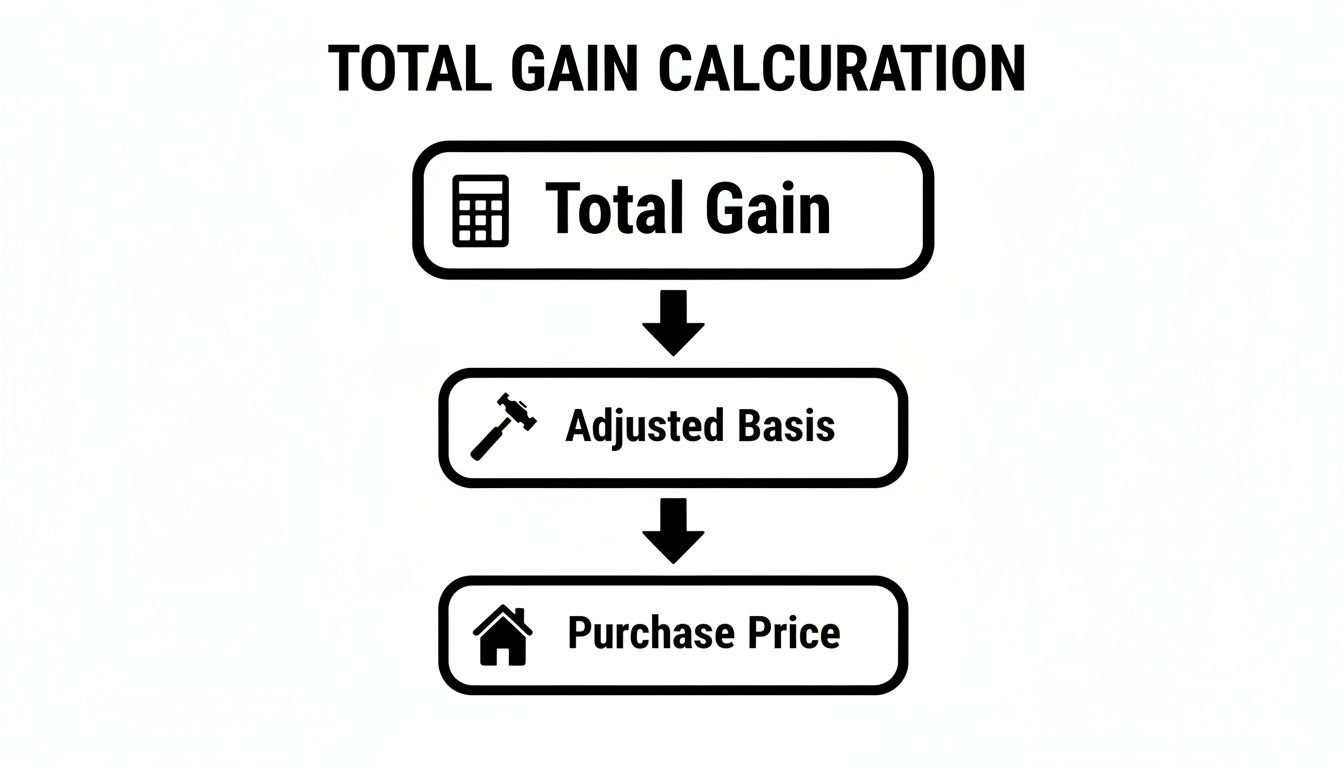
As you can see, your total profit is what's left after accounting for your adjusted basis. From there, the IRS carves out the depreciation to tax it separately at that higher rate.
How Depreciation Recapture Plays Out in Real Life
The impact of recapture tax can be absolutely staggering. Let's run some real numbers. Imagine you bought a rental in Fayetteville for $200,000 ten years ago.
The IRS lets you depreciate a residential property over 27.5 years. On a $200,000 property (building value), that’s about $7,272 in depreciation you could deduct each year.
Over 10 years, that adds up to $72,720 in total depreciation.
When you sell, that entire $72,720 is taxed at the 25% recapture rate. That’s a tax of $18,180—and that’s before you even touch the tax on your property's appreciation!
This is a critical point: your biggest tax liability might not come from your profit, but from paying back the tax benefits you've enjoyed for years. If you've inherited a property, the basis rules are a bit different. You can learn more in our guide on inherited house tax consequences.
The "Bonus" Tax: Net Investment Income Tax (NIIT)
Just when you think you’ve got it all figured out, there’s one more layer. High-income investors might also get hit with the Net Investment Income Tax (NIIT). This is an extra 3.8% tax slapped on top of your investment income, which includes the gain from selling your rental.
You’ll generally have to pay this if your modified adjusted gross income (MAGI) is over:
- $200,000 for single filers
- $250,000 for married couples filing jointly
This extra 3.8% applies to both your capital gains and your depreciation recapture, pushing your total tax rate even higher.
Powerful Strategies To Reduce Or Defer Your Tax Bill

Seeing a huge tax bill looming after your property sale can feel like a punch to the gut. But it doesn't have to be that way. With a bit of smart planning, you can legally shrink—or even push back—what you owe the IRS.
These aren't shady loopholes. They're established, powerful tools in the tax code specifically designed to help real estate investors like you protect the equity you’ve worked so hard to build. Let's walk through the best options you have on the table.
Defer Your Entire Gain With A 1031 Exchange
The go-to strategy for serious real estate investors is the 1031 Exchange. It gets its name from Section 1031 of the IRS tax code, and it’s a game-changer. Think of it less as a "sale" and more like a "swap."
A 1031 exchange lets you sell one investment property and roll all the money you made directly into a new, "like-kind" investment property. When it's done right, you get to defer paying both capital gains tax and depreciation recapture tax. This means your entire nest egg keeps working for you instead of getting a big slice carved out for Uncle Sam.
But here’s the catch: the rules are ironclad. You have to follow them to the letter. There is zero wiggle room.
- The 45-Day Identification Rule: The clock starts the day you close on your sale. You have exactly 45 calendar days to officially identify potential replacement properties in writing.
- The 180-Day Closing Rule: You must buy and close on one or more of those identified properties within 180 calendar days of your original sale date.
These two deadlines run at the same time. You’ll need a professional known as a Qualified Intermediary to handle the funds and make sure you stay compliant. If you’re thinking about this powerful tool, you can dig deeper into our resources on the 1031 exchange process.
Convert The Property To Your Primary Residence
Here's another powerful move that involves changing how you use the property. If your life situation allows for it, you can actually move into your rental property and make it your main home. This can open the door to the Section 121 exclusion—a huge tax break for homeowners.
And it’s an incredibly generous break.
To qualify, you must own the property and have lived in it as your primary home for at least two of the five years right before you sell it. If you check those boxes, you can exclude up to $250,000 of gain if you’re single, or a massive $500,000 if you’re married and file your taxes jointly.
One very important detail: This exclusion wipes out capital gains, but it doesn’t get you out of paying the tax on depreciation recapture. You’ll still owe that 25% tax on the depreciation you claimed while it was a rental. Still, making the capital gains portion tax-free is a massive win.
Spread Out Your Tax Hit With An Installment Sale
What if you don't want the hassle of another property and you can't move into the old one? An installment sale could be your ticket. With this strategy, you sell the property but agree to get paid by the buyer over several years instead of all at once.
Instead of one giant check and one giant tax bill, you get a series of smaller payments. You only report a piece of your gain each year as you get the money. This can be a huge advantage because it can keep your income in a lower tax bracket, potentially cutting the overall tax rate you pay on the profit.
For example, a $100,000 gain could push you into a higher tax bracket if you take it all in one year. But if you spread that out over five years with $20,000 annual payments, you could keep your income—and your tax rate—much lower.
Supercharge Deductions With A Cost Segregation Study
For investors planning to do a 1031 exchange into a bigger, better property, there's an advanced strategy called a cost segregation study. This is a detailed, engineering-based analysis that breaks your building down into its individual parts to speed up depreciation.
Normally, a residential rental is depreciated slowly over 27.5 years. A cost segregation study finds all the things that have a shorter lifespan—like carpeting, specific light fixtures, or landscaping—and reclassifies them for faster depreciation over 5, 7, or 15 years. This lets you "front-load" your tax deductions into the first few years of owning the property.
This strategy is particularly powerful right now. The One Big Beautiful Bill Act (OBBBA), which was signed in 2025, brought back 100% bonus depreciation for 2026. This means you can deduct the full cost of those reclassified assets in the very first year.
Imagine you buy a new $500,000 rental. A cost segregation study might identify $150,000 worth of these short-life assets. Thanks to bonus depreciation, you could get an immediate $150,000 tax deduction to help offset gains from a property you just sold. You can learn more by reading the full guide on the 2026 cost segregation changes.
By understanding these options, you go from being a passive seller to an active strategist, ready to make the smartest financial move for you and your family.
How A Cash Sale Supports Your Tax Strategy
When it comes to taxes on a rental property sale, timing is everything. A fast, as-is cash sale gives you the control you need to make a smart financial move instead of getting stuck in a chaotic process. It’s a huge advantage, whether you’re trying to hit a tight deadline or just want a clean break.
For landlords planning a 1031 exchange, a cash sale is a lifesaver. You have a non-negotiable 45-day window to identify a new property and 180 days to close. A regular sale on the market can fall through at the last minute because of financing problems or bad appraisals. That one setback could blow your deadline and land you with a massive tax bill you weren't expecting.
With a guaranteed closing date from a cash buyer like DIL Group, that risk is gone. You know the exact date your sale closes, so you can start that 45-day clock with total confidence. That certainty is gold when you're working with your Qualified Intermediary to line up the next property.
Gain Control Over Your Tax Year
Beyond the 1031 exchange, a quick cash sale lets you choose which tax year you take the hit. This is a big deal for things like tax-loss harvesting, where you might want to sell a rental to balance out losses from stocks or other investments. A cash sale that closes in just a few days means you can lock in that gain exactly when you need it—like right before December 31st.
This control is also perfect if you think your income will change. If you know you’ll be in a lower tax bracket next year, you can set up a quick sale to close in January. That simple move could directly lower the tax rate you pay on your profit.
When you choose your closing date, you're not stuck waiting on a typical buyer's schedule. You call the shots, lining up the sale with your own tax goals for a predictable, stress-free outcome.
Simplify Your Profit Calculation
One of the best things about a cash sale is how clean the numbers are. When you sell the traditional way, your final profit is a moving target. Surprise repair demands, closing cost help for the buyer, and ongoing holding costs all chip away at your bottom line.
A direct cash sale gives you a clear, final number right from the start.
- No Realtor Commissions: You completely avoid the 5-6% commission, keeping thousands of extra dollars.
- No Repair Credits: We buy properties "as is." You won't get hit with a list of demands after an inspection.
- No Holding Costs: A fast closing means you stop paying the mortgage, insurance, taxes, and utility bills weeks or even months sooner.
This clarity makes it so much easier to figure out what you’ll actually owe in taxes. You can give your CPA a solid number to work with, which means better planning and no nasty surprises. It's especially helpful for landlords who are ready to be done with a property, particularly if they are selling a rental property with tenants and just want a simple, clean transaction.
Got Tax Questions? We've Got Answers.
Thinking about the tax man is probably the least exciting part of selling your rental property. It can feel like a maze of rules and numbers, but don't worry. We've heard all the common questions from sellers just like you, and we're here to give you the straight scoop.
What If I Sell My Rental Property For A Loss?
It might feel like a setback, but selling a rental property for a loss can actually be a smart tax move. The IRS lets you use that capital loss to wipe out other taxable gains, like profits you made from selling stocks or another property.
And if your losses are bigger than your gains for the year? You can still come out ahead. You’re allowed to deduct up to $3,000 of that leftover loss against your regular income (like your job's salary). That's a direct reduction of your tax bill.
Any loss beyond that $3,000 isn't gone, either. You can carry it forward to future years, using it to offset future gains or take another $3,000 deduction. A poorly performing investment can suddenly become a tax tool you can use for years.
Do I Still Owe Depreciation Recapture If I Sell At A Loss?
This one trips up a lot of investors, but the answer is a simple, straightforward no. Depreciation recapture tax only kicks in when you have an overall profit on the sale.
Think of it this way: the IRS only wants to "recapture" the tax breaks you got from depreciation if you're walking away with cash in your pocket. If there's no profit, there's nothing for them to take back.
If you sell for less than your adjusted basis (what you paid, plus improvements, minus all the depreciation you've claimed), you have a capital loss. In that situation, the 25% depreciation recapture tax is completely off the table.
While nobody aims to sell at a loss, it’s a relief to know the IRS won’t add insult to injury by hitting you with a recapture tax on top of it. Your loss is simply a capital loss, which you can use to your advantage as we just discussed.
How Does North Carolina Tax My Rental Property Sale?
As you're figuring out your federal taxes, don't forget the state has its hand out, too. North Carolina plays by a different set of rules, and it’s critical to understand how they work.
The single biggest difference is this: North Carolina does not have a special, lower tax rate for long-term capital gains. The feds give you a break with 0%, 15%, or 20% rates for long-term investments. North Carolina does not.
Instead, the state lumps your entire profit from the sale into your regular income and taxes it all at the same flat rate. This includes what the feds call capital gains and what they call depreciation recapture. It all just gets added together and taxed.
Here’s a quick example to make it clear:
- Let's say you have a total gain of $100,000 from your sale.
- On your federal return, this might be split: $40,000 taxed as depreciation recapture (25%) and $60,000 as a long-term capital gain (15%).
- For North Carolina, the entire $100,000 is just treated as income and taxed at the state's flat rate, which is 4.5% for 2024.
This makes the math on your state return simpler, but it also means none of your profit gets special treatment.
Feeling overwhelmed by the tax planning and the hassle of a traditional sale? At DIL Group Home Buyers, we offer a straightforward solution. We buy houses for cash in Fayetteville and the surrounding areas, giving you a guaranteed closing date to help you execute your tax strategy with confidence. Skip the commissions, repairs, and uncertainty.
Get a fair, no-obligation cash offer today and take control of your sale. Visit us at https://dilgrouphomebuyers.com to learn more.