
So, you've found water damage. It’s a gut-wrenching moment for any homeowner, especially when you’re thinking about selling. Your first instinct might be panic, but you’re not the first person to face this, and you won’t be the last. The reality is, you have options. It really comes down to two very different paths.
The Reality of Selling a House with Water Damage
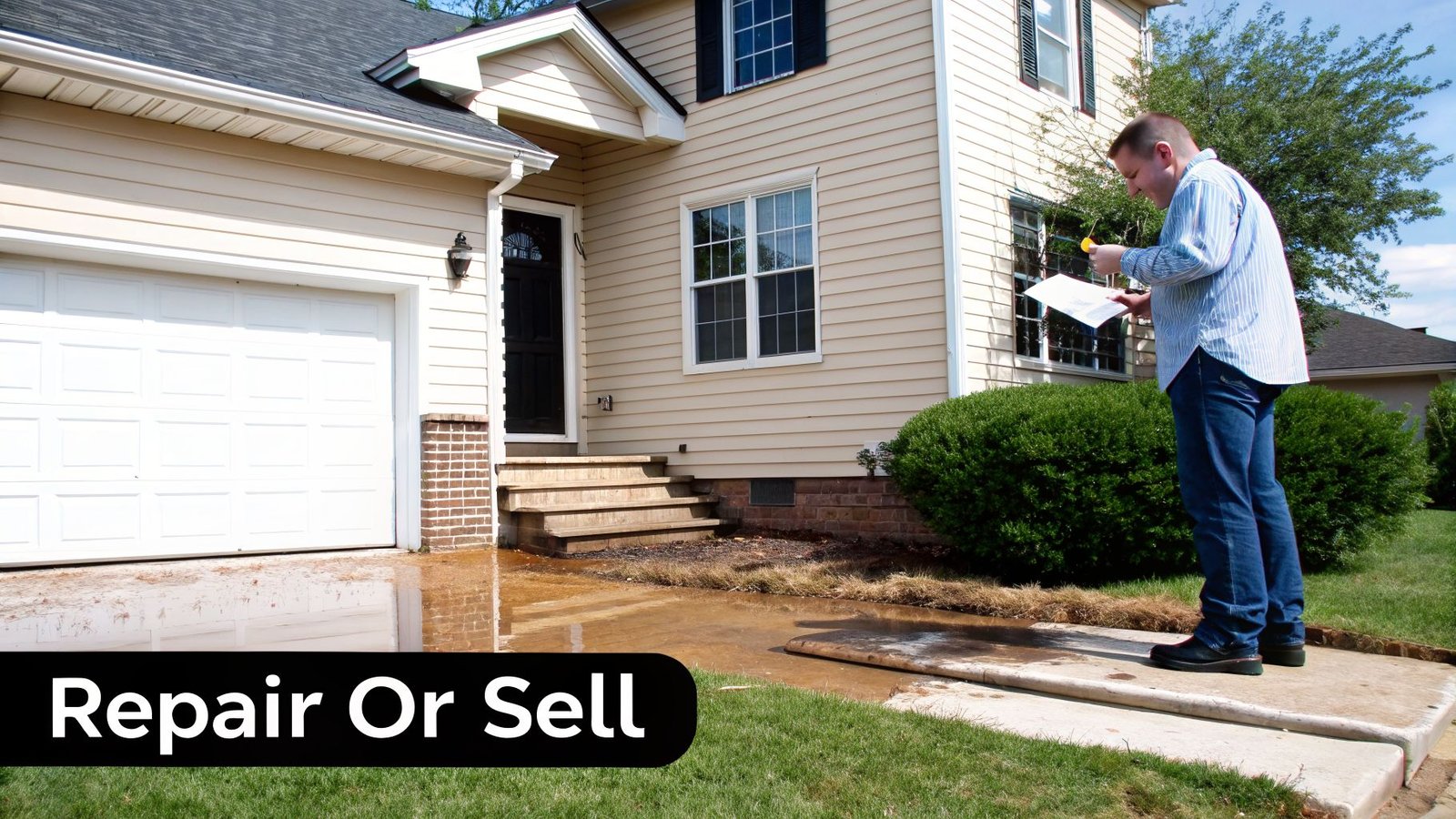
Finding water damage right before you sell can feel like your worst nightmare, but it's a far more common problem than you’d think. This isn’t some rare catastrophe; it’s a frequent headache that puts homeowners in a tough spot.
Just look at the numbers. Between 2018 and 2022, about 1 in every 60 insured homes in the U.S. had a water damage claim each year. These aren’t just minor drips, either—the average claim payout was a staggering $13,954. It's the second most common type of insurance claim, which explains why so many sellers find themselves in this exact position. You can dig into more data on water damage claims and their financial impact for yourself.
Two Paths for Fayetteville Homeowners
If you're a homeowner here in Fayetteville—whether you’re a military family on a tight PCS schedule or an out-of-state owner who can't manage repairs from afar—this decision boils down to a trade-off: time and stress versus a lower, but guaranteed, price.
Key Takeaway: This isn't just a financial decision. It's about what you can handle right now. Weigh the stress and uncertainty of a major renovation against the speed and simplicity of a straightforward as-is sale. Your personal situation will tell you which path is right.
Your first option is the traditional route: repair everything and then list it on the market. The goal here is to get the highest possible sale price. But that means shelling out serious cash for water remediation, structural repairs, and cosmetic fixes before you even know what a buyer might offer.
Your other option? Sell the house as-is to a local cash home buyer, like us at DIL Group Buyers. This path is all about speed, convenience, and certainty. You make zero repairs. You pay zero commissions. You get to close on your timeline and walk away from the financial and emotional weight of a damaged property.
To make it crystal clear, let's break down how these two choices stack up against each other.
Repair and List vs. Sell As-Is Quick Comparison
This table outlines the fundamental differences between repairing your home for a traditional sale and selling it directly to a cash buyer like DIL Group Buyers.
| Factor | Repair & List on MLS | Sell As-Is to a Cash Buyer |
|---|---|---|
| Sale Price | Potentially higher, but not guaranteed | Lower than market value, but guaranteed |
| Upfront Costs | High (remediation, repairs, staging) | None; you pay for nothing |
| Timeline | Months (repairs, listing, closing) | Days or weeks (you choose the date) |
| Certainty | Low (buyer financing can fall through) | High (cash offers are firm) |
| Stress & Effort | High (managing contractors, showings) | Low (one visit, one offer, done) |
As you can see, the choice isn't about which option is "better" in a vacuum. It’s about which one is better for you, right now, in your specific situation.
Assessing the Damage and Its Financial Impact
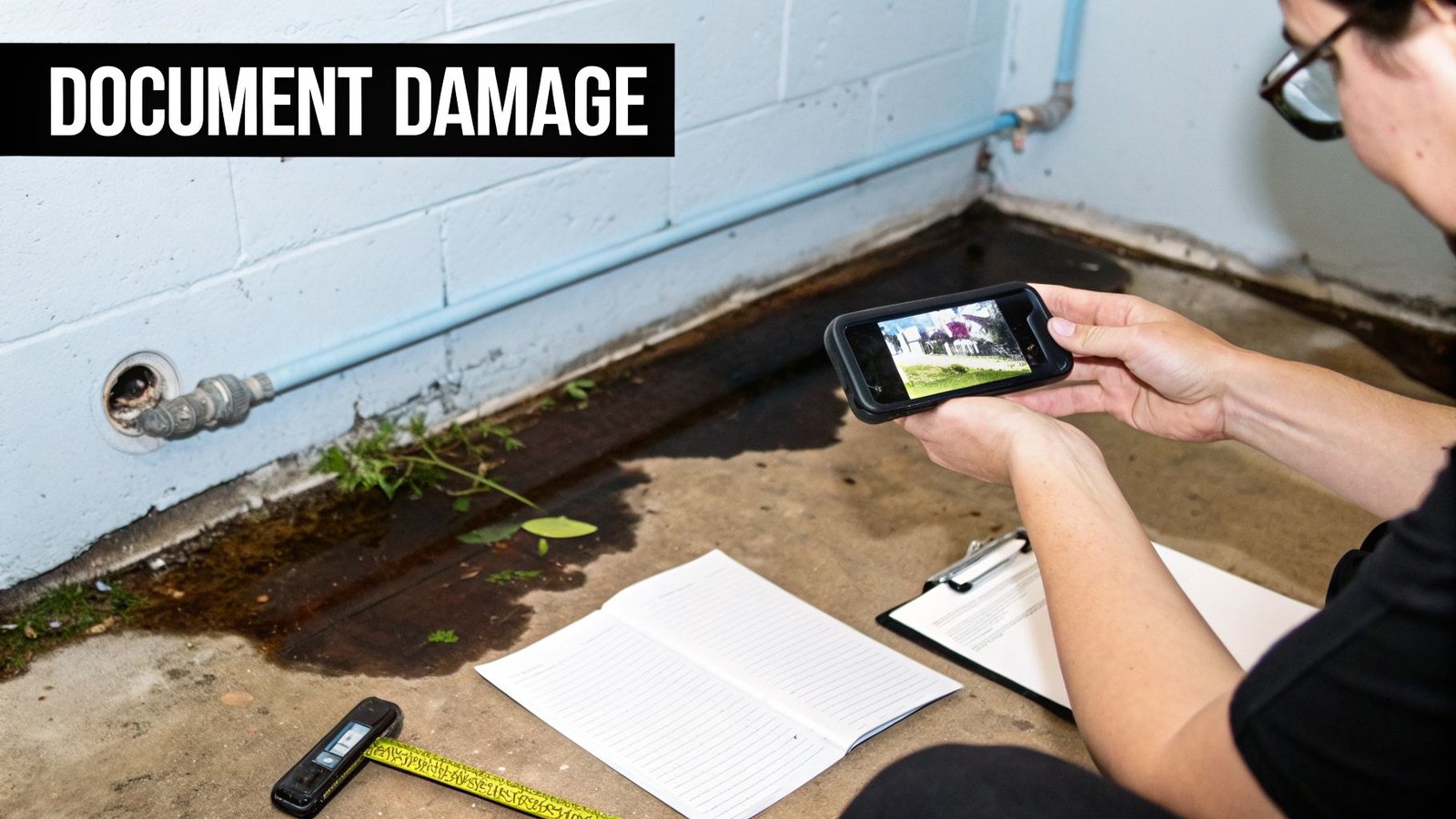
So you've discovered water damage. Before you can even think about what comes next, you have to play detective. That dark spot on the ceiling or the warped floorboard? That’s rarely the whole story. What you can see is often just the beginning of a much bigger, more expensive problem lurking behind the walls.
Your first move should be to grab your phone and document everything. And I mean everything. Take detailed photos and videos of every stain, every piece of peeling paint, and every warped plank. Get close-ups and wide shots. This visual evidence is your best friend, whether you're battling an insurance company, showing the scope of work to a contractor, or explaining the situation to a potential buyer.
Finding the Source and Spotting the Real Deal-Breakers
Now, where is the water coming from? Is it a sudden pipe burst that you've since stopped, or a slow, sneaky leak that's been happening for weeks? A one-and-done dishwasher flood is a completely different animal than a persistent leak from a failing roof or a cracked foundation. The source tells you if the problem is over or just getting started.
As you look around, you need to be on high alert for the red flags I see all the time. These are the issues that terrify regular homebuyers and cause repair costs to explode.
- That Musty Smell: If your house smells damp and earthy, you've got a classic sign of mold or mildew, even if you can't see it. That smell means moisture has been sitting and festering.
- Visible Mold: Seeing black, green, or white specks on your walls, baseboards, or ceilings is a major problem. This isn't just ugly; it's a health hazard that requires professional remediation.
- Spongy Walls: Gently push on the drywall near the water stains. If it feels soft or gives way, the material has lost its integrity. It’s basically mush.
- Buckled Floors: Wood or laminate flooring that is lifting, cupping, or separating is a dead giveaway that it has soaked up a ton of water.
- Cracked or Bulging Walls: This is a big one. It can signal that water has gotten into the home's frame or foundation, causing serious structural damage.
If you find any of these, you’re not just dealing with a cosmetic fix anymore. You're facing potential structural and health hazards, which completely changes the game when it comes to selling.
The True Cost of Repairs
With a clearer picture of the damage, it's time to face the financial music. Don't just get one quote—call at least three different water damage restoration companies and have them give you a detailed estimate. This is the only way to know what you're really up against.
The costs can be all over the place. A tiny leak that just needs a drywall patch might run you under $1,000. But the moment mold is involved, you’re in a different league. Professional mold remediation can easily cost $1,100 to $3,500, and that’s just for the mold itself. If the damage is structural—meaning you have to replace subfloors, joists, or electrical wiring—you could easily be looking at $7,000 or much, much more.
Real-World Scenario: We worked with a landlord in Hope Mills who found a slow leak behind a shower. By the time his tenants noticed, water had rotted the subfloor and crept up the studs. What seemed like a "small repair" ballooned into a $9,500 gut job, including full mold remediation and subfloor replacement—plus a month of lost rent.
How Water Damage Crushes Your Home's Value
The repair bill is just one side of the coin. The simple fact that your home had water damage, even if you fix it perfectly, can torpedo its value on the open market. Buyers are terrified of moisture, and their appraisers will absolutely flag it.
I've seen a moderate history of water issues lead to a 10-20% drop in a home’s market price. For a typical $250,000 house in Fayetteville, that’s a $25,000 to $50,000 hit. Why? Because a buyer doesn't see a "fixed" problem; they see a future risk. They're pricing in the possibility of hidden mold, recurring leaks, and the general stigma. This financial reality is the number one reason sellers in this situation decide to skip the retail market and sell directly to an investor.
Navigating Disclosure Laws in North Carolina
When you're selling a house with water damage in North Carolina, a lot of people think they can just patch, paint, and pretend it never happened. Let me tell you from experience: that's a one-way ticket to a legal nightmare. Honesty isn’t just good practice here—it’s the law, and it’s taken very seriously.
North Carolina might be a "buyer beware" (or caveat emptor) state, but that label is misleading. It comes with a massive catch: the Residential Property and Owners' Association Disclosure Statement. This isn't optional. It's a legally required form where you have to come clean about the home's condition.
What You Absolutely Must Disclose
This form gets specific. It doesn't beat around the bush. You'll be asked directly about your property's history with water. Get ready to answer "Yes," "No," or "No Representation" to questions about:
- Any water intrusion in the basement or crawl space.
- Roof problems, including past or present leaks.
- Issues with plumbing, water heaters, or sump pumps.
- The presence of hazardous substances, which absolutely includes mold from water damage.
Now, you might be tempted to check "No Representation." Don't do it. To any experienced buyer or agent, that's a giant red flag. It basically screams, "I'm either hiding a serious problem or have no clue what's going on with my own house." Neither of those builds the trust you need to close a deal.
Choosing "No Representation" is like putting a sign in the yard that says, "There might be a huge issue here, but you'll have to guess what it is." Buyers will automatically assume the worst and slash their offers accordingly.
The Real Risks of Hiding Water Damage
Let’s be blunt: trying to cover up water damage is a terrible, terrible idea. If you knowingly hide a major issue—what the law calls a "material fact"—you're committing fraud. It's that simple. And the consequences are severe.
A buyer who finds that leak you painted over can, and often will, sue you long after the sale. They can come after you for the full cost of repairs, the drop in the home's value, and all their legal bills. In the worst-case scenario, a judge could tear up the whole sale, forcing you to take back the damaged house and refund every penny. It’s a financial and legal headache that just isn't worth it.
The Buyer Psychology Problem
Even if you do everything by the book and make perfect repairs, the stigma of "water damage" is powerful. In a homebuyer's mind, water equals mold, rot, and a bottomless money pit.
This fear immediately puts you at a disadvantage on the traditional market:
- A Shrinking Buyer Pool: Many potential buyers will run for the hills at the first mention of water. They just don't want the risk.
- Aggressive Lowball Offers: The few buyers who remain will use the damage as their primary negotiation tool. They'll offer a price that covers not just the repair, but also a hefty "risk premium" for the unknown.
- Financing Nightmares: Lenders are extremely cautious. An appraiser noting past moisture problems can instantly kill a buyer's FHA or VA loan, forcing you to put the house back on the market and start all over.
This is exactly why selling your home as-is to a cash buyer makes so much sense. When you understand what selling a house "as is" truly means, you see it’s a way to bypass this entire minefield.
With a cash buyer like DIL Group Buyers, you disclose what you know, we assess the risk, and we make you an offer that reflects the home’s true condition. There are no last-minute financing collapses or lawsuits showing up a year later. Just a clean, straightforward sale.
Choosing Your Path: Repair or Sell As Is
You’ve surveyed the damage and you know your legal duties. Now you’re standing at a fork in the road, and it’s the most important decision you’ll make in this whole process.
Do you sink your time, money, and sanity into fixing the house for a traditional sale? Or do you cut to the chase and sell it as-is for a guaranteed price? This isn't just a financial choice—it’s about your personal situation and what you really need to happen next.
One path is paved with contractors, surprise costs, and the uncertainty of the open market. The other gives you a clear, predictable finish line, letting you move on without the headache of a major renovation. Let's get real about what each option truly looks like.
The Repair-and-List Gamble
Deciding to repair your home before listing it is a big bet. You're betting that by making the place look perfect, you'll attract a retail buyer willing to pay top dollar and that the final price will justify your investment. Sometimes that bet pays off. But I've seen it go sideways more times than I can count.
Before you even think about calling a contractor, you need to be brutally honest with yourself about the real costs. The number on that initial estimate? That’s just the starting point.
- The "While You're In There" Effect: As soon as contractors start tearing out drywall, they find things. More rot, deeper mold, even structural issues that weren't visible before. Your $7,000 patch job can easily spiral into a $12,000 nightmare.
- The Waiting Game: Good contractors are always booked out. You could wait weeks, or even months, just to get on their schedule. Then come the delays for materials or unexpected problems during the job itself.
- The Meter Is Running: All this time, you're still paying the mortgage, taxes, insurance, and utilities. These holding costs bleed you dry, adding thousands to your total expense before you ever see a dime from a sale.
The financial sting of water damage is no joke. Properties with serious issues can take a value hit of up to 30%, and just having a history of water damage can knock off 7.3%. After spending all that money on repairs, there's absolutely no guarantee you'll get it back at closing.
This simple chart lays out the choice you’re facing once you know about the damage. The options are pretty stark.
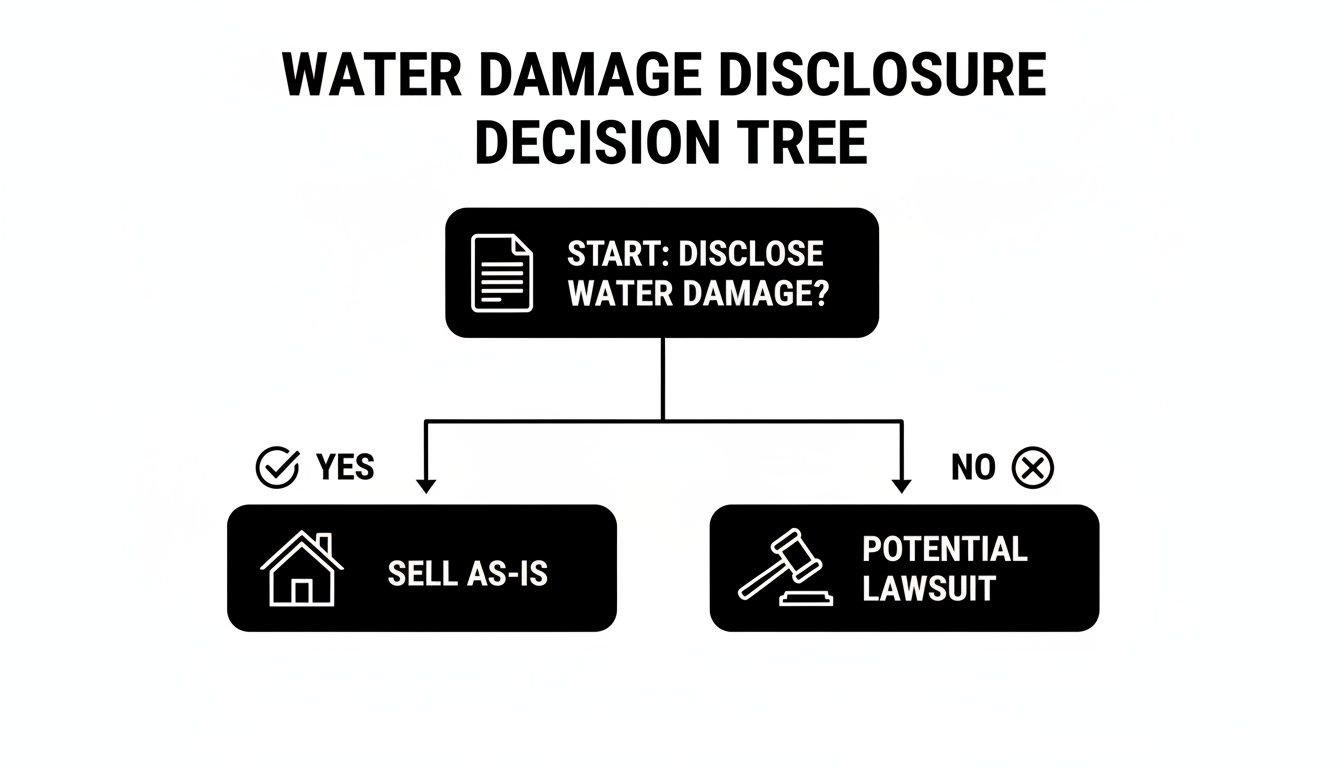
As you can see, the safe and direct route is to disclose the damage and sell the property as-is. Trying to hide it just opens you up to a world of legal and financial pain down the road. It's not worth the risk.
The Certainty of Selling As Is
Now, let’s talk about the other path: selling your house as is. For homeowners who need to be done with a problem property, this option is a lifeline. It's the perfect solution for tough spots—a sudden military PCS, inheriting a house you can't manage, a divorce, or trying to avoid foreclosure.
Selling as-is means exactly what it says. You make zero repairs. You don't touch the damaged drywall, you don't call a mold company, and you don't replace that warped flooring. You sell the house in its current, imperfect condition.
A lot of people think "as-is" automatically means you’re taking a massive financial hit. The truth is, you're trading a potential higher price for a guaranteed sale. You're also sidestepping thousands in repair costs, agent commissions, and holding costs. It's about your final net profit and, just as importantly, your peace of mind.
Working with a local cash home buyer like us at DIL Group Buyers makes the process incredibly simple.
- You Reach Out: A quick phone call or filling out a form is all it takes to get started.
- We See the Property: We’ll schedule a quick, no-pressure walkthrough to see the damage firsthand.
- You Get a Fair Cash Offer: We’ll give you a no-obligation cash offer that already accounts for the needed repairs.
- You Pick the Closing Date: You're in control. We can close in as little as 7-14 days, or on whatever timeline works for you.
This approach gets rid of all the biggest headaches. No last-minute cleaning for showings. No stressful back-and-forth with picky buyers. And zero risk of the deal collapsing because a bank's appraiser doesn't like the look of the place. You can read our detailed guide to understand more about how to sell your house as-is.
For so many homeowners I work with, this is simply the most logical move. It lets you protect your credit, get cash out of an asset quickly, and finally move on with your life without a damaged property weighing you down.
How the Cash Home Buyer Process Works

When your house has water damage, the last thing you want is the headache of a traditional sale. The showings, the nit-picky buyers, the deals that fall through because of financing—it’s exhausting. Selling directly to a cash home buyer cuts right through all that noise. It's a simple, fast alternative.
I talk to homeowners all the time who think selling for cash must be complicated, especially if they're dealing with a military PCS from Fort Bragg or inherited a home in a town like Stedman. The truth is, it’s the exact opposite. It's a straightforward process that we've boiled down to a few transparent steps.
The First Step A Simple Conversation
It all starts with you reaching out. Give us a call, send a text, or fill out the form on our website. That's it. No pressure, no commitment.
That first chat is just for us to get a handle on your situation and the property. We'll ask about the water damage, the general condition of the house, and what you’re trying to achieve. It’s a simple fact-finding conversation to see if we’re a good fit to help you.
The Walkthrough and Offer
Next, we’ll set up a time to swing by the property. This isn't one of those high-stress, white-glove inspections where someone picks your house apart with a clipboard. It’s just a quick walkthrough so we can see the extent of the water damage and get a sense of the repairs needed.
Don’t worry about cleaning up. We’ve seen it all—from small ceiling stains to full-blown flooding—and we know exactly what we’re looking at. We evaluate the home in its current "as-is" condition.
Soon after that visit, you’ll get a firm, no-obligation cash offer from us. The offer is straightforward: it’s the value of your home, minus the cost of the repairs we’re taking on. It’s a guaranteed number, so you don't have to worry about games or last-minute changes.
Our offer is our promise. Unlike retail buyers who often try to chip away at the price after an inspection, what we offer is what you get at the closing table. It’s a clean path forward, free from the typical back-and-forth of a market sale.
The cost of water damage is no joke. Between 2017 and 2021, the average insurance claim for water damage was over $12,500, and it adds up to a staggering $13 billion problem for U.S. insurers every year. For a home in Cumberland County, that kind of damage can sink its value and scare off most buyers. We step in and take on that risk, just like we have for over 150 homeowners from Fayetteville to Eastover. You can read more about the financial impact of water damage claims to see why this is such a hurdle on the open market.
Closing On Your Timeline
Once you accept our offer, you’re in the driver's seat. You pick the closing date.
- Need cash fast? We can close in as little as 7-14 days. This is perfect for people facing foreclosure or needing to move for a new job.
- Need more time? No problem. If you need a few weeks or even a month to get things sorted, we’ll schedule the closing for whatever date works for you.
We handle all the paperwork with a trusted local attorney. There are no agent commissions, no hidden fees, and no closing costs for you to pay. The offer you accept is the cash you walk away with, period. For many sellers we work with, especially those out-of-state, this is a total game-changer. You can learn more about how our local cash home buyer process works and see just how simple it is. It’s a reliable, stress-free way to sell a house with water damage.
Common Questions About Selling a Damaged Home
When your home is hit with water damage, your head is probably swimming with questions. It's a stressful, uncertain time. We get it. Here in North Carolina, especially around Fayetteville and Hope Mills, we hear the same crucial questions from homeowners over and over.
Let's cut through the noise and get you the straightforward answers you need.
What if My House Has Mold from the Water Damage?
The short answer? Yes, you can still sell it. A lot of people think a house with mold is impossible to sell, but that's just not true.
The most important thing to remember is full and honest disclosure. In North Carolina, you’re required to let potential buyers know about any known mold issues on the Residential Property Disclosure Statement. No hiding it.
Now, telling a typical homebuyer about a mold problem will send them running. Their lender will likely kill the deal anyway. But this is exactly where a local cash buyer is your best bet. For a company like DIL Group Buyers, mold isn't a deal-breaker—it's just part of the job. We factor the cost of professional remediation right into our cash offer, and we take the entire problem off your hands.
Do I Have to Fix Anything Before I Sell to a Cash Buyer?
Nope. Not a single thing. And for most people, this is the biggest sigh of relief.
When you sell your house "as-is" to a cash buyer, it means exactly what it sounds like: we buy it in its current condition, water damage, mold, and all. You don’t make any repairs.
We’ll do one quick walkthrough to see the extent of the damage. From there, our cash offer is based on what the house could be worth, minus the cost of us doing all the work. You don't have to manage contractors, worry about surprise costs, or spend a single dollar you don't have.
Key Insight: Selling "as-is" isn't just about saving money on repairs. It's about eliminating the risk of unknown costs. Once you start tearing out walls, you never know what else you'll find. A cash sale takes that entire gamble off the table for you.
How Fast Can This Actually Happen in Fayetteville?
Dramatically faster than you'd think. A traditional sale for a water-damaged home can take months, filled with failed inspections and picky buyers whose banks won't approve a loan on a damaged property. It's a slow, painful waiting game.
With a cash sale, we're talking days or weeks. Here's what it usually looks like:
- You call us or fill out our form: Day 1
- We walk through the property: Usually within 24-48 hours
- You get a no-obligation cash offer: The very same day as our walkthrough
- We close the deal: In as little as 7 to 14 days after you accept.
The best part is that you’re in the driver's seat. If you need more time to pack or figure out your next move, we can set the closing for whatever date works for you. That kind of flexibility is a game-changer, especially for military families dealing with a PCS or anyone on a deadline.
Is a Cash Offer for a Damaged House Just a Lowball Offer?
A cash offer will be less than what you’d get for a perfect, fully renovated house on the open market. That's just a fact. The offer has to account for all the repair costs, holding costs, and risk we’re taking on.
But thinking of it as "low" is the wrong way to look at it. You have to compare what you actually walk away with.
Let's run the numbers.
| Financial Factor | Traditional Sale with Repairs | "As-Is" Cash Sale |
|---|---|---|
| Sale Price | $250,000 (Market Value) | $190,000 (Cash Offer) |
| Repair Costs | -$15,000 | $0 |
| Realtor Commissions | -$15,000 (6%) | $0 |
| Holding Costs (3 mo.) | -$4,500 | $0 |
| Seller Concessions | -$5,000 | $0 |
| Net Profit | $210,500 | $190,000 |
When you subtract the repairs, commissions (we don't charge any), and months of mortgage payments, the gap between the two numbers shrinks fast. For many homeowners, the small difference in net profit is well worth the speed, certainty, and complete lack of stress.
If you're ready to bypass the stress, repairs, and uncertainty of selling a house with water damage, DIL Group Buyers can help. Get a fair, no-obligation cash offer and close on your timeline. Visit us at https://dilgrouphomebuyers.com to get started.