
Before you can even think about selling an inherited house, there's a legal hurdle you have to clear first: probate. This is the critical first step. In North Carolina, you must get the home's title legally transferred into your name. Until that's done, you can't list the property, you can't make repairs, and you definitely can't accept any offers.
Navigating the Initial Steps of an Inherited Property
Inheriting a property in Fayetteville or Hope Mills can feel like being thrown into the deep end. One minute you're dealing with the loss of a loved one, and the next, you're a property manager—often from hundreds of miles away. The first and biggest challenge is a legal one. You need the court's permission to sell the home. Without it, your hands are tied.
This first phase is all about the probate process. It’s how the Cumberland County Clerk of Court validates the will and makes sure the estate is settled correctly. If there’s a will, your main job is to get formally appointed as the executor.
Your Initial Inherited Property Checklist
Getting started can feel overwhelming. This checklist breaks down your immediate first actions into manageable steps, telling you exactly what to do and why it matters here in Cumberland County.
| Action Item | Why It's Important | Where to Go in Cumberland County |
|---|---|---|
| Locate the Will | This document is the roadmap for the entire process and names the executor. | Check personal files, safe deposit boxes, or with the deceased's attorney. |
| Secure the Property | Prevent vandalism, squatters, and liability by changing locks and ensuring the home is secure. | A local locksmith and your own regular check-ins are key. |
| Contact an Attorney | An estate attorney can save you from costly mistakes and guide you through the probate filing. | Look for a reputable estate planning attorney in the Fayetteville area. |
| Notify Utilities | Keep the lights and water on to prevent damage (like burst pipes) but transfer billing. | Contact PWC in Fayetteville or your local municipal provider. |
Taking these first steps protects the asset and sets you up for a smoother process, whether you decide to keep, rent, or sell the house.
Securing Your Role as Executor
Just because the will says you're the executor doesn't mean you can start making decisions. You have to go to the courthouse and make it official.
You’ll petition the court, and once they approve you, they issue "Letters Testamentary." This piece of paper is your golden ticket. It's the legal document that gives you the authority to act for the estate—paying bills from the estate's bank account, hiring agents, and, most importantly, selling the house.
What if there's no will? The court calls this "intestate." They will appoint an "Administrator," who is usually the closest living relative, to do the same job. Executor or Administrator, getting that legal authority is the only way to move forward.
This graphic breaks down those first legal hurdles for you.
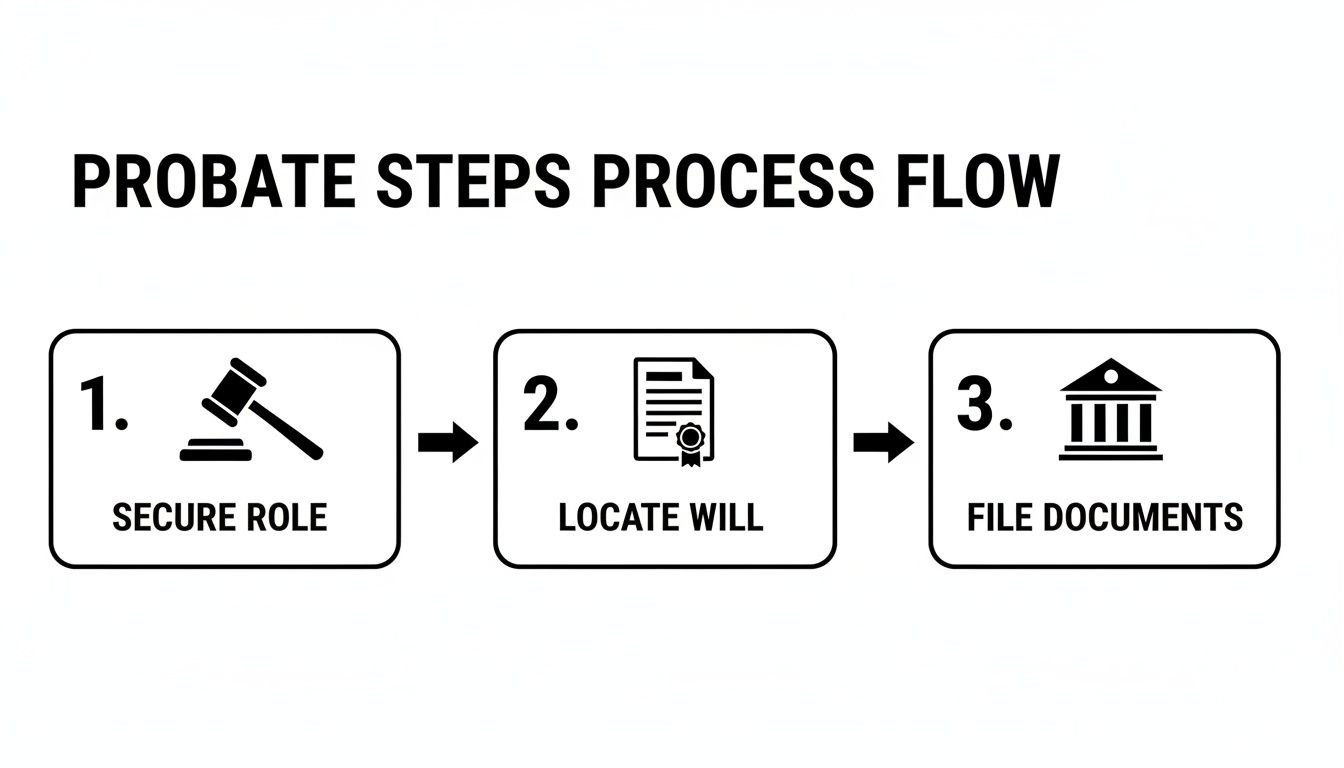
Getting these things right from the start ensures every action you take is fully authorized and legal.
Getting Organized and Keeping the Peace
Once you have the legal power, it's time to get all the paperwork together. We're talking about the deed, any mortgage statements, recent utility bills, insurance policies, and property tax records. Having everything in one place will make your life a hundred times easier when you start talking to attorneys, agents, or a cash buyer like us.
Pro Tip: Scan every single document and save it in a digital folder on your computer. If you're dealing with this from out of state or have siblings involved, being able to email everything instantly is a lifesaver.
This is also when you need to have honest talks with any other heirs. Money and property can bring out the worst in families. Getting everyone on the same page about what to do with the house early on can stop arguments before they start. A fair, straightforward cash offer often becomes the simple solution everyone can agree on. For more on this, check out our guide on navigating probate property sales in North Carolina.
The truth is, inheriting a house is a huge financial shock for most people. It's part of a trend called the Great Wealth Transfer. Experts at Cerulli Associates estimate a mind-boggling $124 trillion will be passed down by 2048, and a lot of that is real estate. But as Realtor.com reports, nearly 40% of heirs can't actually afford to keep the homes they inherit. They're hit with taxes, insurance, and repair bills they never expected, forcing them to sell inherited property fast.
Should You Repair or Sell Your Inherited House As-Is
So, the legal side is finally sorted out, and the house is officially yours. Now comes the biggest, most practical question you’ll face: do you sink your own money and time into fixing it up, or do you sell the inherited property exactly as it is?
This is the fork in the road. Your answer will dictate everything that comes next—your timeline, your out-of-pocket costs, and frankly, your stress level.
On paper, renovating sounds like a no-brainer to get a higher price. But in reality, especially with the older homes we see all over Cumberland County in places like Spring Lake or Stedman, it’s a whole different ballgame. It's rarely as simple as a weekend trip to the hardware store.
The Real Costs of Renovating an Inherited Home
Let’s be honest. Taking on a renovation for an inherited house, especially if you’re not living in Fayetteville, is a huge project. That budget you wrote down on a napkin? You can probably double it. Homes that have been loved and lived in for decades are notorious for hiding expensive secrets behind their walls.
It happens all the time. You decide to do a simple cosmetic refresh—a little paint, some new flooring. But the moment your contractor pulls up that 1980s carpet, they find termite damage chewing through the subfloor. Just like that, your quick $5,000 facelift has turned into a $15,000 structural nightmare.
We’ve seen it countless times. Here are a few "gotchas" you absolutely have to plan for:
- Getting up to code. That old house might have plumbing and electrical systems that were fine in their day but won't pass a modern inspection. Bringing everything up to current Cumberland County building codes can mean a total, and very expensive, overhaul.
- Managing from a distance. If you're out of state, you're either paying a project manager a hefty fee or trying to wrangle contractors over the phone. That’s a recipe for delays, miscommunication, and costs spiraling out of control.
- The cost of "empty." While the house is sitting vacant during all this work, you're still on the hook for utilities, property taxes, and pricey vacant property insurance. Those carrying costs bleed you dry, adding up to thousands over just a few months.
Before you even think about picking out paint colors, you need a brutally honest assessment of what that house really needs to be sellable on the open market.
The Financial Toll of an Uncertain Market
Here’s the toughest pill to swallow: even after pouring your heart, soul, and savings into repairs, there's zero guarantee you'll get that money back. The traditional real estate market is fickle. You could drop $30,000 on a beautiful new kitchen and roof, only for the market to take a downturn or for the official appraisal to come in way under what you expected.
A renovation only adds value if it’s something buyers in that specific neighborhood are actually looking for. We see heirs make this mistake all the time—they over-improve a house for its location because they don't know the local market.
Think about this scenario, which we see play out often: an heir invests $40,000 to update their parents' 1970s ranch in Hope Mills. They list it for sale, but it just sits. After three long months and two price drops, the best offer they get only nets them $15,000 more than they could have gotten from an as-is cash offer months ago.
Factor in the renovation costs, holding costs, and realtor commissions, and they actually lost money on the deal. Not to mention the months of stress.
The Simplicity of Selling Your Inherited Property As-Is
Choosing to sell an inherited property as-is gives you something the other path can’t: certainty.
It’s a straight-line, predictable process. When you work with a cash home buyer like DIL Group, the offer we make is the cash you get. Period. There are no last-minute repair demands from picky buyers, no deals falling apart because of a low appraisal, and no agonizing months of waiting.
This route offers immediate relief from the weight of owning a property you never asked for. You get to skip:
- The headache of managing and funding a renovation.
- The gamble of a volatile real estate market.
- The slow drain of taxes, insurance, and utility bills.
- The 6% realtor commissions and closing costs.
For most heirs we talk to, who are already juggling their own jobs, families, and finances, that peace of mind is priceless. It allows you to close this chapter with dignity and move forward, free and clear.
Understanding Tax Obligations When Selling
Let's talk about the big one: taxes. I see this worry with almost every family I work with who has inherited a property. The fear of a massive tax bill can be paralyzing, but I have good news. The reality is usually much less scary than you think.
First, take a deep breath. Here in North Carolina, we do not have an inheritance tax or an estate tax. That’s a huge deal. It means the state won’t take a cut just because the property was passed down to you.
You are, however, on the hook for property taxes from the day you inherit the house until the day you sell it. This is exactly why a quick, clean sale is so important—it stops that meter from running and keeps more cash in your wallet.
The Power of Stepped-Up Basis
Now for the most important tax rule you need to know. It's called the "stepped-up basis," and it's a federal tax benefit that can save you a fortune.
Here’s how that plays out. The "cost basis" of the home is "stepped up" to its fair market value on the date the original owner passed away. This new value is your starting point for calculating profit.
Let's use a real-world Fayetteville example. Say your parents bought their home for $50,000 back in the day. At the time of your inheritance, the home is now worth $220,000. That $220,000 is your new basis. If you turn around and sell it quickly for $225,000, you only have a $5,000 profit to worry about for capital gains taxes.
The key takeaway? You are not taxed on the decades of appreciation that happened while your parents owned the home. This rule is designed specifically to help heirs avoid a devastating tax hit.
This is exactly why selling fast makes so much financial sense. The less time that passes between inheriting and selling, the less the property's value is likely to increase, which keeps your potential tax bill at a minimum. We cover this in much more detail in our guide to inherited house tax consequences.
Why Heirs Are Selling Now
The current housing market is putting a lot of pressure on families. The reality is, most people can't afford the insurance, property taxes, and constant upkeep on a second home. This is causing a flood of inherited houses to hit the market.
Research actually shows that a jump in local inheritance directly leads to more homes for sale, sometimes even cooling prices a bit because of the extra inventory. One study pointed out how tax rules, like the 15% capital gains tax on certain properties, push heirs to sell.
Ultimately, knowing these tax rules puts you in the driver's seat. You know North Carolina isn't coming for an inheritance tax, and you know the stepped-up basis protects you from massive capital gains.
For many people in this situation, the answer becomes obvious. Selling the house "as-is" to a cash buyer like DIL Group is the most direct path. It gives you a fast closing, which stops the carrying costs and minimizes your tax exposure. It's clean, simple, and lets you move forward.
Why a Cash Offer Is Your Best Move for an Inherited House

When you've inherited a property, especially one that's far away or needs a ton of work, the traditional real estate market is a minefield. Listing with an agent means you're signing up for months of showings, last-minute repair demands, and deals that fall through. For most heirs, it’s a headache you just don’t need.
This is where a local cash home buyer like DIL Group comes in. We offer the most direct path to getting that property off your hands. Yes, it’s fast. But the real value is skipping all the costs, fees, and nonsense that make a typical sale so draining.
Selling for cash gives you a clean break. We see it all the time—a family in Fayetteville inherits a house with a reverse mortgage, or they discover years of unpaid property taxes. In these situations, a fast, guaranteed cash sale isn't just convenient. It's a lifesaver.
Traditional Sale vs Selling to a Cash Buyer
It's crucial to understand the two very different paths you can take. One is slow and expensive; the other is fast and certain. Here’s a quick breakdown of what you can expect when selling an inherited house.
| Factor | Traditional Market Sale | Selling to a Cash Buyer |
|---|---|---|
| Timeline | 3-6 months (or longer) | 7-14 days |
| Repairs | Often required by buyers | None. We buy "as-is" |
| Commissions | 5-6% of the sale price | 0%. No realtor fees |
| Closing Costs | Seller pays 1-3% | We pay them for you |
| Certainty | Deals fall through (financing, inspections) | Guaranteed sale. No contingencies |
| Showings | Multiple showings, open houses | One quick walkthrough |
As you can see, the choice is clear if you value speed, certainty, and keeping more money in your pocket. A cash sale eliminates the guesswork and gets you to the finish line without the runaround.
Keep Your Money: Skip the Commissions and Closing Costs
One of the biggest shocks for sellers is how much money disappears before it ever hits their bank account. Standard realtor commissions are 5-6% of the sale price. For a $200,000 house, that’s $12,000 gone, just like that.
Then you have the seller's closing costs, which add another 1-3% to the bill. All of a sudden, you're walking away with $15,000 to $18,000 less than you thought.
A cash sale with us means zero commissions and zero fees. We even cover the closing costs. The offer you accept is the money you get. Period.
This makes everything simple, especially when there are multiple heirs. A clear, all-cash number means no arguments over confusing settlement statements. It’s fair and straightforward.
Certainty in an Uncertain Process
The open market is filled with "what-ifs." The buyer's loan gets denied. The appraisal comes in low. These issues are a pain for any seller, but they're a nightmare when you're trying to manage an estate from out of state.
A cash offer from us cuts through all that. We use our own funds, so there’s zero risk of financing falling through. We buy houses in any condition, so we don’t waste time with bank appraisals. The sale is guaranteed.
This is a game-changer if you don't live in the area. Forget flying back to Fayetteville to deal with agents and contractors. You can handle the entire sale right from where you are. Get a fair offer, sign the papers, and get your cash. Working with a dedicated cash home buyer in the Fayetteville area is built for simplicity.
The Power of an "As-Is" Sale
"As-is" isn't just about avoiding repairs. It's about solving real-life problems, instantly. We deal with these situations every day:
- Problem Tenants: Inherited a house with a tenant who won't pay or leave? The eviction process is a legal and financial nightmare. We buy the house with the tenant still in it and take on the problem.
- Hoarder Houses: The home is filled to the ceiling with stuff, making it impossible to even walk through, let alone show. No problem. Take what you want and leave the rest. We’ll clean it out.
- Foreclosure Looming: The mortgage on the inherited house is behind, and the bank is starting foreclosure. A cash sale can close in as little as 10 days, paying off the bank and protecting your family’s credit.
Over the next decade, an estimated $2.4 trillion in property will be passed down to the next generation, according to a report from Coldwell Banker Global Luxury. For many in communities like Hope Mills or Raeford, that "inheritance" is a problem property with liens and damage. As you can learn from reading about these trends from experts on heirs and the market on Realtor.com, a traditional sale just isn't an option for many.
When you sell inherited property to a cash buyer, you're not just selling fast. You're making a smart choice to trade the stress and expense of the open market for a guaranteed, hassle-free solution.
The Simple Closing Process with a Cash Buyer

Alright, you've accepted our no-obligation cash offer for your inherited house. So, what's next? The "closing process" can sound like a headache, but when you work with us, it’s the easiest part of the whole deal. This is where we take the wheel, and you can finally relax.
Forget everything you’ve heard about traditional sales. There are no buyers to impress, no banks to wait on, and zero last-minute drama over appraisals. The second you say "yes," our only mission is getting cash in your hand on your schedule. It’s a straight, simple path to being done.
Your Flexible Closing Timeline
The biggest relief when you sell an inherited property for cash is that you’re in the driver's seat. We work completely around your family’s needs. There’s no one-size-fits-all timeline here.
We see all kinds of situations here in Fayetteville and the surrounding communities:
- Need to close fast? If you've got bills piling up or just need the money now, we can get it done. We often close in as little as 7-10 days because the cash is ready to go. No waiting for loan approvals.
- Need more time? We get it. Many families need a month or more to sort through a lifetime of memories and belongings. That's no problem at all. We can set a closing date 30, 60, or even 90 days from now to give you the breathing room you need.
You tell us the date. Our goal is to take the pressure off, not add to it.
This flexibility is something you just can't get on the traditional market. With a typical buyer, their lender calls all the shots. With a cash sale, you are in 100% control of the calendar.
Handling the Paperwork and Title Search
Once you accept the offer, our team gets to work right away with a trusted local real estate attorney to handle all the legal stuff. You don't have to worry about finding the right lawyer or trying to figure out complicated paperwork, especially if you’re handling this from another state.
First thing the attorney does is a title search. This is a standard check to make sure the property is free and clear of any surprises, like old liens or ownership disputes. If something small pops up, our team knows exactly how to handle it and keep things moving without delays.
Next, we’ll send you a simple purchase agreement. It’s a straightforward contract that lists the sale price and the closing date you chose. No confusing jargon or tricky clauses. We believe in being transparent, and we’re always here to walk you through every single line if you have questions.
The Final Signing and Getting Paid
The last step is the closing itself, and we make it as convenient as possible. If you live out of town, you don’t have to travel back to Fayetteville. The closing attorney can email or overnight the documents for you to sign with a notary right in your own city. It really is that easy.
Once you send back the signed paperwork, the funds are wired directly into your bank account or sent as a certified check. It's a clean, official transfer.
You get your cash, and you can finally walk away from the property—free and clear. No more property taxes, no more insurance bills, and no more worrying about maintenance. The whole process is built to help you close this chapter and move forward.
Common Questions About Selling an Inherited Home
When you inherit a property, the questions start piling up. It can feel like a maze of legal papers and tough decisions, especially when you're dealing with a loss. We get it. Families across Cumberland County, from Fayetteville to Hope Mills, ask us the same things every day.
We're here to give you straight answers. These aren't just textbook scenarios—they're the real challenges you're facing right now.
What if Multiple Heirs Disagree on Selling
This is the toughest one we see, and it happens all the time. One sibling wants to keep the house, another wants to rent it, and you just want to sell. When heirs can’t find common ground, everyone loses. The house just sits there, bills add up, and the family tension gets worse.
Trying to talk it out is the first step, but it doesn't always work. If you're stuck, you have a couple of legal paths, but they aren't great.
- A Buyout: One heir can try to buy out the others. This is tough because it means they need a lot of cash or have to qualify for a new loan on their own.
- A Partition Action: This is a lawsuit to force the sale of the house. It works, but it’s expensive, slow, and can seriously damage family relationships. Think of it as the last resort.
A fair cash offer often breaks the deadlock. It puts a real, solid number on the table for everyone to see. Suddenly, it’s not an emotional fight—it’s a simple business decision. It gives every heir a clean break and their fair share of the cash without any more conflict.
Can I Sell an Inherited House with a Mortgage
Yes! This is a very common situation. You do not have to pay off the mortgage before you can sell. The process is simple and handled for you at closing.
When you sell the property, the existing mortgage balance is paid off directly from the sale money. The closing attorney takes care of everything. They get the final payoff amount from the bank and settle the debt.
Whatever money is left over goes straight to you and the other heirs. A fast cash sale with us means you know there’s enough money to cover the mortgage and you can walk away without ever making a payment from your own pocket.
How Is a Cash Offer for an Inherited Property Determined
We believe in being 100% transparent. When you sell to a cash buyer like DIL Group, you skip the slow bank appraisals and waiting games. Our offer is based on a simple, real-world formula.
We look at a few key things to give you a fair cash offer:
- Location: Where the home is located in Cumberland County or nearby areas like Raeford or Stedman.
- Current Condition: We look at the house “as is.” That includes the roof, HVAC, foundation, and anything else that needs work.
- Repair Costs: We estimate what it will cost to fix and update everything to get the house ready for a new owner.
Our offer is the property's potential value after it’s all fixed up, minus our estimated repair costs and business expenses. This lets us give you a fast, guaranteed price that reflects the home's true condition today. No guesswork, no waiting.
Are you ready to stop worrying and get a clear, guaranteed cash offer for your inherited house? The team at DIL Group Buyers can give you a no-obligation offer and close on your schedule, letting you finally move forward. Get Your Free Cash Offer Today