
When a loved one passes away, the house they leave behind becomes a probate property. This just means the sale is handled through the court system to make sure all their debts are paid off and whatever is left goes to the right family members or heirs. The whole process is managed by a court-appointed person, usually called an executor or administrator.
Your First Steps as an Executor in a Probate Property Sale
Being named the executor of an estate is more than just a title—it's a heavy responsibility. You're balancing the grief of losing someone with a long list of legal tasks. If a house is involved, things get even more complicated. You’re not just a grieving family member anymore; you're legally in charge of what's probably the biggest asset in the estate.
This gets especially tough for folks trying to manage a sale from another state, which happens all the time with military families around Fayetteville and Hope Mills.
The very first things you do will shape how the entire probate sale goes. Your top priority? Secure the property. This isn't just about locking the doors. It means changing the locks, getting the mail forwarded, and making sure the house is safe from break-ins or just falling into disrepair. An empty house is an easy target.
Next, you have to start the tedious work of creating an inventory of everything in the home. We're not talking about sentimental value here; this is for the court's official record. From the dining room table to the jewelry in the bedroom, every major item has to be listed and, if needed, formally appraised. This list is a critical piece of the paperwork you'll file with the North Carolina probate court.
Understanding Your Core Fiduciary Duties
As an executor, you have what's called a fiduciary duty. That's a fancy legal term for a simple concept: you must always act in the best interest of the estate and the people inheriting from it. Every single decision you make has to be guided by this principle. It's not about what's easiest for you; it's about what best serves the will and the heirs.
This duty breaks down into a few key areas:
- Managing Assets: You're responsible for taking care of all the estate's assets, especially the house. That means keeping up with the mortgage, property taxes, insurance, and utilities until it's sold. If you let these things slide, you can create huge legal and financial headaches.
- Paying Off Debts: Before any money can be handed out to the heirs, all the deceased's legitimate debts have to be settled. This could be anything from a mortgage and credit card bills to final medical expenses. The money from the probate property sale is typically used to clear these debts.
- Keeping Everyone in the Loop: It’s absolutely crucial to communicate clearly and regularly with all the beneficiaries. Letting them know what's happening can prevent a lot of arguments and mistrust down the road.
A big mistake I see executors make is waiting to sell, thinking the market might get better. But the carrying costs of an empty house—insurance, taxes, upkeep, utilities—can drain an estate by thousands of dollars every month. A quick, decisive sale almost always puts more money in the heirs' pockets in the end.
Facing the Reality of the Probate Timeline
You need to be realistic about how long this is all going to take. The probate process here in North Carolina is not a sprint. A simple, straightforward case can easily take nine months to a year, and if there are any complications, it can drag on much, much longer.
This timeline is a huge factor when you're deciding how to sell the house.
Listing a home the traditional way with a real estate agent can add even more months to an already long process. You have to think about making repairs, staging the home, dealing with showings, and then hoping a buyer's financing doesn't fall through at the last minute. For many executors, especially those living out of state, that's just not practical.
The constant delays and mounting expenses are exactly why so many people in this situation decide to look for a more direct way to sell, clearing the path for a faster and more predictable outcome for everyone involved.
Navigating the North Carolina Probate Court Process
Once you've secured the property and started taking stock of everything, the next step is diving into the formal North Carolina court process for the probate property sale. I know this part sounds intimidating, with all its legal jargon and deadlines, but breaking it down makes it much easier to handle, even if you're not in the state.
Think about a situation we see all the time. An adult child, serving in the military overseas, finds out their parent has passed away back home in Fayetteville. They’re the executor and now have to figure out how to sell the family house near Fort Bragg from thousands of miles away. This isn't just an example; it’s a reality for so many people.
Their first official move is filing the original will with the Clerk of Superior Court in the county where their parent lived—in this case, Cumberland County. That single action is what formally kicks off the probate case.
Getting Your Official Authority to Act
After the will is filed, you can't just start making decisions. You need the court to officially grant you the power to manage the estate. The document that does this is called Letters Testamentary.
Think of it as your official ID badge as the executor. Without it, you have zero authority. You can't open an estate bank account, you can't pay bills with the estate's money, and you definitely can't list or sell the property.
To get your Letters, you'll submit an application and take an oath, promising to do your job faithfully. For our military member stationed abroad, this usually means hiring a local North Carolina attorney to handle the filings. It's a very common and smart move for any out-of-state executor.
Key Takeaway: The Letters Testamentary are absolutely essential. Don't even think about trying to sell the property before this document is in your hands. It will only create a mess of legal problems and long delays.
The Critical Notice to Creditors
Okay, so you have your Letters Testamentary. What’s next? You have a legal duty to let any potential creditors know that the person has passed away. This isn't a suggestion—it's a requirement to make sure all legitimate debts are handled.
It's a two-part process:
- Direct Notice: You have to mail a formal notice to any creditors you know about or could reasonably find.
- Public Notice: You’re also required to publish a notice in a local newspaper. This typically runs once a week for four straight weeks.
This publication starts a countdown. Creditors usually have 90 days from the date the first notice is published to make a claim against the estate. If you mess this step up, you could end up being personally on the hook for unpaid debts. It's crucial to get it right.
This infographic lays out the core duties you'll be handling.
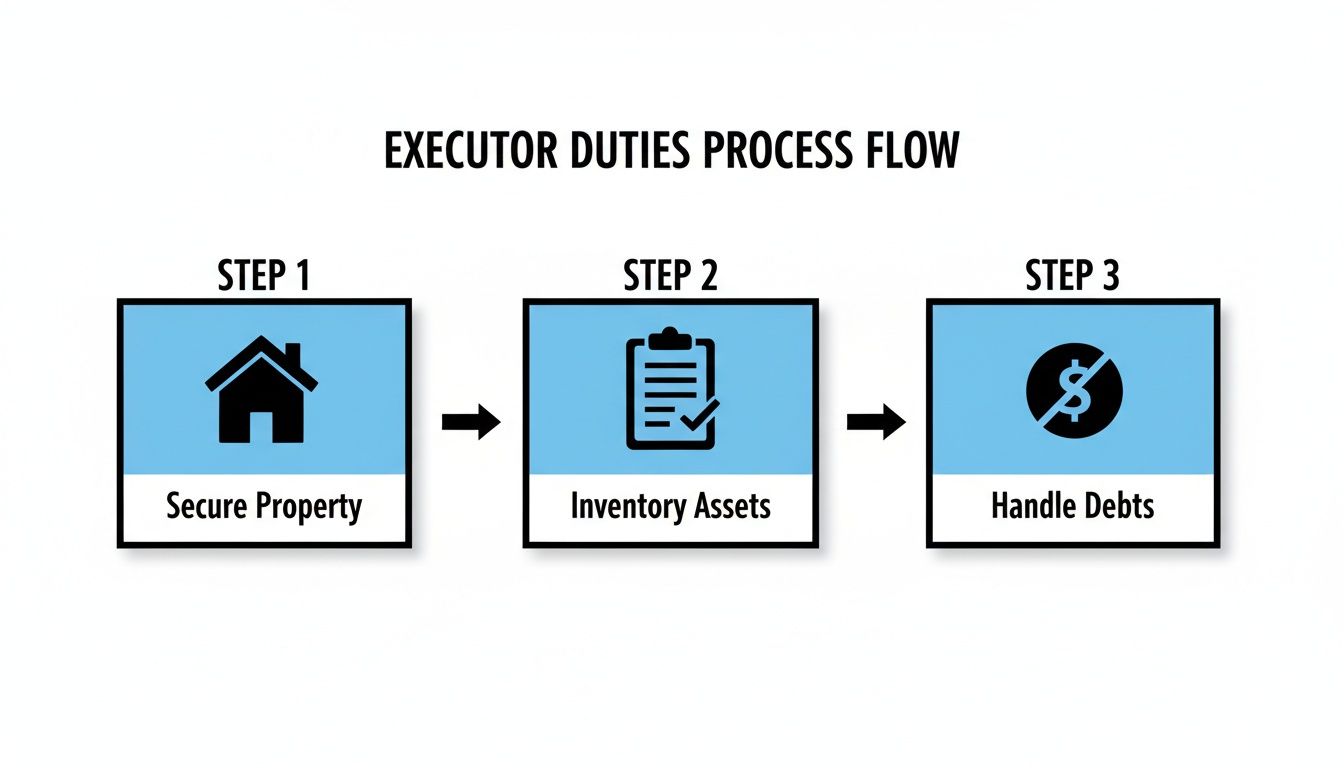
As you can see, dealing with debts is just as important as securing the property and creating an inventory.
Filing the Inventory and Closing Things Out
Within three months of getting your Letters, you have another deadline: filing a detailed inventory of the estate's assets with the court. This form, called the "Inventory for Decedent's Estate," is a complete list of everything the deceased owned—the house, bank accounts, cars, everything—with its value on the date of their death. For the house, you'll likely need to get a formal appraisal.
Finally, after all the assets are gathered, the debts are paid, and the property is sold, you'll submit a final accounting to the court. This is basically a detailed spreadsheet showing every dollar that came in and every dollar that went out. Once the Clerk of Court gives it the green light, you can distribute the remaining money to the heirs and officially close the estate. Your job as executor is done.
Choosing the Right Way to Sell an Inherited Home

As the executor, one of the biggest decisions you'll face in a probate property sale is deciding how to actually sell the home. This one choice has a massive impact on the timeline, the costs, and the stress level for everyone involved.
You have to ask yourself: what’s the main goal here? Are you chasing the highest possible price, no matter how long it takes? Or is a fast, clean closing more important? Maybe you just want the path of least resistance.
Each option has its pros and cons, especially for inherited properties right here in Fayetteville, which often come with their own set of challenges. Let's walk through the three main ways you can sell an inherited home.
The Traditional Real Estate Agent Route
This is what most people picture when they think about selling a house. You find a local agent, stick a sign in the yard, and list it on the market. Then comes the parade of showings, offers, negotiations, and inspections.
If the house is in perfect, move-in-ready shape, this method can sometimes get you top dollar. But let's be realistic—that's rarely the case with probate properties.
More often than not, an inherited house needs a lot of work just to be competitive. As the executor, you're stuck deciding whether to sink estate funds into costly renovations or take a major hit on the price.
Plus, this route is loaded with uncertainty. Deals fall through all the time because of a buyer's financing, a low appraisal, or a home inspector who finds a dozen things to argue about. Every delay means more holding costs—taxes, insurance, upkeep—chipping away at the inheritance.
Court-Supervised Auctions
Sometimes, the court steps in. This usually happens if there are major disagreements among the heirs or if the will doesn't give the executor the "Power of Sale." The court then orders a public auction to sell the property.
The good thing about an auction is that it's transparent and final. The sale happens out in the open, and once the gavel drops and the court gives its blessing, the deal is done. It's one way to cut through family drama and let the market decide the price.
The downside? Auctions are a gamble. You might not get the best price. The bidders are often seasoned investors looking for a deep discount, and the final sale price can easily be 10-20% below what you might get otherwise. On top of that, you’re adding more court dates and legal paperwork to an already complicated probate process.
Selling Directly to a Cash Home Buyer
There’s a third option that’s become a go-to for executors who value speed, certainty, and simplicity: selling directly to a cash home buyer. This path lets you sidestep nearly all the headaches of a traditional sale or auction.
The biggest advantage is that cash buyers purchase properties "as-is." This is a game-changer. You don’t have to clean out decades of belongings, fix the leaky roof, or update the 1970s kitchen. The buyer handles all of it.
Executor's Insight: The power to sell "as-is" can’t be overstated. It means you can close the estate and distribute the funds without spending a dime on repairs that might not even pay off. You get a fair cash offer and simply move on.
This approach is also incredibly fast. A cash buyer can typically make an offer within 24 hours and close the deal in just a week or two. Compare that to the months a traditional sale can drag on. That speed stops the bleeding from holding costs and gets money into the hands of the heirs when they need it.
If you're curious about the specifics, our team put together a detailed guide on how to sell inherited property with as little friction as possible.
To make it even clearer, let’s look at how these three methods stack up against each other.
Comparing Methods for Selling a Probate Property
Making the right choice depends entirely on your specific situation—the condition of the property, the urgency of the estate, and your tolerance for risk. This table breaks down the key differences at a glance.
| Factor | Traditional Realtor Sale | Court-Ordered Auction | Direct Cash Buyer |
|---|---|---|---|
| Timeline | 3-6+ months | 2-4 months | 1-4 weeks |
| Repairs | Almost always required | Not required | Never required |
| Commissions | 5-6% of sale price | Court and auctioneer fees | Zero commissions or fees |
| Certainty | Low (buyer financing, inspections) | High (court-approved) | Very High (guaranteed cash offer) |
| Convenience | Low (showings, staging, repairs) | Medium (court process) | High (no showings, sell as-is) |
For many executors in the Fayetteville area, especially those trying to manage an estate from another city or state, the benefits of a direct cash sale are hard to ignore. It cuts right through the biggest obstacles of a probate property sale—the repairs, the long waits, and the uncertainty—and gives you a clear, straightforward way to get the job done.
Managing the Financial Side of a Probate Sale
When you're tasked with selling a probate property, the final sale price is only part of the story. The real financial headache comes from the relentless hidden costs that start cropping up the minute the probate process kicks off. These expenses can quietly bleed an estate dry while the house just sits there, empty.
Think of yourself, the executor, as the temporary financial manager for the home. That means you’re on the hook for every single bill—and they don't stop just because the owner has passed away. These aren't just one-time fees; they are a constant drain on the estate's cash.
The True Cost of Waiting: Holding Costs
The longer a property is tied up in probate, the more it costs. These carrying expenses, what we call "holding costs," can snowball into a shocking amount over time.
You'd be surprised what a vacant probate property costs to maintain:
- Ongoing Mortgage Payments: The bank doesn't pause the mortgage. That bill is still due every month.
- Property Taxes: The county wants its money on schedule. Fall behind, and you risk penalties or even a tax lien on the house.
- Homeowners Insurance: Insuring a vacant home is almost always more expensive than a standard policy, but you can't skip it. It's your only protection against disasters like fire, vandalism, or someone getting hurt on the property.
- Utilities: Even an empty house needs power to keep pipes from freezing in the winter or to run a security system. Water and electricity aren't free.
- Maintenance and Upkeep: The grass keeps growing, gutters get clogged, and you never know when a pipe might burst. Someone has to pay for it.
These costs are a constant pressure. The average probate process can drag on for months, and every single one of those months means more money flowing out of the estate—money that should be going to the heirs.
How Probate Delays Destroy the Bottom Line
Time is your biggest enemy here. While some estates settle quickly, many get bogged down in legal holdups. Only about 20-30% of probate cases even involve selling a house, but when they do, the delays can easily stretch from 9 to 24 months.
During that time, it's not unusual for heirs to sink over $10,000 into just keeping the place afloat. Here in North Carolina's Cumberland County, we see it all the time—inherited homes with tax liens or damage from bad tenants. If you end up going the traditional court auction route, you can expect a sale price 10-20% below what the house is actually worth. On a $300,000 home, that’s a $30,000 to $60,000 loss.
Executor Reality Check: A fast sale isn't about getting a lowball offer; it's about stopping the financial bleeding. Selling directly to a cash buyer like us cuts off those holding costs immediately, preserving as much value as possible for the beneficiaries.
Don't Forget Your Tax Advantage: The Stepped-Up Basis
While the holding costs are a huge concern, there is one major financial upside to a probate sale that every executor needs to know about: the stepped-up basis. This is a critical tax rule that can save the estate a fortune in capital gains taxes.
It’s pretty straightforward. For tax purposes, the property’s value is "stepped up" from what the person originally paid for it to its fair market value on the day they died.
Let's say your parents bought their house for $50,000 years ago. By the time they passed, it was appraised at $250,000. That $250,000 becomes the new cost basis for the estate. If you turn around and sell it for that same amount, there is zero taxable gain. The estate only pays capital gains tax on any amount you sell it for above that new, stepped-up value.
This is an incredibly powerful tool, but its benefit shrinks the longer you let the house sit on the market. Understanding the tax side of things is key. If you want to dig deeper, you might want to check out our guide on whether North Carolina has an inheritance tax.
A Practical Guide for Out of State Heirs

Trying to manage a probate property sale is tough enough. Doing it from another state? That adds a whole new layer of stress and headaches. This is a reality for many military families connected to Fort Bragg, who suddenly find themselves the executor for a loved one's estate right here in North Carolina while they're stationed hundreds of miles away.
From a distance, even simple tasks can feel impossible. How do you make sure the property is secure? Who can you actually trust on the ground? How are you supposed to handle court filings and legal meetings without booking a flight every other week?
The secret is building a reliable local team and setting up a system to manage everything from where you are.
Building Your Local Support Team
Your first move—and your most important one—is to find a solid local estate attorney in the county where the house is. This person is much more than just a lawyer; they become your official representative in North Carolina, handling court filings and acting on behalf of the estate.
Don't just pick the first name you find in a search. You need someone who:
- Specializes in Probate: This area of law is a maze. You want an expert who knows it inside and out, not a generalist.
- Is Comfortable with Technology: Make sure they’re good with video calls, e-signatures, and sharing documents online. Smooth communication is everything.
- Has Dealt with Non-Resident Executors: They'll already know the specific hurdles you're facing and can guide you through North Carolina's rules for out-of-state representatives.
Once you have your legal expert, you need "boots on the ground" to deal with the physical property. This is where a local cash home buyer becomes your most valuable player. Instead of you flying in to handle inspections, repairs, or cleanouts, a company like DIL Group Buyers can be your local proxy. We can assess the property and manage the logistics so you don't have to.
Navigating probate from afar is all about delegation. Your job as a remote executor is to be the project manager, not the person swinging the hammer. Building a trusted local team is the single best investment you can make in a smooth, stress-free sale.
Creating a Remote Management System
With your team in place, it's time to get organized. Technology is your best friend here. Set up a secure digital folder on a platform like Google Drive or Dropbox to keep every important document in one place.
Your digital probate file should have:
- A scanned copy of the will
- The death certificate
- Your Letters Testamentary
- A running list of estate assets
- All emails and letters with your attorney and other pros
This central hub makes sure everyone—you, your lawyer, and anyone else involved—is looking at the same information. It's a simple move that prevents a ton of confusion and delays down the road.
For heirs living out of state but inheriting property in places like Fayetteville or Hope Mills, NC, probate can quickly become a nightmare of expenses. Did you know the property and casualty insurance sector has grown to include 4 million businesses, many catering to families with inherited homes? That's because probate often takes 12-18 months, and all that time the property is sitting vacant, racking up taxes and maintenance costs. You can see more on this from IBISWorld's market research.
The Advantage of a Local Cash Buyer
The sheer logistical strain of managing a property from another state is exactly why so many executors choose to work with a direct home buyer. It cuts through all the noise. You don't have to coordinate repairs, schedule showings, or negotiate with picky buyers who might demand all sorts of concessions.
If you want to understand this option better, we have a great resource that explains how companies that buy houses for cash work.
By partnering with a trusted local buyer, you turn dozens of difficult remote tasks into one straightforward transaction. We give you a guaranteed cash offer, buy the home "as-is," and can close whenever it works for you. This lets you fulfill your duties as executor efficiently, with minimal travel, saving the estate both time and money.
Common Questions About North Carolina Probate Sales
Going through a probate property sale in North Carolina brings up a ton of questions. It's a tough time—you're dealing with legal duties while also grieving. As an executor or heir, you just want straight answers so you can make the right moves.
This section tackles the most common concerns we hear from families every single day. We'll cut through the legal jargon and give you the practical advice you need to feel confident and keep things moving.
Can I Sell a House During Probate Without Court Approval in NC?
This is the big one—the question we get asked most. The answer comes down to one thing: the will.
If the will gives the executor the "Power of Sale," you can usually sell the property like any other home sale, without needing the court’s permission at every turn. It’s a much more direct process.
But, if the will doesn't mention a Power of Sale, or if there's no will at all (this is called dying intestate), you'll almost certainly need to go through the Clerk of Court to get permission. This means filing motions and possibly showing up for hearings, which can really slow things down. A good cash buyer knows how to work with either situation, making sure the sale stays on track no matter what the court requires.
How Long Does an Executor Have to Sell a Property?
North Carolina law doesn't set a hard-and-fast deadline, but you do have a legal responsibility—a fiduciary duty—to handle the estate promptly. Letting a house sit empty for months on end just isn't an option.
The longer a house sits, the more money it drains from the estate. Taxes, insurance, utilities, and upkeep can eat up thousands of dollars that should be going to the heirs. With most NC probate cases taking 9 to 24 months, selling quickly is key to protecting the estate's value and getting it closed.
Do I Have to Fix Up an Inherited House Before Selling?
Absolutely not. You are under no legal obligation to pour your own money or the estate's cash into renovations. In fact, most inherited homes are sold "as-is."
If you go the traditional route with a real estate agent, buyers will likely hit you with a list of requested repairs after the inspection. That can kick off a new round of stressful negotiations, unexpected costs, and major delays.
This is where selling to a cash buyer is a total game-changer. We buy properties exactly as they are. You don't have to lift a finger—or spend a dime—on repairs.
What if the Inherited Property Has a Mortgage or Liens?
It's really common for an inherited home to have some financial strings attached. Whether it's a mortgage, back taxes, or other liens, these debts have to be paid off before the property can officially belong to someone else.
Usually, all those debts get paid right out of the sale proceeds at closing. The title company manages the money, making sure every creditor gets paid what they're owed before the rest goes to the estate.
Experienced cash buyers deal with this all the time. We can make a fair offer that takes any existing debts into account and work directly with the title company to clear everything up. It makes for a clean, hassle-free closing for you and the estate.
At DIL Group Buyers, our specialty is making the probate sale process simple for executors and heirs. If you're dealing with these questions and just want a straightforward path forward, we can give you a guaranteed, no-obligation cash offer to help you close the estate fast.
Visit us at https://dilgrouphomebuyers.com to learn more.