
So, you need to file a quitclaim deed. The process itself seems simple on the surface: get the right form, fill it out, sign it with a notary, and file it with the county. But what you're really doing is transferring property interest without any guarantee that the title is clean. That’s a huge detail to understand before you dive in.
What a North Carolina Quitclaim Deed Actually Does

Before you even think about filling out a form, let's get one thing straight about what a quitclaim deed is—and more importantly, what it isn’t. Think of it as a quick and simple handoff. The person giving away the property (the grantor) is basically saying, "Whatever ownership I have in this property, I'm giving it to you" (the grantee).
The catch? This transfer comes with absolutely zero promises. Unlike a full-blown warranty deed, a quitclaim offers no guarantee that the title is free and clear of other claims or liens. You’re getting the property interest "as-is," baggage and all.
Common Scenarios for Using a Quitclaim Deed
Even with that big caveat, quitclaim deeds are incredibly common and useful, especially when there's a high level of trust between the people involved. They are the perfect tool for straightforward property transfers that aren't a typical sale between strangers.
Around here, we see them used all the time in situations like:
- Family Transfers: A parent in Fayetteville decides to gift their home to one of their kids.
- Adding a Spouse: A homeowner gets married and wants to add their new spouse to the title.
- Divorce Settlements: One spouse signs over their interest in the family home to the other as part of their divorce agreement.
- Estate Planning: Someone moves their property into a living trust to make things easier for their family down the road.
These deeds are the engine behind millions of property transfers in the U.S. every year. Out of the 6.1 million existing homes sold in 2023, countless related transfers—like family gifting or trust setups—relied on quitclaims to get it done quickly and cheaply, avoiding the complexity of a warranty deed.
Key Takeaway: A quitclaim deed is a fast pass for transferring property interest, but it offers zero protection against old title problems. You inherit the property and any skeletons in its closet.
The Risks You Inherit
That "as-is" part is where things can get tricky. When you accept a property with a quitclaim deed, you’re also accepting any clouds on the title. These could be problems left behind by previous owners that you know nothing about.
For instance, imagine the grantor hired a contractor who never got paid for a kitchen remodel. That contractor could have slapped a mechanic's lien on the property. Once that quitclaim deed is in your name, that lien is now your problem to solve. This is a critical point; our guide on if you can sell a house with a lien on it digs deeper into how these issues can complicate things.
This is exactly why you almost never see a quitclaim used in a sale between strangers. No savvy buyer would take on that kind of financial risk without the protection of a warranty deed and title insurance.
The Hidden Dangers of Filing a Quitclaim Deed
The biggest selling point of a quitclaim deed—its simplicity—is also its greatest weakness. On the surface, it looks like an easy, cheap way to hand a property over to someone else. But if you don't understand the risks, that simple piece of paper can turn into a legal and financial nightmare. This is especially true as property fraud gets more and more common.
Scammers absolutely love the lack of protection built into this process. A classic scheme is called title theft, where a criminal simply forges your signature on a quitclaim deed and files it with the county. Just like that, they appear to be the new legal owner, and you’re stuck with a costly, uphill legal battle to get your own home back.
The Rise of Quitclaim Deed Fraud
Don't think this is some rare, once-in-a-blue-moon problem. It’s happening all the time. The FBI's Internet Crime Complaint Center (IC3) found that between 2019 and 2023, a shocking 58,141 people lost a combined $1.3 billion to real estate scams, with many of those scams involving bogus quitclaim deeds. You can read the full report on quitclaim deed scams to see just how bad it’s gotten.
How is this even possible? Because the county office, like our Cumberland County Register of Deeds, isn't a fraud detection agency. Their job is just to make sure the document is filled out correctly and the filing fees are paid. They do not verify the authenticity of signatures. If the paperwork looks legitimate, it gets recorded.
Once a deed is filed, it's presumed to be valid. The burden of proof is now on you—the real owner—to prove in court that it was fraud. That’s a fight that can drag on for years and cost a fortune in legal fees.
Inheriting More Than Just Property
Even without outright fraud, the lack of guarantees in a quitclaim deed opens you up to other huge risks. Since the deed offers zero warranties, you’re not just getting the property; you’re inheriting all of its financial baggage, too.
This could include things like:
- Unpaid Property Taxes: The person who gave you the deed might have been behind on their taxes for years. Now, the county is looking at you to pay up.
- Contractor Liens: Maybe a roofer or plumber did work on the house and never got paid. They can place a legal claim—a lien—against the property that you’re now responsible for clearing.
- Judgments or Other Encumbrances: The previous owner could have other court judgments against them that are legally attached to the property title.
Imagine a relative kindly deeds you their house, only for you to discover a $15,000 lien from a contractor a few months later. These hidden problems can pop up out of nowhere, creating a financial mess that could even put your ownership at risk. In the worst-case scenarios, these inherited debts can become so overwhelming that people have to learn how to stop foreclosure on your home.
Another critical point is that filing a quitclaim deed can completely void an existing owner's title insurance policy. This leaves you totally exposed. If some old title defect from decades ago suddenly comes to light, you have no protection. You’re on the hook for all the legal fees and any financial losses from claims made against your property.
How To File A Quitclaim Deed In Cumberland County
Alright, let's get down to the brass tacks—actually filing the quitclaim deed. If you know the steps, getting this done in Cumberland County is pretty straightforward. I'll walk you through preparing the document, getting it notarized, and officially recording it so the property transfer is locked in.
First things first: you need the right document. Those generic, one-size-fits-all forms you find online? They're often a recipe for rejection by the county clerk. North Carolina has very specific legal requirements for deeds, so it's critical to use a state-compliant quitclaim deed form.
Preparing The Quitclaim Deed Document
Accuracy is everything. Seriously. One tiny mistake can create what’s called a "cloud on the title," which is a massive headache that can stop you from selling or refinancing the property down the road.
Pay close attention to these fields:
- Grantor Information: This is the full legal name and address of the person transferring the property. It must match the name on the existing deed exactly. No nicknames.
- Grantee Information: This is the full legal name and address of the person receiving the property. Double-check the spelling.
- Legal Property Description: This is the most important part, and where most people mess up. You can't just use the street address. You have to use the official legal description from the current deed—the one with lot numbers, block numbers, and subdivision names.
Once it's filled out, go over it with a fine-tooth comb. A single typo in a name or a misplaced number in the legal description can get the whole thing thrown out.
Pro Tip: Have the current deed sitting right in front of you while you fill out the new one. This is the easiest way to copy the grantor's name and the legal description perfectly.
Notarization And Recording Your Deed
A quitclaim deed isn't legally valid until it's signed in front of a notary public. The grantor—the person giving away the property—is the one whose signature needs to be notarized.
Do not sign the document beforehand! You have to sign it in the physical presence of the notary, who will check your ID and officially witness you signing it.
With the notarized deed in hand, the final step is recording it at the Cumberland County Register of Deeds.
Here’s a quick rundown of what to expect there:
- Location: 117 Dick St, Room 114, Fayetteville, NC 28301
- Filing Fee: The standard recording fee is $26 for the first 15 pages.
- Payment: They take cash, checks, money orders, or credit/debit cards (with a small convenience fee).
To make this even easier, here’s a simple checklist to follow for filing in Fayetteville.
Cumberland County Quitclaim Deed Filing Checklist
This table breaks down the entire process, from getting the right form to the final filing, with a few extra tips based on my experience.
| Step | Action Required | Details & Estimated Cost (NC) | Pro Tip |
|---|---|---|---|
| 1. Obtain Form | Get a North Carolina-compliant quitclaim deed form. | Online legal sites or an attorney. Cost: $10 – $50 for a form. | Avoid free, generic templates. They often miss state-specific language. |
| 2. Draft Deed | Accurately fill in Grantor, Grantee, and Legal Description. | Cost: $0 (if DIY). | Copy the legal description exactly from the prior deed. Don't improvise. |
| 3. Notarize | Grantor signs the deed in front of a Notary Public. | Cost: $5 – $10 per signature. | Bring a valid, government-issued photo ID. Banks often offer free notary services to customers. |
| 4. Record Deed | File the original, notarized deed with the Register of Deeds. | Cumberland County Fee: $26 (first 15 pages). | Make a copy for your records before you hand over the original to be filed. |
Following these steps ensures a clean, legal transfer. The whole thing can often be done in just a few days. The key is to be meticulous. As industry experts who track property fraud can tell you, proper deed filing is your first line of defense against some serious risks.
This infographic shows just how quickly things can go wrong if you're not careful.
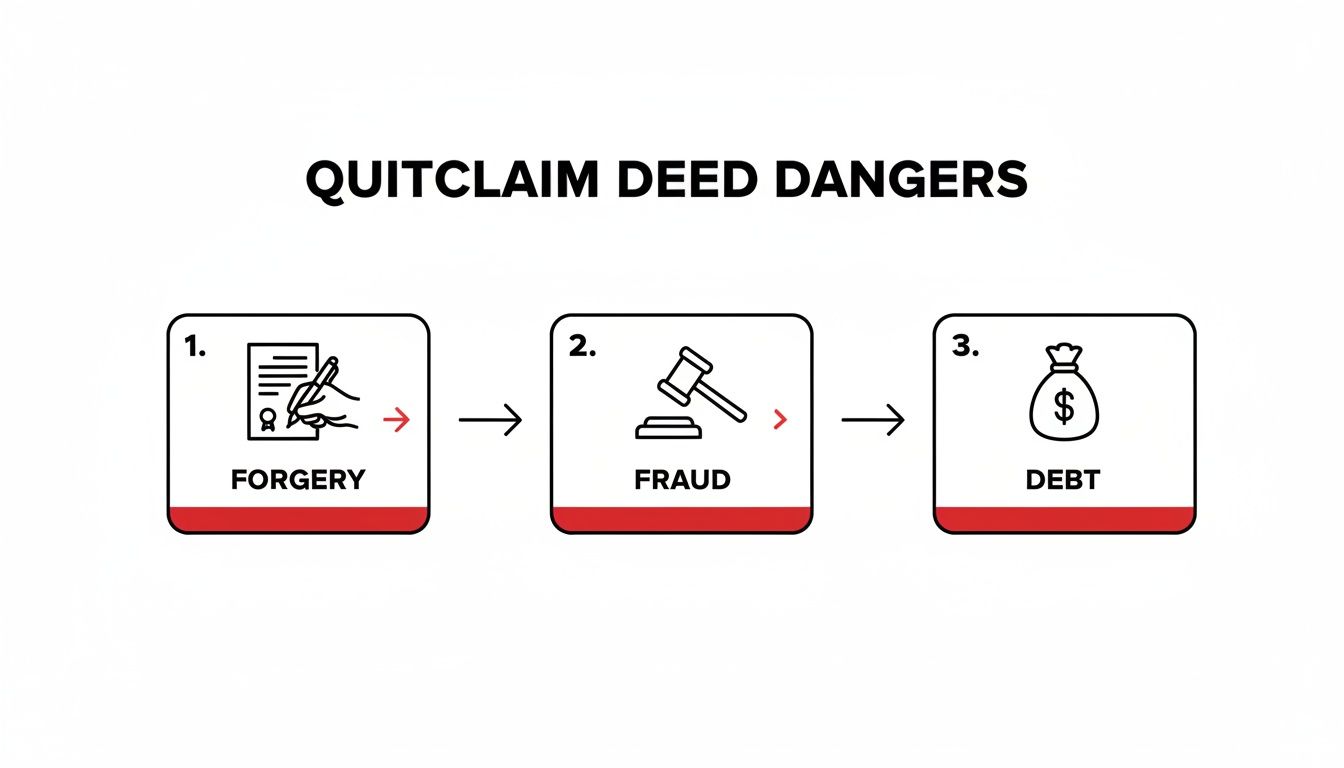
As you can see, a simple mistake or a bad actor can turn a document forgery into full-blown fraud, leaving the new owner holding the bag for unexpected debt.
While filing a quitclaim deed on your own is doable, it's not the answer for every situation. If you're dealing with liens, a looming foreclosure, or just need to get out from under a property quickly, there are safer bets.
For example, if you want to bypass all these complexities, you might consider options to sell your house fast in Fayetteville NC for a guaranteed cash offer. It provides a clean break without the potential risks of a DIY deed transfer.
Costly Mistakes to Avoid When Filing Your Deed

Thinking a quitclaim deed is just a simple form you fill out is the first mistake—and it's a big one. Even a tiny error on this document can create massive legal and financial headaches years from now, potentially making it impossible to sell or refinance your property.
You absolutely have to sidestep these common blunders to make sure the property transfer is secure and legally sound.
One of the most frequent slip-ups we see is people grabbing a generic, one-size-fits-all form from the internet. North Carolina has very specific legal requirements for the language and formatting of deeds. Using a form that isn't compliant with state law is a surefire way to get it rejected by the Cumberland County Register of Deeds, which means you've wasted both time and your filing fees.
The Devil Is in the Details
The single most critical piece of information on a quitclaim deed is the legal property description. This isn't the street address you use for your mail. It’s the official description found on the existing deed, often packed with details like lot numbers, block numbers, and subdivision names.
Get this wrong, and you create what's known as a "cloud on the title." That’s a legal term for a red flag that makes your ownership questionable. It basically poisons the well for any future sale or loan until you go through the complex—and expensive—process of getting it legally corrected.
Key Takeaway: An invalid deed isn't just a paperwork problem; it can completely void the property transfer. If a court finds the deed was prepared or executed improperly, it’s as if you never made the transfer at all.
Fatal Errors in Execution
Even if you have a perfectly filled-out form, the way you sign and notarize it can trip you up. The biggest mistake here? Signing the document before you are physically in front of the notary public.
A notary’s entire job is to witness your signature, which means they must see you do it. A pre-signed document can't be legally notarized, and a deed without a proper notarization is worthless.
Here are a few other critical execution mistakes to watch out for:
- Incorrect Grantor Name: The name of the person giving the property has to match the existing deed exactly. No nicknames, no abbreviations, no exceptions.
- Missing Signatures: You need both the grantor's signature and the notary's signature, along with their seal and commission expiration date. All of them are mandatory.
- Forgetting to Record the Deed: A signed and notarized deed does absolutely nothing until it's officially filed with the county. An unrecorded deed gives zero public notice of the ownership change, leaving the property vulnerable to claims from creditors or other parties.
These errors might seem small, but any one of them can invalidate your deed and put your ownership of the property at risk. Learning how to file a quitclaim deed correctly from the start is about learning how to avoid these costly pitfalls. Taking the time to be meticulous is the best investment you can make.
Not So Fast: Safer Alternatives to a Quitclaim Deed
After digging into the risks, you might be second-guessing if figuring out how to file a quitclaim deed is the right call. For a lot of homeowners dealing with complicated situations, the answer is a hard no. A quitclaim is fast, sure, but it offers zero protection. That leaves you wide open to nasty surprises like hidden liens and other title defects.
There's a much safer route: a warranty deed. Unlike a quitclaim, this deed comes with a legal guarantee from the seller (the grantor) that the title is clean. This means the grantor is on the hook to defend the title against any claims down the road, giving the buyer total peace of mind. It’s the gold standard in real estate for a reason—it protects everyone.
A Practical Fix for Messy Problems
But what if your situation is messy? Maybe you inherited a house that comes with a bunch of liens. Or you’re facing a last-minute military PCS and need to move now. Maybe you're trying to get out from under the threat of foreclosure.
In these tough spots, a quitclaim is too risky, and a traditional sale is too slow. This is where selling directly to a local cash buyer like DIL Group Buyers becomes a powerful and, more importantly, secure alternative.
Instead of just handing over the keys with a risky "as-is" deed and crossing your fingers, you get a clean, guaranteed closing.
Think about these benefits:
- No Title Headaches: We take care of the entire title search. If we find existing issues, like old liens or judgments, we work to clear them up as part of the sale. You get to walk away free and clear.
- Guaranteed Closing: No ifs, ands, or buts. We give you a firm, all-cash offer and close when it works for you—often in just a couple of weeks.
- Zero Hassle: Forget about repairs, showings, agent commissions, or even attorney fees. It’s a clean, simple transaction built to solve your problem fast.
When you're in a tough situation—like handling an unwanted inherited house or getting orders for a quick PCS move—a direct cash sale isn't just a transaction. It's your secure exit strategy. It gives you certainty and cash without the gamble of a quitclaim deed.
This approach gives you a clean break. It completely removes the guesswork and legal risks of a quitclaim, letting you move on with cash in your pocket and confidence that every detail was handled professionally.
Answering Your Top Questions About Quitclaim Deeds in NC
When you're dealing with a quitclaim deed, a lot of practical, "what-if" questions are bound to come up. Let’s cut through the noise and get you direct answers to the things North Carolina property owners worry about most.
How Much Does It Really Cost to File a Quitclaim Deed in NC?
The good news is that a quitclaim deed is one of the most affordable ways to transfer property. Your main mandatory cost is what the county charges you to make it official.
If you're in Cumberland County, the numbers are pretty straightforward:
- Recording Fee: It's a flat $26 for the first 15 pages of the document.
- Notary Fee: This usually runs between $5 to $10 for each signature you need witnessed.
All in, you’re looking at a total cost of less than $40. Of course, that’s if you’re handling the paperwork yourself. If you decide to have an attorney draft the deed to make sure it’s ironclad, you'll need to factor in their legal fees as well.
Will a Quitclaim Deed Take My Name Off the Mortgage?
This is a huge one, and it trips people up all the time. The answer is an absolute no.
A quitclaim deed only transfers your ownership interest—your rights to the property. It does nothing to change your financial contract with the bank. If your name is on that mortgage, you are still 100% on the hook for the payments, even after you’ve signed away your ownership.
Critical Warning: Be careful. Signing over the deed could trigger a "due on sale" clause in your mortgage. This gives your lender the right to call the entire loan balance due immediately.
Do I Have to Hire an Attorney for a Quitclaim Deed?
Legally speaking, North Carolina does not require you to use an attorney to file a quitclaim deed. If it's a simple, straightforward transfer between people you trust—like giving a house to your child—you can certainly do it yourself if you’re meticulous with the details.
However, you should seriously consider getting a lawyer involved in more complicated scenarios:
- As part of a divorce or legal separation.
- If you suspect there are old liens or potential title problems.
- When moving property into an LLC, a business, or a trust.
An attorney doesn't just fill out a form; they make sure it’s done right and can warn you about tax implications or other legal headaches you haven’t thought of. That peace of mind is often worth every penny.
What Happens If I Make a Mistake on the Deed?
A mistake on a filed deed is a big deal. It creates what’s known as a "cloud on the title," and it can cause major problems down the road.
Something as simple as a misspelled name, an incorrect legal property description, or a missed signature can make the whole transfer invalid. Fixing it isn't easy—it usually means drafting a brand new corrective deed or, in the worst cases, going to court. A clouded title can make it impossible to sell or refinance the property later.
Trying to navigate property transfers while dealing with liens, a looming foreclosure, or a last-minute PCS can feel impossible. DIL Group Buyers offers a way out. We buy your house for cash, take care of all the tricky title work, and close whenever you need us to. You get a guaranteed sale without the stress and risk of a DIY deed. Get your fair cash offer today and move on with your life.