
The chaos and shock after a house fire are indescribable. Your first instinct isn't to save things—it's to make sure your family is okay and the property is secure. This is your roadmap for getting through that initial crisis and preparing to sell your fire damage house.
Navigating the First 24 Hours After a House Fire
Once the fire trucks pull away, the silence is deafening, and it’s hard to know what to do next. Those first 24 hours are absolutely critical for your safety and for protecting your financial interests down the road.
Before you even think about going back inside, stop. Do not set foot on that property until the fire department gives you the official all-clear. Period.
Even then, the house is a minefield of hidden dangers. A fire can cook the structural integrity right out of the floors, walls, and roof, putting you at serious risk of a collapse. The soot and smoke left behind are full of toxic junk you don't want to breathe, and all that water used to fight the fire can create electrical hazards or kickstart a nasty mold problem.
Your Immediate Action Plan
Your first phone calls are the most important. Get on the phone with your insurance company right away to get the claim started. They’ll connect you with an adjuster and help you sort out immediate needs, like a temporary place to stay. You'll also need to get the official fire report from the fire department—that piece of paper is non-negotiable for your insurance claim and any future sale.
Next, before a single thing is moved, start documenting everything. Pull out your phone and take pictures and videos of all the damage from every angle you can think of.
Key Takeaway: Your phone is your most powerful tool right now. Get detailed photos and videos of the structural damage and your lost personal belongings. This visual proof is undeniable for your insurance claim and shows any potential buyer exactly what they're dealing with.
Understanding Structural and Safety Risks
A fire-damaged home has dangers you can't always see. Getting a professional structural assessment isn't just a good idea; it's a must. We've seen it all, and there are a few tell-tale signs of serious trouble:
- Sagging ceilings or floors: This is a huge red flag that the support joists have been weakened by extreme heat.
- Warped or cracked walls: This shows you just how intense the fire was and can point to deeper foundation problems.
- Melted siding or fixtures: If things are melted, you know the temperatures were off the charts, likely affecting the structure underneath.
You also have to confirm that all utilities—gas, electricity, and water—are shut off right at the main source to prevent another disaster. Sometimes, the damage is so bad that the city will declare the property uninhabitable. You can learn more about what happens when a house is condemned.
Taking these first steps for safety and documentation will give you a feeling of control when everything else feels out of control.
Repair or Sell Your Fire Damaged House As Is
After the fire trucks leave and the smoke clears, you’re facing a huge decision. It’s a fork in the road with two very different paths. You can take on the long, difficult process of rebuilding your home, or you can choose a faster, cleaner solution by selling your fire damage house as is.
Neither choice is simple, but knowing exactly what you're getting into is everything.
The thought of rebuilding is completely understandable. It was your home. But the reality is often a nightmare of stress, endless phone calls, and constant uncertainty. Most homeowners are simply not prepared to manage a massive construction project from start to finish.
The Long Road of Rebuilding
Deciding to repair your home means you're signing up for a fight. You'll spend months, maybe even years, battling your insurance company. It’s a full-time job you never asked for.
You’ll be chasing down contractors, trying to get permits, and making sure every single detail meets today's building codes—which are probably much stricter than when your house was built. This isn’t a quick fix. It’s a marathon.
The numbers don't lie. After major California wildfires between 2017 and 2020, only 37% of the 22,500 destroyed homes had even received rebuild permits years later. The delays are real and can leave you and your family in limbo indefinitely. The emotional strain of managing all this, on top of the trauma of the fire, is just immense.
The Certainty of Selling As Is
There's another way. You can sell your fire-damaged house exactly as it stands today. This path replaces the unknown timelines and constant stress of rebuilding with speed, simplicity, and a definite end date.
When you sell your house as is to a cash home buyer, you are choosing a guaranteed outcome.
The Bottom Line: Selling a fire-damaged house as is means you hand over the entire problem—the cleanup, the repairs, the permits, the risk—to someone else. You get cash in your pocket and the freedom to move on without the weight of a construction project on your shoulders.
So, how do you decide which path is right for you? It really comes down to what you value most right now: time, money, or peace of mind. Let’s break it down.
Repairing vs Selling As-Is: A Side-by-Side Comparison
| Consideration | Repairing and Rebuilding | Selling As-Is to a Cash Buyer |
|---|---|---|
| Timeline | Months to years. Expect major delays with insurance, permits, and contractors. | Days to weeks. Cash buyers can close in as little as 7-14 days. |
| Effort & Stress | Extremely high. You manage the entire project, from negotiations to construction oversight. | Minimal. The buyer handles everything. You just sign the papers and get your cash. |
| Financial Cost | Unpredictable. Insurance may not cover everything. You could be on the hook for code upgrades and unexpected expenses. | Zero out-of-pocket costs. No repairs, no commissions, no closing fees. |
| Outcome | Uncertain. The final result depends on your contractor, budget, and a thousand other variables. | Guaranteed. You get a firm cash offer and a set closing date. No surprises. |
Ultimately, selling as-is offers a clean break. It’s a practical, straightforward solution that gives you the cash you need to start over, without the headaches.
This flowchart shows the very first things you need to do after a fire. Getting these initial steps right is crucial before you can even begin to think about repairing or selling.
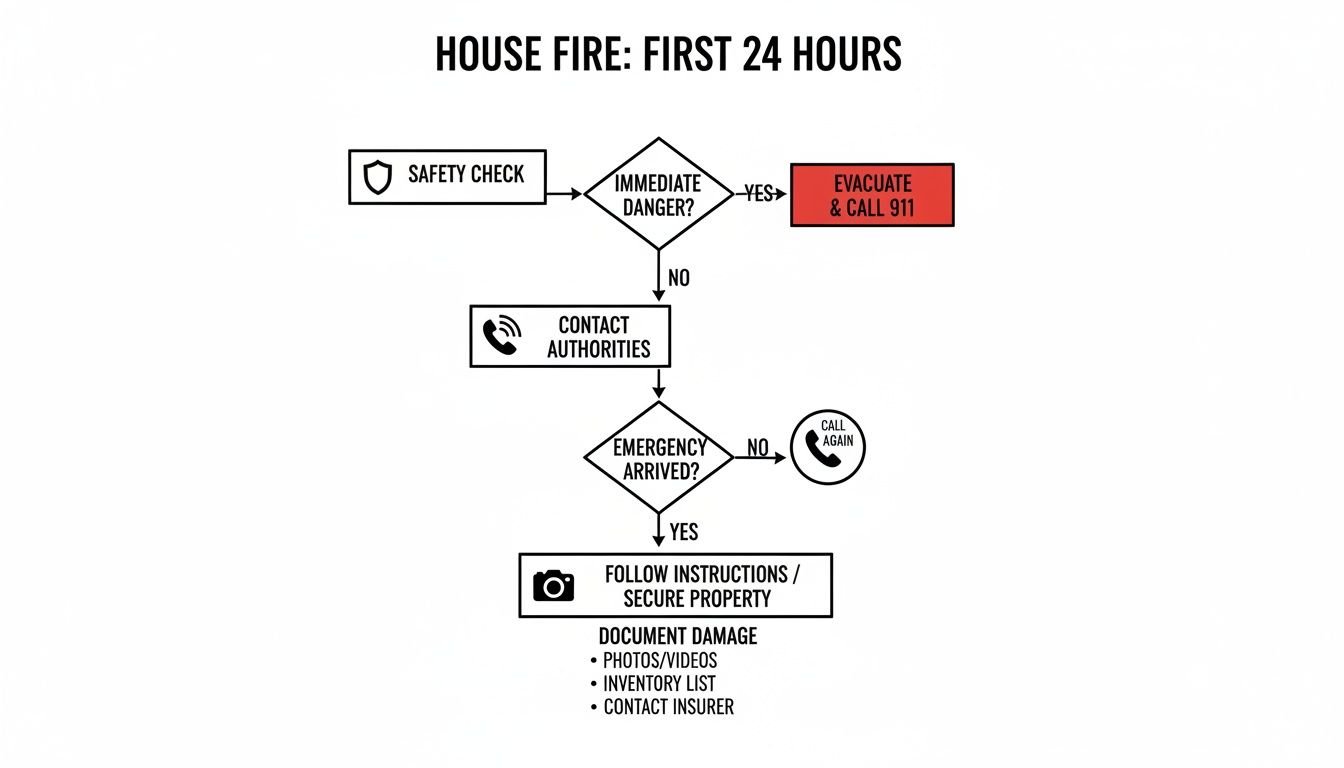
For a lot of homeowners, especially if you need to move for a new job, live out of state, or just feel completely overwhelmed by the situation, selling as is is a lifeline.
It gives you the financial freedom to get a fresh start somewhere new, on your own terms. Companies like DIL Group Home Buyers specialize in these situations. We provide fair, all-cash offers to help you close fast and move on with your life. You can learn more in our complete guide to selling your house as is.
How to Value a Fire Damaged Property
Trying to price a regular house is simple enough—you just look at what similar homes in the neighborhood sold for. But when you have a fire damage house for sale, you have to throw that entire playbook out the window.
The real value isn't about what the house used to be. It's all about its future potential and, more importantly, the cost to get it there. To know if you’re getting a fair offer, you need to understand how an investor or cash buyer thinks. It’s a completely different math problem, one that’s loaded with risk they have to account for.
A fire changes everything. We saw this firsthand after the 2025 Los Angeles wildfires, where homeowners learned a brutal lesson about property value. In hard-hit areas like Pacific Palisades, the market was suddenly flooded with damaged properties, and lot prices dropped by a staggering 40% almost overnight. The value of a burned house often boils down to the land value minus the cost of hauling away the debris. You can get more insights on how investors value these unique properties by checking out this guide on wholesaling fire-damaged houses from RealEstateSkills.com.
The Formula Investors Use: After Repair Value
Professional cash buyers don't pull numbers out of thin air. We use a time-tested formula for a fire damage house that centers on a key concept: the After Repair Value (ARV).
After Repair Value (ARV): This is the price your house could sell for on the open market if it were fully repaired and in perfect, move-in-ready condition.
Once an investor determines that number, they simply work backward. They subtract all the costs standing between the home's current state and its renovated state. It’s a transparent process based on real numbers, not just a shot-in-the-dark lowball offer.
Breaking Down the Numbers
So, what exactly gets subtracted from the ARV to calculate your final cash offer? It comes down to four main things:
- Cost of Repairs: This is the big one. It’s not just drywall and paint. It’s structural repairs, new roofing, all-new electrical and plumbing, smoke and soot remediation, and often mold removal. It's a massive undertaking.
- Holding Costs: While the house is being renovated, the investor is paying the bills. This includes property taxes, insurance, utilities, and any loan interest. These costs add up every single month.
- Selling Costs: After all the work is done, the investor has to sell the house. That means paying realtor commissions, closing costs, and transfer taxes, which typically eats up about 10% of the final selling price.
- Investor’s Minimum Profit: Let’s be frank—a cash buyer is a business. For taking on the huge financial risk and headache of a fire restoration, they need to make a reasonable profit.
When you see how an experienced buyer like DIL Group breaks it down, you realize the offer is based on cold, hard data. It takes the emotion out of it and focuses on the financial reality of the project. This is precisely why banks and traditional mortgage lenders won't touch these properties, making a reliable cash buyer a critical option for owners who just need to sell and move on.
Choosing a Reputable Cash Home Buyer

If you’ve decided selling your fire damage house as-is is the right move, this is where you need to pay close attention. Finding a trustworthy cash buyer is everything. A good one means a fast, fair sale. A bad one can leave you high and dry.
Let's be blunt: not all "cash buyers" actually have cash. Many are just wholesalers who put your house under contract with no intention of buying it themselves. Their whole game is to find a real investor to sell the contract to.
This is a huge risk for you. These deals often fall apart at the last minute, or the "buyer" comes back asking for a lower price. You end up right back where you started, having wasted precious time. You need a direct buyer—a professional company with the money in the bank ready to close.
Questions to Ask Every Potential Buyer
To protect yourself, you need to vet anyone who makes you an offer. A legitimate buyer won't be bothered by tough questions. In fact, they'll respect you for asking.
Here’s what you need to ask before you even think about signing a contract:
- Can you show me proof of funds? This is the most important question. A real buyer can instantly provide a bank statement or a letter from their bank. No excuses.
- How did you come up with this offer? They should be able to walk you through the numbers without hesitation. Ask them about the After Repair Value (ARV) and the repair costs they’re estimating.
- Are there any commissions or fees? The only right answer is “no.” You shouldn’t pay a dime. We make our money after we fix and sell the house, not by charging you.
- Where can I see reviews or testimonials? A company with a solid track record will be proud to show you what past sellers have said. Look for people who were in a situation like yours.
Bottom Line: The real pros have the cash and can explain their offer clearly. Wholesalers are just middlemen who add risk and uncertainty. If they can’t show you the money, walk away.
The Advantage of a Local Expert
While you’ll see big national companies advertising, nothing beats a local expert who actually lives and breathes your market. For homeowners with a fire damage house for sale in Fayetteville, Hope Mills, or near Fort Bragg, a local buyer like DIL Group brings knowledge you just can’t get from a 1-800 number.
We know the neighborhoods, we know what repairs really cost here, and we know the local permitting offices. That insider knowledge means our offers are fair and accurate from day one—no surprises.
This is even more critical if you're a military family with PCS orders or an out-of-state owner. You need a team you can trust to handle everything on the ground. A local buyer is your direct point of contact, ensuring a smooth closing on your schedule, without you needing to be there. We go into more detail on our process in this guide to working with a cash home buyer.
Understanding Your Legal and Disclosure Duties
Let's cut right to it—the paperwork. Selling any home comes with a stack of legal documents, but when you’re dealing with a fire damage house for sale, your responsibilities are on a whole different level.
The most important thing to get straight is that selling a house "as is" absolutely does not mean you can hide the truth. In fact, it’s the exact opposite.
You are legally required to be an open book about the property's condition. This isn't just a friendly suggestion. Failing to disclose everything you know can come back to bite you with serious legal and financial consequences long after you’ve sold the house.
The Power of Full Disclosure
Think of your disclosure documents as the full, unvarnished story of the fire. You need to paint a crystal-clear picture of what happened, detailing the extent of the damage, where it was worst, and all the related problems that came with it.
You absolutely have to be specific. We're talking about:
- Fire Damage: Note exactly which rooms were hit and how bad the structural impact is. Don't gloss over this.
- Smoke Damage: Soot and smoke travel much farther than the flames. You have to disclose every area where it settled.
- Water Damage: You must mention all the spots affected by the water used to put the fire out. That water is a breeding ground for mold.
Being brutally honest is how you build trust with a buyer. Any reputable cash home buyer expects this level of detail and will factor it into their offer. Hiding problems just makes you look suspicious and is the fastest way to kill a potential deal.
We see how fast a market can get flooded with damaged homes, forcing people into urgent sales. Look at the devastating January 2025 wildfires that threatened nearly 20,000 homes in Los Angeles. Redfin reported that 14% of homes in those fire zones were affected. In situations like that, companies like DIL Group Buyers become a lifeline, buying houses for cash in any condition. For homeowners staring down foreclosure or just needing out, it's a fast, clean solution. You can even read more on how events like this affect the housing market at Zillow.com.
Simplifying the Paperwork with a Cash Buyer
The thought of wrestling with legal documents on top of everything else is enough to make anyone's head spin. This is another huge reason to work with a professional cash buyer—we simplify the entire process. We handle the piles of paperwork and walk you through every single step.
The main document you'll be dealing with is the purchase agreement. This contract will clearly state that the home is being sold as-is, with all known faults. A good buyer makes sure the language in that contract protects both you and them, creating a clean legal break from the property.
Key Insight: Working with an experienced cash buyer like DIL Group eliminates so many of the typical headaches. We handle all the title work and often cover every single closing cost, so you don’t get hit with surprise fees at the finish line.
This straightforward process is a game-changer, especially if you’re in a tough financial corner. If you’re facing foreclosure or have liens piling up on the property, a fast cash sale can be the exact thing that stops the proceedings and saves your financial future. It gives you a swift, guaranteed resolution, allowing you to pay off debts and walk away with cash in your pocket, finally free to move on.
Your Top Questions Answered: Selling a House After a Fire
After a fire, you're left with a lot of questions. I get it. I've seen it all, and I want to give you some straight answers based on my experience helping homeowners just like you.
Can I Still Sell My House If I Have an Open Insurance Claim?
Yes, absolutely. This is something we deal with all the time. You don't have to wait around for the insurance company to finally cut a check, which can take months.
You can sell the house, and we can take over the insurance claim for you. We'll handle all the back-and-forth and the paperwork to get the claim benefits transferred to us. This lets you get cash in your pocket and move on with your life, fast.
Do I Have to Clean Anything Out Before I Sell?
No. Seriously, don't lift a finger. This is one of the biggest reliefs for people selling a fire damage house for sale. Go through the property, take the personal items and memories that matter to you, and just walk away from the rest.
We take on the full responsibility for the entire cleanout. That means all the debris, the damaged furniture, the soot—everything. You don't have to spend a dime on dumpsters or break your back hauling junk. We handle the mess, period.
The bottom line: When you sell to a cash buyer like us, "as-is" means you take what you want and leave the disaster behind. We'll take care of it.
How Fast Can I Actually Sell a Fire Damaged House for Cash?
The speed is probably the biggest difference you'll notice. A typical sale on the market can drag on for months, especially with a damaged property. A cash sale is a different story.
Once we agree on a price, we can close the deal and get you your cash in as little as 7 to 14 days. It's all about giving you a quick, certain exit so you can start fresh without delays.
Will a Bank Give a Buyer a Mortgage for a Fire Damaged House?
Almost never. Banks and traditional lenders won't approve a mortgage for a house with major damage. It’s just too risky for them. They see structural problems and safety hazards and immediately say no.
This is exactly why cash buyers are often the only realistic option. We use our own funds, so we don't need a bank's permission. We see the potential and can buy a property no matter its condition, giving you a way out when traditional buyers can't.
Going through this is tough, but you don't have to do it by yourself. If you're ready for a fast, fair, and guaranteed cash offer for your property, DIL Group Home Buyers is here. We can help. Contact us and get a no-obligation offer, and see how you can close in as little as a week. Get started right now at https://dilgrouphomebuyers.com.