
Let's get straight to it: are probate sales cash-only? Legally, no. But in the real world? Cash is king.
Think of it this way: a cash offer is like an express lane through a complicated legal maze. A financed offer is the scenic route, full of detours and dead ends that can kill the deal. For an estate that needs to be settled, that’s a risk most aren’t willing to take.
Why Probate Sales Lean Toward Cash
When you’re dealing with a probate sale, you’re not just selling a house. The entire transaction is under court supervision to make sure everything is handled by the book for the deceased's estate. This adds a layer of legal oversight that makes traditional mortgage lenders very nervous.
The biggest problem is time and uncertainty. A financed offer brings a third party into the mix—the bank—and they have their own long list of rules and timelines. Lenders hate surprises, and the probate court schedule is full of them.
The Practical Roadblocks for Financing
Most inherited homes are sold "as-is," which is a huge red flag for banks. If the property has deferred maintenance or needs serious repairs, it often won't pass the strict appraisal standards required for a conventional loan.
But the court confirmation process is the real deal-breaker. A financed offer is always contingent on the buyer’s loan getting approved. If that loan falls through after everyone has waited months for a court date, the entire sale has to start all over again. The estate loses time, money, and momentum.
That’s why executors and courts almost always favor the certainty of a cash deal. While not technically required, cash eliminates the financing risk that can derail the entire process. Banking industry resources show that financed closings can drag on for 6 to 12 months—a timeline that makes a fast, guaranteed cash offer look even better. You can learn more about the typical home buying process from educational materials like those offered by Chase.
To make it crystal clear, here’s a quick breakdown of how these two offer types stack up in a probate context.
Cash Offers vs Financed Offers in Probate Sales
| Feature | Cash Offer | Financed Offer |
|---|---|---|
| Speed | Fast. Can close in a few weeks. | Slow. Can take 6 to 12 months or more. |
| Certainty | High. No financing contingency. | Low. Deal can fall through if the loan is denied. |
| Court Approval | Highly favorable. Seen as reliable and definite. | Less favorable. The financing contingency adds risk. |
| "As-Is" Friendly? | Yes. Cash buyers expect "as-is" properties. | No. Banks may deny loans for homes needing repairs. |
| Simplicity | Simple. Two parties: the estate and the buyer. | Complex. Involves a third party (the bank) with its own rules. |
As you can see, a cash offer strips away the layers of risk and delay that come with bank financing, making it the preferred path for a clean and efficient probate sale.
Understanding the North Carolina Probate Process

So, what makes a probate sale so different from a regular one? It really boils down to one thing: court supervision. When a person passes away, probate is the legal process the court uses to manage and settle their affairs. If a house is part of that estate, selling it suddenly involves a judge.
This isn't just a suggestion; it's the law. Whether the property is in Fayetteville, Hope Mills, or anywhere else in Cumberland County, the court oversees the sale to ensure everything is done by the book. A personal representative, usually called an executor, is appointed to take charge. This person is now legally on the hook for handling everything from paying off the deceased's debts to getting the remaining assets to the heirs.
The Executor's Role in a Home Sale
When an executor has to sell a house, their number one job is to protect the estate’s value. It’s not about their personal preference; they have a legal duty to act in the best financial interest of the heirs.
This responsibility shapes every decision they make. They can't just put up a "For Sale" sign and hope for the best. There's a strict process to follow, which typically includes:
- Getting an appraisal to establish the home’s fair market value.
- Petitioning the court just to get permission to sell the property in the first place.
- Making sure all debts and taxes are fully paid using the money from the sale.
Think about it from their perspective. They are accountable to a judge and the family. The last thing they need is a buyer who backs out at the last minute, forcing them to start all over. A deal falling through can create massive legal headaches and financial losses for the estate. This is exactly why the certainty of a cash offer is so appealing in these situations.
The probate system is designed for one thing: settling an estate according to the law. A fast, certain home sale simplifies this duty, allowing the executor to close the estate efficiently and distribute funds to heirs without unnecessary delays or risks.
You can learn more about the specific ins and outs of this process in our guide to probate property sales. Understanding this legal framework is the key to seeing why cash offers aren't just a preference—they're often a necessity.
Why Cash Offers Dominate North Carolina Probate Sales
While a probate sale isn't legally required to be cash-only, the reality on the ground tells a different story. For an executor, every decision boils down to one thing: protecting the estate by minimizing risk and getting things done efficiently. Cash offers just happen to be the best way to do both.
Think of it this way: a financed offer is like a local train with a dozen stops, any one of which could cause a major delay. A cash offer is the express route, getting you straight to the closing table without any of the usual holdups. In a court-supervised process, that difference is everything.
Speed Eliminates Costly Delays
The probate court process itself can drag on for months, sometimes even more than a year. A cash buyer who is ready to close right away can literally shave months off that timeline. There’s no waiting around for a mortgage underwriter to pick through bank statements or for a slow lender appraisal to get scheduled and approved.
This isn’t just about being convenient; it’s about saving the estate real money. Every single month a sale is delayed, the estate is bleeding cash. Those funds have to cover:
- Utilities for a property that’s sitting empty
- Property taxes and insurance premiums
- Lawn care and general maintenance
These holding costs add up fast, chipping away at the inheritance that should be going to the heirs. A fast cash closing puts an immediate stop to that financial drain.
Certainty Removes Financing Risks
Here’s the single biggest reason cash is king in probate: certainty. An offer that depends on a bank loan isn't a done deal. It’s a promise that could fall apart weeks or even months down the line, often for reasons nobody can control.
A common deal-killer is the home’s condition. Many inherited properties are sold "as-is" and have years of deferred maintenance. A traditional lender can refuse to finance a home with a bad roof or old plumbing, causing the entire sale to collapse long after you thought it was settled.
A cash offer completely removes that risk. There are no financing contingencies, which means the sale isn't hanging on a bank’s approval. For an executor who has a legal duty to protect the estate’s assets, that kind of guarantee is priceless.
This isn't just a local trend. National studies, like this one from the Yale Law Journal on probate lending, show that cash-heavy deals are the standard for resolving estates quickly.
If you want to understand how this provides such a high level of confidence, you can learn more about the process of working with a cash home buyer. It’s all about taking the guesswork out of the sale and providing a firm, reliable path to closing the estate for good.
The Risks of Accepting a Financed Offer on a Probate Home
Sure, it's possible to sell a probate house to a buyer using a mortgage, but for you as the seller, it's a path riddled with potential headaches. Accepting a financed offer can easily unravel the entire sale, leaving you back at square one.
The bottom line is that a financed deal brings two huge uncertainties into the mix: a buyer who has to be incredibly patient and a lender who actually understands the mess of probate paperwork. Finding that perfect combination is tough.
The Last-Minute Disaster Scenario
Let me paint a picture for you—it’s a nightmare we’ve seen happen time and time again. You accept a financed offer and then wait four, five, or even six months for the court to finally give the green light. Just when you think you’re at the finish line, the buyer’s loan gets denied at the eleventh hour.
This isn’t some rare occurrence. It happens all the time, usually because of the property appraisal.
- Appraisal Problems: The bank sends out an appraiser who takes one look at the home's "as-is" condition—the old roof, a few foundation cracks, or an ancient electrical panel—and decides it doesn't meet their lending standards. Loan denied.
- Buyer's Financial Shake-up: Maybe the buyer lost their job, or they bought a new car and threw their debt-to-income ratio out of whack. Suddenly, they no longer qualify for the loan.
- Lender Delays: Sometimes the bank's own internal process is so slow it can't keep up with the court's strict closing deadlines.
When a buyer's financing collapses after you've already waited months for court approval, the entire sale falls apart. This forces you, the executor, to restart the whole process from scratch, which costs the estate more time, more money, and a ton of stress.
You’re right back where you started. Now you have to tell the heirs the bad news, keep paying for the property's upkeep, and start searching for a new buyer all over again. Worse, the property might have new problems, like liens, that make the next sale even harder. We explain this in more detail in our guide on selling a house with a lien on it.
Comparing Probate Sale Timelines: Cash Versus Financing
To really get why cash offers are king in probate, you have to see the two paths side-by-side. Think of selling a probate home like a road trip. A financed offer is the scenic route—long, full of unexpected detours, and you might not even reach your destination. A cash offer? That's the direct expressway, getting you there fast and without any drama.
The timeline for a financed offer is just packed with potential delays. It's not unusual for the whole process to drag on for 6 to 12 months. For an estate executor, whose job is to settle things efficiently, that kind of risk and uncertainty is a non-starter.
The Financed Sale Journey
When you accept a financed offer, the road to closing is a complicated mess of hoops you have to jump through for both the court and the lender. Every single step adds more time and another chance for the whole deal to fall apart.
Here’s what that bumpy ride often looks like:
- Offer & Court Petition: First, the executor accepts an offer. Then, they have to file a petition with the court for permission to sell, a step that can easily eat up weeks or even months.
- Waiting on Overbids: The court schedules a confirmation hearing, which adds more waiting. At this hearing, any other buyer can show up and try to outbid the accepted offer.
- Court Confirmation: If no one outbids, the court will confirm the sale. But you're still not at the finish line.
- The Long Loan Process: Now the buyer’s lender gets serious. They start the official loan underwriting, order an appraisal, and put the buyer’s finances and the house itself under a microscope.
This is where things get really dicey. A financed deal can completely collapse months into the process.
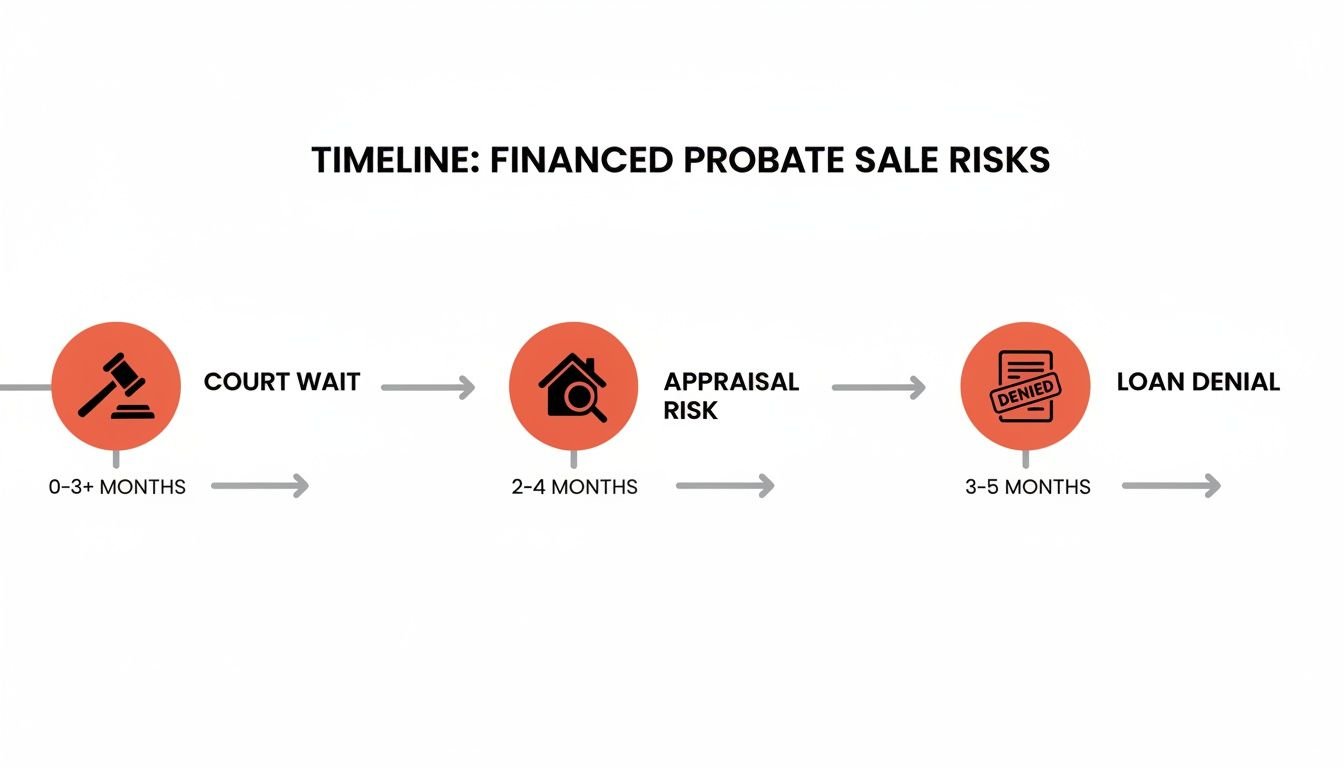
As you can see, major problems like a low appraisal or the bank denying the loan at the last minute can send you right back to square one after you've already wasted months.
The Cash Sale Journey
A cash sale, on the other hand, is a straight shot from offer to closing. It’s clean and simple.
A cash offer removes the biggest variable in any real estate transaction: the bank. This certainty is invaluable to a court and an executor responsible for settling an estate efficiently.
Because there’s no lender involved, the whole process is streamlined, predictable, and fast.
The table below really highlights the difference. For an executor, especially one dealing with the stress of settling a loved one's affairs, the choice is usually obvious.
Typical Probate Sale Timeline Comparison
| Milestone | Cash Sale Timeline | Financed Sale Timeline |
|---|---|---|
| Offer Accepted | Day 1 | Day 1 |
| Court Petition Filed | Within 1-2 days | Within 1-2 days |
| Court Confirmation | 2-4 weeks | 4-8 weeks (or longer) |
| Buyer Due Diligence | 0-7 days (often waived) | 7-14 days |
| Appraisal & Loan Process | Not Applicable | 21-45 days (high risk of delays) |
| Closing | Within 7-10 days of court approval | Within 30-45 days of court approval (if loan is approved) |
| Total Estimated Time | 3-6 weeks | 2-6 months+ |
The bottom line is clear: a cash sale offers speed and certainty, while a financed sale introduces significant risk and delays. For a military family needing to PCS from Fort Bragg or an heir living out-of-state, the simplified cash timeline makes it the obvious choice.
This is exactly why solutions like DIL Group Home Buyers are so valuable. We provide that certain, all-cash offer that lets you bypass the headaches and close on your schedule, giving you peace of mind when you need it most.
The Simple Solution for Your Inherited NC Property
Dealing with a probate sale in North Carolina doesn't have to be a nightmare. After seeing all the headaches, risks, and long waits, it's easy to see why people look for a guaranteed way out. This is where a cash home buyer answers the question, "are probate sales cash only?"
Legally, no. But choosing a cash buyer like DIL Group Home Buyers makes the process feel that simple—in the best way possible. We specialize in buying inherited properties for cash, so you can skip all the common problems.
Imagine a sale with:
- No deals falling through because of bank financing
- No demands for repairs or stressful clean-outs
- No realtor commissions or surprise fees eating into your inheritance
Get Cash Fast and Move On
We guarantee a closing on your schedule. This gives you the peace of mind you need to finally settle the estate and move forward. Whether you’re stuck managing a property from another state or a local Fayetteville family, we offer a fast, simple alternative.
Selling to a cash buyer turns a complicated, court-involved mess into a simple cash transaction. It gets rid of all the unknowns so you can close the estate with confidence.
With experience buying over 150 local homes, we get the challenges you’re up against. We provide a fair, honest, and understanding solution to help you get past the burden of a traditional property sale.
Got Questions About Selling a Probate House?
When you’re dealing with an inherited property in North Carolina, you’re bound to have questions. Here are some straight answers to the most common ones we hear from sellers.
What If the Inherited House Still Has a Mortgage?
If you've inherited a house that isn't paid off, that debt doesn't just disappear—it becomes the estate's problem to solve. The mortgage has to be paid, and usually, that means selling the property.
A fast cash sale is the simplest way to handle this. It gives you the funds to pay off the bank quickly, avoid any threat of foreclosure, and split whatever money is left over among the heirs.
Do I Have to Clean Out or Fix Up the House?
Absolutely not. When you sell to a cash buyer like DIL Group Home Buyers, we take the property "as-is." That means you can walk away and leave everything behind—old furniture, trash, you name it. You don’t spend a dime on repairs or even a single minute cleaning.
This is a huge relief for families who don't have the time, money, or emotional energy to tackle a massive clean-out and renovation project.
Selling a house "as-is" to a cash buyer means you can skip the stress and expense of getting it ready for the market. It’s the simplest path forward in a probate sale.
How Long Does Probate Take in Cumberland County?
In North Carolina, the probate process can drag on for six months to over a year, sometimes even longer if things get complicated. Selling a house through the traditional market adds even more time to that clock.
Choosing a cash buyer cuts that timeline way down. As soon as the court gives the green light to sell, we can move fast to get the deal done.
If you’re stuck in a complicated probate sale and just want a simple way out, DIL Group Home Buyers is here to help. We make a guaranteed, all-cash offer so you can close on your schedule and settle the estate without the stress. Get your fair cash offer today.