
You’re staring at a closing statement, and the line items keep piling up. Attorney fee. Title work. Payoff coordination. Recording. Maybe you’re already dealing with a late mortgage, a rental that got trashed, an inherited house, or PCS orders that won’t wait. At that point, closing attorney cost stops feeling like a routine fee and starts feeling like one more problem you don’t need.
In North Carolina, this cost is real, and it matters. It’s also one of the most misunderstood parts of a home sale. A lot of sellers assume it’s just paperwork. It isn’t. It’s legal work tied directly to whether your deal closes cleanly or blows up late.
The good news is simple. If you’re selling through a traditional route, you need to understand what this fee covers and what makes it rise. If you’re in a tougher situation, there are sale options where you may not have to pay this cost at all.
What Are Closing Attorney Costs and Why Do They Matter
A seller in Cumberland County gets an offer, signs a contract, and thinks the hard part is over. Then the closing figures arrive. Suddenly there’s an attorney fee on the sheet, and nobody has explained why it’s there or whether it can be avoided.
That’s common. Closing attorney cost is the fee paid for the legal work required to get a North Carolina real estate deal across the finish line. In this state, the closing attorney isn’t optional background help. The attorney is part of the process.
If you’ve ever wondered what closing on a house means, this is one of the clearest answers. Closing isn’t just signing papers and getting paid. It’s the legal transfer of ownership, and the attorney helps make sure that transfer holds up.
What this fee really covers
This isn’t a random administrative charge. It pays for legal tasks connected to the sale itself.
- Title review: The attorney checks for issues tied to ownership, liens, or claims that can interfere with the sale.
- Document preparation: Deeds and other required closing papers have to be prepared correctly.
- Payoff coordination: If there’s a mortgage, somebody has to make sure it gets paid off properly at closing.
- Final oversight: The attorney helps make sure signatures, filings, and legal requirements are handled the right way.
Practical rule: If money is tight, don’t dismiss the attorney fee as useless overhead. In a traditional sale, it’s one of the fees most directly tied to getting clear title transferred.
Why it matters more when life is messy
If your sale is straightforward, this fee may feel manageable. If your sale involves an inherited home, unpaid bills tied to the property, an out-of-state owner, or a looming deadline, the attorney’s role becomes much more important.
That’s also why some sellers decide a traditional sale isn’t worth the friction. When speed matters, or the property already has problems attached to it, a direct cash sale can remove this fee from your side altogether. For many stressed sellers, that’s not a nice bonus. It’s the difference between moving forward and staying stuck.
The Role of the Closing Attorney in a North Carolina Home Sale
Think of the closing attorney as the legal traffic controller for the sale. Money, signatures, title records, lender payoffs, and filing requirements all have to move in the right order. If one piece stalls, the whole deal can stall.
In major U.S. markets, seller attorneys handle deed preparation, mortgage payoff coordination, contract review, and closing attendance, making their role essential. Even in complex deals, their flat fee can still be a small slice of total seller closing costs. One New York City example puts the seller attorney fee at $2,500 on a $1.87 million sale, or 1.6% of total seller closing costs, according to Hauseit’s NYC closing cost breakdown.
North Carolina works differently from a casual handshake deal. If you want the transfer done right, somebody has to handle the legal mechanics.
What the attorney actually does
Some of this work happens behind the scenes, so sellers underestimate it. Here’s what the closing attorney typically handles in a North Carolina sale:
Title search and problem spotting
The attorney reviews the property’s title history and flags issues that can block the transfer.Deed preparation
The new deed has to be drafted correctly. If the legal description is wrong or ownership names are wrong, you’ve got a problem.Mortgage payoff coordination
If you still owe a lender, the payoff has to be ordered and coordinated so the old loan gets satisfied from sale proceeds.Document review
Contracts and closing papers need to match the actual terms of the deal.Signing and closing oversight
The attorney supervises the execution of final documents and helps ensure the transaction is legally completed.
Why sellers should care
A lot of people only focus on the sale price. That’s a mistake. The cleaner question is this: Will the deal survive the closing process without surprises?
That’s where the attorney earns the fee in a traditional sale.
A good closing attorney doesn’t just push paper. That attorney catches title defects, payoff issues, and filing problems before they turn into failed closings.
Where sellers get frustrated
The frustration is understandable. Sellers often hear “attorney required” and assume it’s just another professional adding cost. But the attorney is usually cleaning up problems nobody else can legally or properly resolve.
That includes things like:
- Old mortgage details that need payoff confirmation
- Deed errors from a prior transfer
- Liens or claims tied to the property
- Missing paperwork that delays recording
If your property is clean, this process feels routine. If it isn’t, the attorney becomes the person standing between you and a delayed or dead deal.
How Much is the Closing Attorney Cost in North Carolina
If you want the short answer, here it is. In North Carolina, closing attorney cost typically ranges from $500 to $1,500 in a traditional sale, according to Zillow’s closing cost guide.
That’s the number most sellers are looking for. But the more useful answer is this: that range usually applies to a standard transaction, not a messy one.
North Carolina is one of the states where a closing attorney is required. The same Zillow guide notes that average buyer closing costs for a home purchase in North Carolina total $11,764, and the attorney fee is one piece of that overall settlement picture.
What you’re paying for in that range
That $500 to $1,500 usually covers the core legal closing work in a normal residential transaction. The attorney’s work includes title searches and legal document preparation, which helps reduce the risk of undiscovered liens or title defects.
Zillow also notes those issues can delay a closing by weeks and can lead to thousands in future legal costs if they aren’t caught early in the process.
Why the number isn’t the whole story
A seller hears “$500 to $1,500” and thinks the fee is settled. It often isn’t. That’s the typical range for a relatively clean file.
If the property has baggage, the legal work grows. The attorney isn’t just filling in blanks at that point. The attorney is helping resolve actual obstacles.
For sellers trying to estimate total costs, it helps to review who pays closing costs in North Carolina before agreeing to anything. The attorney fee is only one line item, but it’s one that tends to confuse people because they don’t always know when it applies, who covers it, or how a complicated title can change the final bill.
My advice on this fee
Don’t shop for the cheapest closing attorney cost in isolation. That’s backward thinking.
Use this fee as a signal. If your house is easy to sell and your timeline is normal, a standard attorney fee is part of the deal. If your property has problems and your timeline is tight, ask a harder question: whether a traditional closing process still makes sense for you at all.
What Makes Your Closing Attorney Cost Go Up
The fastest way to push closing attorney cost higher is to hand the attorney a file that isn’t clean. That doesn’t mean you did anything wrong. It means the property comes with legal loose ends.
In states like New Jersey, attorney fees of $1,500 to $3,000 are standard, and those costs can rise significantly for distressed sales involving foreclosures or liens, according to Defalco Realty’s New Jersey closing cost overview. North Carolina sellers run into the same basic problem. More legal cleanup usually means more attorney work.
Common situations that increase legal work
Here are the situations I see create the most stress for sellers.
Inherited property with multiple heirs
One person wants to sell. Another won’t sign. A third lives out of state. The attorney has to sort out who has authority and what documents are needed.Liens attached to the house
Tax liens, judgment liens, or contractor claims can stop a clean transfer until they’re addressed.Foreclosure pressure
When the clock is ticking, everyone has less room for delay. That makes every title or payoff issue more serious.Title mistakes from an earlier transfer
A bad deed, missing spouse signature, or old ownership error can force corrective work before closing.Remote ownership
Out-of-state owners often need extra coordination for signatures, document delivery, and communication.
If you’re not sure what an attorney is checking, it helps to understand what a title search for property involves. A lot of fee increases start with what that search uncovers.
Why distressed properties cost more to close
A distressed property creates legal drag. The house may need repairs, but the primary problem is often on paper, not in the walls.
A seller dealing with foreclosure, code issues, unpaid taxes, or inherited ownership usually needs more than routine document prep. The attorney may need to coordinate additional records, confirm who can sign, work through lien payoffs, and solve title questions before the buyer will close.
The uglier the paper trail, the more expensive the closing process tends to get.
My blunt recommendation
If your property has title problems, liens, or estate complications, assume the legal side will be harder than you think. Don’t build your plan around a best-case closing.
That’s where many sellers get burned. They choose the traditional path, spend time and money getting to the finish line, then learn the attorney needs more work done before anyone can close. If your situation is already stressful, simplicity has real value.
Who Pays the Closing Attorney and Can You Avoid This Cost
This is the question often implied when searching for closing attorney cost. Not “What is it?” but “Do I have to pay it?”
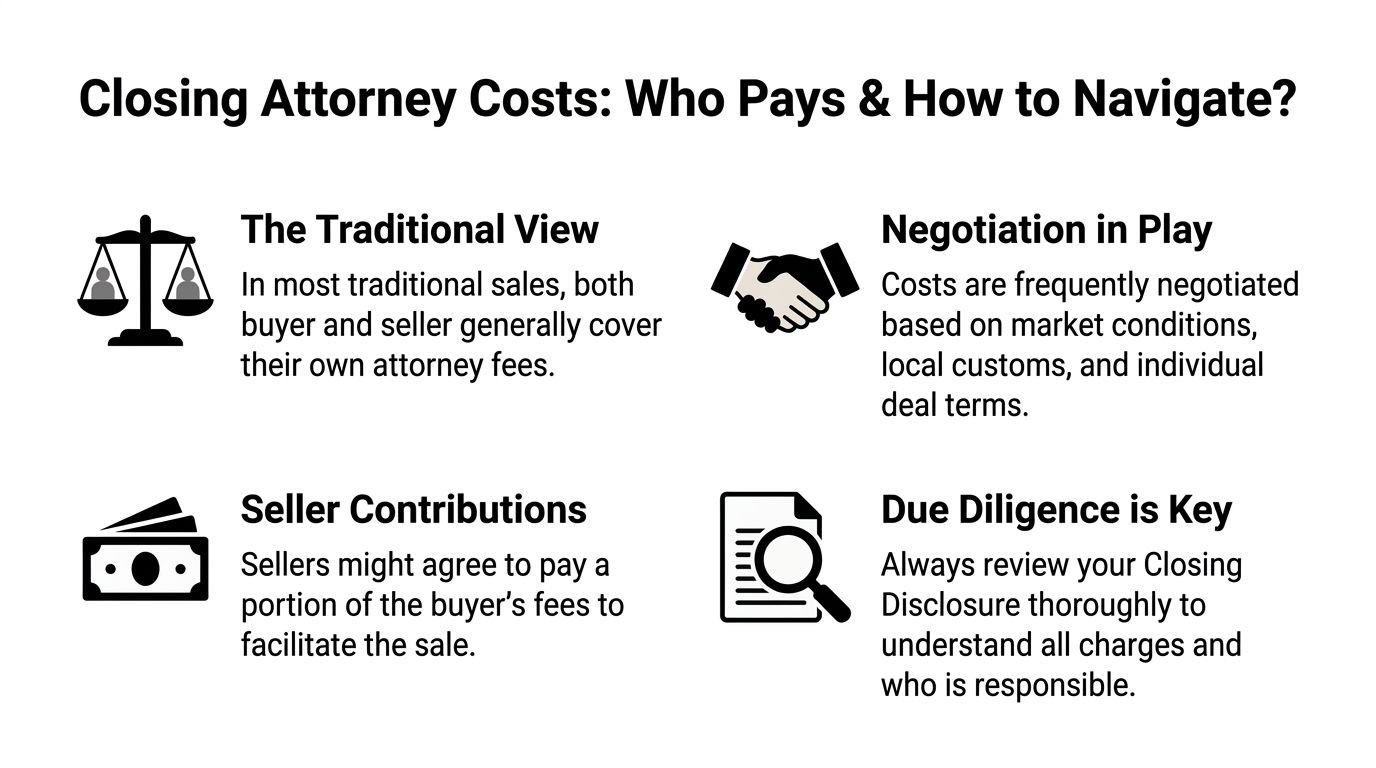
In a traditional sale, the answer depends on the contract, the local custom, and the structure of the deal. Often, each side covers its own legal and closing-related costs. Sometimes costs get negotiated. Sometimes a seller agrees to absorb more to keep the deal moving.
The traditional model
Here’s the plain version. In a normal market sale, you should expect the closing statement to be a negotiated stack of charges, not a fixed script.
| Cost / Factor | Typical Traditional Sale | Sale to DIL Group Buyers |
|---|---|---|
| Closing attorney cost | Seller may pay their own closing attorney cost, depending on the deal | Often waived or covered entirely |
| Repairs before closing | Often expected after inspection or buyer negotiation | Sold as-is |
| Agent commissions | Usually part of seller expenses in a listed sale | No realtor commissions |
| Timeline | Depends on financing, underwriting, and closing coordination | Seller chooses a closing date that fits the timeline |
| Process | Showings, contract terms, inspections, and possible renegotiation | Direct sale process |
| Hidden costs risk | Seller needs to review multiple line items carefully | Marketed as no hidden costs |
The cleanest way to avoid confusion is to read every line of your closing paperwork. If the numbers feel vague, ask direct questions before signing.
Bottom line: In a traditional sale, assume attorney fees are part of the deal unless the contract clearly shifts or removes them.
A quick explainer may help if you want a visual overview before deciding how to sell.
When the answer changes
Sellers in challenging situations should note that while traditional sellers in North Carolina face closing attorney costs of $500 to $1,500, cash buyers like DIL Group often waive or cover these fees entirely. For the 150+ properties DIL Group has purchased, that model has been particularly beneficial for out-of-state owners and distressed sellers, saving them an average of $750 to $3,000 per deal by eliminating legal overhead, according to this real estate lawyer cost discussion.
That changes the math.
If you’re behind on payments, handling an inherited property, moving on military orders, or trying to sell from another state, avoiding attorney fees isn’t just about saving money. It reduces the number of things that can go wrong.
My recommendation
If your property is clean, you have time, and you want full market exposure, a traditional sale can still make sense.
If your property is distressed, your timeline is short, or you need certainty more than process, a direct cash sale is often the better move. It cuts out a fee that many sellers never wanted in the first place.
Your Closing Attorney Cost Questions Answered
I’m in the military and need to move fast. Do I still have to deal with closing attorney cost
In a traditional North Carolina sale, you’re still dealing with the standard legal closing process. That means an attorney is part of the transaction, and the paperwork, title review, and scheduling still have to line up.
If you’re on PCS orders, the main problem usually isn’t just the fee. It’s delay. A financed buyer can create extra moving parts, and every moving part creates another chance for the closing date to slide.
A direct cash sale can remove a lot of that friction. For military families, that matters because certainty often beats squeezing for every possible dollar while the calendar keeps moving.
If you’re selling on a military deadline, don’t judge the process only by headline price. Judge it by how likely it is to close on time.
I live out of state and need to sell a house in North Carolina. Does that make this more expensive
It can. Remote ownership tends to create more coordination. Documents still need to be prepared, signatures still need to happen correctly, and title issues don’t become easier just because you’re not local.
Traditional closings can still work for out-of-state owners. They just tend to feel heavier. You’re managing calls, paperwork, deadlines, and problem-solving from a distance.
That’s one reason fee-free cash sale models appeal to absentee owners. They simplify a transaction that already feels inconvenient before the first document is signed.
My house has liens, code problems, or estate issues. Should I expect the attorney cost to rise
Yes. That’s the safest assumption.
Those issues create more legal work, more review, more coordination, and more opportunity for a closing to stall. In a traditional sale, the buyer may also become nervous once those problems surface, which can lead to renegotiation or cancellation.
If you already know the property has baggage, don’t pretend it’s a clean retail listing. Treat it like a problem-solving sale. That usually means comparing the total burden of a traditional process against a simpler direct sale where the buyer is prepared to take the property as-is.
Is it ever worth paying the closing attorney cost in a traditional sale
Absolutely. For a normal property with a normal timeline, it’s part of a legitimate closing process. The attorney is helping transfer ownership correctly and reduce legal risk.
The mistake is assuming every seller should take that route no matter what. If your sale is simple, the fee may be perfectly reasonable. If your sale is tangled, the smarter move may be the option that removes the fee and the complications tied to it.
Move Forward Without Hidden Fees or Delays
Closing attorney cost is a normal part of a traditional North Carolina home sale. It usually covers real legal work, and in the right situation, it’s money well spent.
But if you’re dealing with foreclosure pressure, inherited property issues, bad tenants, code problems, or an out-of-state sale, you don’t need more moving parts. You need fewer. That’s why so many stressed sellers stop asking how to manage one more fee and start asking how to avoid the whole pile of them.

My advice is simple. If your situation is straightforward, review your closing figures carefully and make sure the legal work matches the fee. If your situation is stressful or urgent, don’t force yourself through a process built for ideal conditions. Choose the path that gives you clarity, speed, and fewer chances for the deal to break down.
If you want a direct, local option without realtor commissions, repairs, attorney fees, or hidden costs, DIL Group Buyers offers cash purchases for homes in Fayetteville, Hope Mills, Spring Lake, Raeford, Dunn, and nearby North Carolina communities. You can reach out, get a no-obligation cash offer, and pick a closing date that works for your timeline.