
Your phone buzzes. The message says your report date changed and you need to move fast. Or maybe you inherited a house in Fayetteville that needs work, has old stuff still inside, and you live states away. Or you are done dealing with a rental where the tenant stopped paying and the property is becoming your second full-time job.
That is when the usual real estate advice stops being useful.
If your life is calm, your house is updated, and you have time to wait, a traditional listing can make sense. If your deadline is tight, the property is rough, or you need certainty more than drama, a cash sale can be the right move. The core issue is not which option sounds better in theory. It is which option leaves you with the better net financial outcome and the least chaos in your life.
Your Two Paths for Selling a Home Cash Sale vs Traditional Listing
Most sellers in Cumberland County are choosing between two very different roads.
One road is the standard listing. You hire an agent, prep the house, put it on the market, allow showings, negotiate offers, and hope the buyer’s financing holds together all the way to closing.
The other road is a direct cash sale. You skip the public listing, deal with one buyer instead of a crowd, and move on a much shorter timeline.
A lot of homeowners assume cash buyers are some fringe option. They are not. In the first half of 2025, 32.8% of homes sold in the U.S. were all-cash transactions, according to Realtor.com’s all-cash sale trends report for H1 2025. That same report notes traditional home sales usually take 30 to 60 days or longer, while cash deals can close in as little as 7 to 10 days.
That matters in Fayetteville.
A seller near Fort Bragg might have new PCS orders and no appetite for keeping the lawn cut while the house sits on the market. An out-of-state heir might not want to fly back and forth to manage repairs. A landlord in Spring Lake may care less about squeezing every dollar from the house and more about ending the problem this month.
If you are trying to compare your options, it helps to start with a simple principle: a listing is built to maximize exposure, while a cash sale is built to maximize speed and certainty.
For homeowners who want a direct-offer route, this is the kind of process people usually mean when they talk about selling a home for cash.
How Each Home Selling Process Works
The biggest mistake sellers make is treating these two paths like they are different versions of the same process. They are not. They ask different things from you.

What a traditional listing usually looks like
With a listing, the work starts before the home even goes live.
You usually meet with an agent, talk through pricing, and get a punch list of what needs attention. That may include cleaning, hauling off old furniture, paint, yard work, minor repairs, and sometimes bigger updates if the house shows poorly.
Then the home gets photographed, listed, and opened up for showings.
After that, you are dealing with strangers walking through the property, schedule interruptions, offer negotiations, and buyer requests. Even after you accept an offer, you are still not done. The buyer may have a financing contingency, appraisal contingency, and inspection contingency.
That means the sale can still wobble late in the process.
What a cash sale usually looks like
A direct cash sale is shorter and far less public.
You reach out to a buyer, share basic information about the property, and schedule a walkthrough. The buyer looks at condition, location, title issues if any, and what it will take to buy the property as-is.
Then you receive an offer.
If the offer works for you, the closing timeline is usually built around your needs. Some sellers want to move quickly. Others need more time to clear out personal belongings or coordinate a relocation.
Practical takeaway: The listing process asks you to prepare the home for the market. A cash process asks the buyer to price the home based on its current condition.
The core difference is what the seller has to manage
Traditional listings usually demand more energy from the homeowner.
You may need to:
- Prepare the house repeatedly: Cleaning for every showing gets old fast.
- Negotiate repairs: Buyers often come back after inspections asking for credits or fixes.
- Stay flexible: Delays can come from the lender, appraiser, title work, or the buyer’s own moving timeline.
A cash sale usually removes most of that friction.
You are often dealing with:
- One buyer instead of many
- One property review instead of repeated showings
- One straightforward close instead of layers of financing-related back-and-forth
That simplicity is why the pros and cons of selling house for cash are not just about money. They are also about how much disruption you can tolerate.
A Detailed Comparison of Financial Outcomes
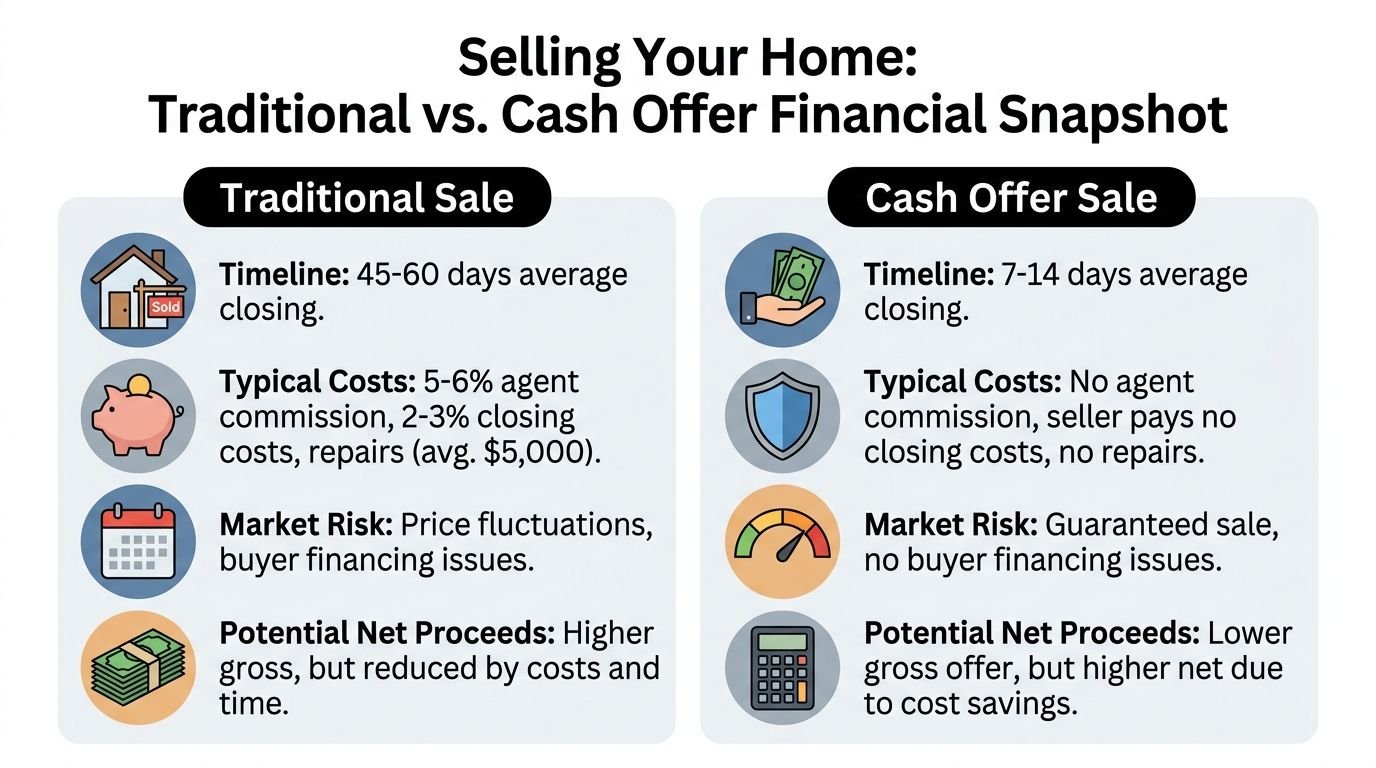
At this point, sellers need to get serious. Do not compare a cash offer to your dream sale price. Compare it to your actual walkaway number after costs, delays, and risk.
The gross offer is not the same as your net
Cash buyers usually do not offer full market value. That is the hard truth.
According to this analysis of the hidden downsides of selling to cash house-buying companies, cash buyers typically offer 10-15% below fair market value. The same source says sellers netted $51,000 less on average compared with traditional sales, and some deals include 6-10% hidden service fees.
If you stop reading there, you will conclude cash is a bad deal.
That is too simplistic.
A traditional sale has its own deductions. The same source notes traditional sales often involve 5-6% commissions, closing costs, and repair bills. Once those are backed out, the gap can shrink a lot.
Early side-by-side comparison
| Expense/Factor | Traditional Listing | Cash Sale (DIL Group) |
|---|---|---|
| Offer price | Usually higher gross price | Usually lower gross price |
| Agent commission | Commonly applies | Typically no agent commission |
| Repairs before closing | Often needed or requested | Often sold as-is |
| Showings | Multiple showings and prep | Usually one walkthrough |
| Buyer financing risk | Present | Removed |
| Appraisal risk | Present | Commonly avoided |
| Fees | Standard closing costs, possible concessions | Must be checked carefully for hidden fees |
| Timeline | Longer and less predictable | Faster and simpler |
| Net result | Can be higher, can also be cut down by costs | Can be lower, but cleaner and more predictable |
Why cash offers come in lower
Cash buyers are usually pricing in three things.
First, they are taking the house as-is. If the roof is old, the HVAC is tired, the flooring is shot, or the place needs a deep cleanout, they are accepting that burden.
Second, they are charging for convenience whether they call it that or not. You are paying with price in exchange for speed, privacy, and simplicity.
Third, they are protecting themselves against resale risk. Investor buyers are not charities.
That does not make cash bad. It just means you need clear eyes.
Key trade-off: A cash sale often means a lower headline number. In return, you may avoid commissions, repair spending, months of holding costs, and the risk of a financed deal dying late.
Traditional listings leak money in slower ways
Homeowners often underestimate how expensive waiting can be.
A listed home can cost you in ways that do not show up in the final settlement sheet right away. You keep paying the mortgage. You keep paying utilities. You keep handling lawn care, cleanup, and maintenance. If the property is vacant, you worry every week about vandalism, squatters, or one small issue becoming a big one.
You also carry emotional cost.
If you are in the middle of a divorce, probate, job loss, or a move out of state, the cheapest path on paper is not always the cheapest path in real life. The longer the house stays unresolved, the more it drags on everything else.
Certainty has financial value
This point gets ignored because it is harder to measure than a list price.
A financed buyer can look strong and still fall apart. Loan issues, appraisal issues, and inspection renegotiations kill momentum. Even when the deal survives, the seller usually burns more time and patience getting to the closing table.
Cash removes the biggest source of collapse. The financing contingency is gone.
That is one reason many sellers choose the certainty of cash when the property has problems or the seller’s timeline is critical.
How to compare the two paths
Use this simple framework instead of guessing.
For a traditional listing, estimate:
- Expected sale price
- Minus agent commission
- Minus likely closing costs
- Minus repairs and cleanup
- Minus holding costs while you wait
- Minus the cost of one failed contract if the first buyer falls out
For a cash offer, estimate:
- Cash offer amount
- Minus any fees listed in the agreement
- Minus any seller-paid closing charges if they exist
- Plus the value of a faster timeline and less disruption
Then compare the two numbers.
What I tell Fayetteville sellers
If your house is clean, updated, empty, and you have time, test the open market first.
If the property has major repair issues, difficult tenants, title headaches, or a hard deadline, stop obsessing over top-line price and focus on net certainty. That is where cash often wins.
A lot of sellers lose money by chasing the highest theoretical number. They ignore the deductions, the delays, and the possibility that the deal does not close.
The best sale is not the one that looks best at the kitchen table on day one. It is the one that leaves you with the best outcome when the dust settles.
When a Cash Sale is the Smartest Move
Cash is not automatically better. It is better in specific kinds of pressure.

When foreclosure is getting close
If you are behind on payments, speed matters more than pride.
A foreclosure can drop a FICO score by 100-150 points and stay on record for 7 years, according to this write-up on the pros and cons of selling a house for cash. That same source notes a quick cash sale can avoid that outcome entirely.
In plain English, waiting too long can cost you more than money. It can damage your credit and limit your next move.
If the house needs repairs and a financed buyer will take too long, a direct cash sale can be the clean exit that protects what is left.
When military PCS orders change everything
Fayetteville deals with this every day.
Military families do not always get the luxury of a slow, polished sale. Orders come in. Timelines shift. A spouse may already be coordinating schools, movers, storage, travel, and the next housing situation.
A traditional listing often asks for the one thing military families do not have. Extra time.
Cash works better when the house needs to be sold around a deployment, reassignment, or rapid relocation. If you need a direct local option, many sellers start by looking at a cash home buyer rather than trying to force a normal listing timeline onto an abnormal life event.
When you live out of state and the house is becoming a burden
Absentee ownership sounds manageable until the calls start.
The yard is overgrown. The neighbor complains. A pipe leaks. The city sends a notice. The tenant leaves a mess. A relative says the house needs attention, but nobody can agree on who is handling it.
That same source says 25% of U.S. foreclosures in 2025 involved non-local owners. That tracks with what many people already know from experience. Distance makes every property problem worse.
A cash sale fits this kind of situation because it removes the need to coordinate repairs, showings, and repeated trips back to North Carolina.
Local reality: Out-of-state owners usually do not need a perfect sale. They need a dependable sale that stops the bleeding.
When tenants or damage make listing miserable
Some houses are hard to show. Some are hard to enter. Some are both.
If you have bad tenants, heavy deferred maintenance, pet damage, smoke odor, code issues, or a house packed with years of stuff, a retail listing can become an endurance test. The market may still buy that house, but it will ask you to fix, clean, negotiate, and keep the property accessible.
That is not realistic for every seller.
A cash buyer is often a better fit when the property itself is the problem.
Here is a short explanation that helps many sellers think more clearly about the trade-off:
When the emotional cost is already too high
Inherited properties are a good example.
Sometimes the house is not just a house. It is tied to grief, family conflict, deferred maintenance, and years of unfinished decisions. In those cases, the cleanest exit is often the right one.
The pros and cons of selling house for cash become very personal here. Yes, you might make more through a full listing process. You might also spend months dealing with repairs, estate logistics, cleanout, and buyer demands while your life sits in limbo.
If you are exhausted already, there is no trophy for choosing the more complicated path.
Selling Your House in the Cumberland County Area
National advice only gets you so far. Cumberland County has its own rhythm.
The Fort Bragg effect changes everything. People come in fast, leave fast, rent homes they never planned to hold long term, and inherit properties they are not equipped to manage from a distance. That creates a local market where speed matters more often than outsiders realize.
Why cash has a stronger role here
In military-heavy markets like Cumberland County, cash buyer activity is rising. The Fort Bragg area saw a 22% year-on-year increase in cash purchases due to PCS relocations, according to this guide on cash house buyers. The same source says cash offers nationally average 10-20% below market value, but a 2025 Redfin analysis found sellers in some markets netted 5-8% more from a cash sale after commissions and major repair costs were factored in.
That sounds contradictory until you remember the difference between gross price and net result.
A seller in Hope Mills with a clean, updated house may still do better listing traditionally. A seller in Spring Lake with an aging roof, old flooring, and a hard relocation deadline may not.

The local pain points are specific
In Fayetteville, Raeford, and nearby towns, the same problems come up again and again:
- Military relocation: Owners need a deadline that matches orders, not buyer financing.
- Absentee ownership: The seller lives elsewhere and cannot keep managing surprises.
- Aging housing stock: Older homes can trigger repair demands that kill retail momentum.
- Landlord fatigue: Vacancy, damage, or non-cooperative tenants make listing much harder.
- Inherited homes: Families want resolution, not months of prep work.
My blunt local advice
If your house would show well in a competitive retail market, take advantage of that.
If your situation is messy, local cash buyers are not the backup plan. In Cumberland County, they are often the practical plan. This area has enough military turnover, distressed inventory, and out-of-state ownership that a direct sale is often a logical first option, not a desperate last one.
How to Vet Cash Buyers and Avoid Scams
The biggest con in the cash-sale world is not always the price. It is the wrong buyer.
Some companies make a clean first offer, tie the property up, then start chipping away at the number. Others advertise “no fees” and hide costs in the paperwork. Some do not have the money ready to close.
You fix that by vetting hard.
What to check before you sign
According to this comparison of cash buyers and traditional buyers, sellers should verify a buyer’s track record, ask for proof of funds, check BBB ratings and local reviews, and watch for buyers who keep lowering their offer after the initial inspection. That source also mentions a benchmark example of 150+ properties purchased as a sign of established experience.
Use that as your baseline.
- Track record: Ask how many properties the company has bought. Experience matters.
- Proof of funds: Do not accept vague reassurances. Ask them to show they can close.
- Reviews and BBB profile: Look for local feedback, not just polished website claims.
- Contract clarity: Read every line. If the fee structure is fuzzy, walk away.
- Re-trade behavior: If the buyer is known for dropping the price late, that is a major warning sign.
Red flags sellers ignore too often
Some warning signs are obvious. Others are subtle.
A buyer who avoids specific questions is a problem. A buyer who pressures you to sign immediately is a problem. A buyer who cannot explain the closing process in plain language is a problem.
Pay attention to how they communicate.
If they are slippery before the contract, they will not become easier after the contract.
Smart rule: A genuine cash buyer should be able to explain the offer, provide proof of funds, and show a history of closed deals without getting defensive.
Use a local standard, not a generic promise
A national ad saying “we buy ugly houses” does not tell you much.
You want someone who knows the Cumberland County market, understands title and condition issues that show up locally, and has enough reputation to be checked. If you are comparing local options, this page on companies that buy houses for cash near me reflects the type of criteria sellers should use when screening buyers.
The right buyer makes the process simpler. The wrong one makes a stressful situation worse.
Making Your Decision A Final Checklist
The wrong way to decide is asking one question: “Which offer is higher?”
That question is too shallow.
The right question is: Which path leaves me with the best combination of cash, certainty, and relief?
Run the numbers accurately
Write down the expected retail sale price of your house.
Then subtract the actual costs you are likely to face:
- Agent commission
- Repairs or cleanup
- Seller-paid closing costs or concessions
- Mortgage, taxes, utilities, and upkeep while waiting
- The cost of your time and disruption
Then compare that with a direct cash offer.
Do not compare fantasy to reality. Compare net to net.
Score your situation, not just the property
A house can be list-ready while your life is not.
Ask yourself:
- How fast do I need this solved
- Can I handle showings, repairs, and uncertainty
- What happens if my first buyer falls through
- Am I local enough to manage problems if they pop up
- Is peace worth more to me right now than squeezing out the final dollars
If your answers point toward urgency, complexity, or burnout, that matters.
Be honest about emotional wear and tear
Many sellers lie to themselves at this point.
They say they can manage one more month. One more repair. One more buyer request. One more delay. Then the process drags out and the house starts controlling their schedule, their money, and their mood.
A simple deal can be worth taking even if the top-line offer is lower.
Bottom line: The best decision is usually the one that gives you the strongest walkaway number with the least chance of the deal unraveling.
My recommendation
Choose a traditional listing if all three are true:
- The property is in strong showing condition.
- You have time.
- You can tolerate uncertainty.
Choose a cash route if any of these are true:
- You have a hard deadline.
- The house needs serious work.
- You are out of state.
- The property has liens, tenants, or other complications.
- You need closure more than optimization.
That is the core framework. Not hype. Not slogans.
Frequently Asked Questions About Cash Home Sales
Will I owe capital gains tax if I sell for cash
A cash sale does not change the basic tax treatment just because the buyer paid without financing.
The source material provided for this article notes that cash sales qualify for the same $250K/$500K capital gains exclusion as traditional sales, if you otherwise meet the standard requirements. If the home is an investment property, the same background material also notes that a faster sale can help investors move quickly for a 1031 exchange. For personal tax advice, talk to a qualified tax professional before closing.
What if the house has tenants, liens, or code issues
That is exactly the kind of property many direct buyers are set up to handle.
A traditional buyer usually wants a clean, accessible home and a predictable closing. Properties with tenant issues, title complications, deferred maintenance, or city notices tend to narrow your retail buyer pool. A serious cash buyer may still buy the house as-is, but you need to review the contract carefully and confirm they are prepared to close on a complicated property.
What happens after I accept a cash offer
The next steps are usually straightforward.
The buyer and closing company work through title, confirm paperwork, and set the closing date. You will sign documents, handle any agreed move-out timing, and receive funds at closing according to the final settlement paperwork. Because there is no mortgage lender involved, the process is usually shorter and less cluttered.
Can a cash buyer still back out
Yes. Cash does not mean magic.
A buyer can still try to renegotiate, raise concerns during their review period, or back out if title problems appear. That is why proof of funds, contract clarity, and buyer reputation matter. The strongest cash buyers are the ones who make clean offers and stick to them.
Is selling as-is always a good idea
No. It is a useful idea when the cost, delay, and hassle of repairs outweigh the upside of listing.
If your home only needs light touch-ups and the market would likely reward that effort, doing some prep and listing may be smarter. If the house needs major work, cleanout, or ongoing management you cannot handle, selling as-is may protect both your time and your sanity.
Should I get both a cash offer and a listing opinion
Yes. That is the smartest move for most sellers.
Get a realistic opinion of what the home might sell for on the open market. Then get a direct cash offer. Compare the two based on net proceeds, timeline, and risk, not just the biggest number on the page.
If you want a no-pressure way to compare your real options, reach out to DIL Group Buyers. They buy houses across Fayetteville, Hope Mills, Spring Lake, Raeford, and nearby areas in as-is condition, and they work with sellers facing foreclosure, inherited property issues, tenant problems, liens, repairs, and military relocation. Get a direct cash offer, compare it against your listing path, and make the decision that solves your problem.