
That sinking feeling when you find a formal notice taped to your front door is something no homeowner wants to experience. A notice of abandonment of property isn't just a piece of paper; it's a legal shot across the bow from your lender or the county.
It’s their way of saying, "We think this house is empty, and you aren't coming back." This is serious. It’s often the first step in an accelerated foreclosure process, and it starts a legal clock you can't afford to ignore.
Decoding the Notice of Abandonment of Property
Getting a notice like this can send you into a panic. But take a breath. It's not an eviction notice—at least, not yet. Think of it as a loud, official warning bell.
Your mortgage company or a local office, like Cumberland County code enforcement, is required to post it when they have good reason to believe a property has been deserted. And they don't just guess. They look for clear, physical signs that no one is home.
It’s important to know this process is completely different from issues with rental tenants. If you're a landlord dealing with a renter who left stuff behind, you need to follow a separate set of rules. We cover those specifics in our guide to handling abandoned tenant property.
Common Triggers for an Abandonment Notice
Banks and code inspectors are looking for a pattern—a collection of red flags that together paint a picture of neglect. One issue might not be enough, but when they start adding up, the notice goes up.
Here’s what they’re typically looking for:
- Missed Mortgage Payments: This is usually the first domino to fall, especially when paired with other signs of vacancy.
- Visible Neglect: Think overgrown grass, a mountain of mail piling up, or busted windows that never get fixed.
- Utility Shutoffs: No water, power, or gas is a dead giveaway that nobody's living there.
- Neighbor Reports: Sometimes a concerned neighbor calls the bank or the county to report a house that looks deserted.
Here in the Fayetteville area, we see this all the time. A military family gets sudden PCS orders and has to leave in a hurry. An owner who lives out of state can't keep up with maintenance. Or someone inherits a house they simply don’t have the time or money to deal with.
To make sense of it all, here's a quick breakdown of what you'll find on that notice and what you should do immediately.
Decoding Your Property Abandonment Notice
This table breaks down the key parts of a notice of abandonment, helping you quickly understand what you've received and what your first steps should be.
| Component | What It Means for You | Recommended Action |
|---|---|---|
| Official Letterhead | Shows who sent it (your bank, the county, etc.). | Identify the sender. This is who you need to contact first. |
| Your Name & Property Address | Confirms the notice is for you and your specific property. | Double-check that all information is correct. |
| Statement of Belief of Abandonment | The core legal declaration that they believe the property is vacant. | Do not ignore this. It starts a legal countdown. |
| List of Observed Conditions | The evidence they're using (e.g., overgrown lawn, no utilities). | Review their reasons. This is what you'll need to address or dispute. |
| Response Deadline | A critical date (often 10-30 days) by which you must respond. | Mark this date on your calendar. Missing it has severe consequences. |
| Instructions to Contest | Explains how to tell them, "I have not abandoned my property." | Follow these instructions exactly to protect your rights. |
| Consequences of No Response | Spells out what happens next, like accelerated foreclosure or fines. | Understand the stakes—losing your property is a real possibility. |
Seeing all this in black and white can be overwhelming, but now you know what you're looking at. The absolute worst thing you can do is throw the notice away and hope it goes away.
It won't.
Ignoring it is a surefire way to lose your property, get hit with massive fines, and let the bank take control. This notice is your chance to step in, state your intentions, and stop things from spiraling into a legal and financial nightmare.
The Real Consequences of Ignoring the Notice
That notice of abandonment isn't just a suggestion. Think of it less like junk mail and more like a final warning before things get serious. Tossing it aside is like hearing a smoke detector and just turning up the TV. Once the sender—whether it's your bank or a city office—officially flags your property as abandoned, they can move fast, and it can cost you big time.
For starters, your lender can hit the gas on foreclosure. This is what's known as an accelerated foreclosure, and it's exactly what it sounds like. It crushes the normal timeline, leaving you with way less time to figure out a plan before they take your home for good. It’s a fast track to losing everything.
Financial Penalties and Lasting Damage
While the bank is making its move, don't expect the local government to just watch from the sidelines. Here in Cumberland County, cities like Fayetteville can start piling on serious fines for code violations on a property that looks empty. We’re talking about overgrown grass, broken windows, or any sign of neglect.
Those penalties add up faster than you can imagine, often ticking up every single day. A small ticket for high grass can quickly snowball into thousands of dollars in debt.
The real knockout punch comes when those unpaid fines are turned into liens against your property. A lien is a legal claim that basically holds your house hostage until you pay up. It poisons your credit, making it nearly impossible to get another mortgage, a car loan, or sometimes even a credit card.
This whole financial nightmare can start with just one single notice you decided to ignore.
The Rise of Vacant Property Ordinances
This isn't some new-fangled problem. After the U.S. housing crisis, abandoned homes became a huge issue, and cities fought back with tough new rules. They created what are called Vacant Property Registration Ordinances (VPROs) to crack down on neighborhood blight and make sure owners couldn't just walk away.
A HUD study revealed just how fast these laws spread—the number of ordinances skyrocketed from only 15 before 2000 to 248 by April 2012. You can explore more about these findings and their impact on absentee owners.
These VPROs give cities the power to:
- Force you to register the property just 30-90 days after it becomes vacant.
- Slap you with big registration fees, adding another bill to the pile.
- Hit you with massive fines—sometimes up to $1,000 per month—if you don't register or keep the property maintained.
If you're an out-of-state owner, a military family dealing with a PCS, or just can't keep an eye on your property, these rules are a minefield. The fallout from ignoring a notice of abandonment of property is swift and severe. It’s a loud and clear signal that you need to act—and act now.
Know Your Rights and Timelines in North Carolina
Getting a notice of abandonment slapped on your property feels like a punch to the gut. It’s designed to be intimidating, but it is not the final word.
Here in North Carolina, you still have rights as the legal homeowner. Think of that notice as a loud, blaring alarm bell, not a final judgment. It starts a clock, but you have time to act and you have options.
Knowing what you can do—and how fast you need to do it—is what puts you back in the driver's seat. Whether that notice came from your mortgage lender or a Cumberland County official, the law gives you a window to respond.
Your Rights as a North Carolina Homeowner
First things first, you have the right to contest the notice. If your property isn’t truly abandoned—maybe you’re a soldier on deployment or were away for a family emergency—you can fight their claim. You just have to follow their process to prove the house is still under your care.
You also have the right to sell your property anytime before the foreclosure auction is officially over. This is a critical lifeline. It’s an exit strategy that lets you settle your debts, save your credit, and walk away before things get much worse. A sale stops the foreclosure process dead in its tracks.
Your most important right is the right to communicate. Ignoring the notice is the worst thing you can do. Silence looks like you agree with their claim of abandonment. Answering them, whether it’s the bank or the county, opens a conversation and can reveal options you never knew you had.
The Accelerated Foreclosure Timeline is No Joke
A notice of abandonment often puts the foreclosure process on the fast track. This is where time becomes your enemy. Once a lender thinks a property is vacant, they move lightning-fast to secure it.
The numbers don't lie. In just one recent month, lenders started foreclosure on 25,928 properties across the country. Total foreclosure filings hit 38,840, and banks took back 4,077 homes. The timeline from a notice to losing your house can be shockingly quick, which is why you have to act immediately.
This fast-track process also applies to other legal actions, like when a property is deemed unfit to live in. You can learn more about what happens when a house is condemned in our other guide.
Here in North Carolina, you typically get a grace period of just 10 to 30 days to respond to that first notice. Don't wait. Taking immediate, smart action is the only way to stay in control of the situation.
Your Step-by-Step Action Plan
That notice showing up can make your head spin. It feels overwhelming, but this isn't the time to panic. It's time to take a breath and make a plan. Let’s walk through the exact steps you can take right now to get a handle on this.
Step 1: Read That Notice Front to Back
Before you make a single phone call, sit down and actually read the entire document. Who's it from? Is it your mortgage lender, or is it a code enforcement officer from right here in Cumberland County? You need to know what they think is wrong.
Look for the deadline. This is the most important date on that paper. You'll usually have 10 to 30 days to respond. Mark that date on your calendar, because it's the clock you're racing against.
Step 2: Get Real About Your Situation
Alright, now it’s time for an honest gut-check. Do you really want to keep this house? More importantly, can you? The answer to that question will decide everything that comes next.
Think about your money, where you are, and if you can actually deal with the property's issues. If you’re a military family who just got PCS orders or you own the house from another state, trying to manage repairs and problems from a distance can be a total nightmare. Be realistic about what you can and can't do.
Step 3: Pick Up the Phone or Write a Letter
Silence is the absolute worst thing you can do. Ignoring that notice just tells them they were right—that you have walked away. You have to contact whoever sent it before that deadline hits.
A simple phone call or a formal letter telling them you have NOT abandoned the property is your first move. It buys you time and opens the door to figure out what you need to do, whether that's getting current on payments or fixing whatever code violations they've flagged.
No matter what you decide to do long-term, you absolutely must respond to the notice of abandonment of property. It's a non-negotiable step that protects your rights and gives you the breathing room you need to make a smart decision.
This chart breaks down the three main roads you can take after getting that notice.
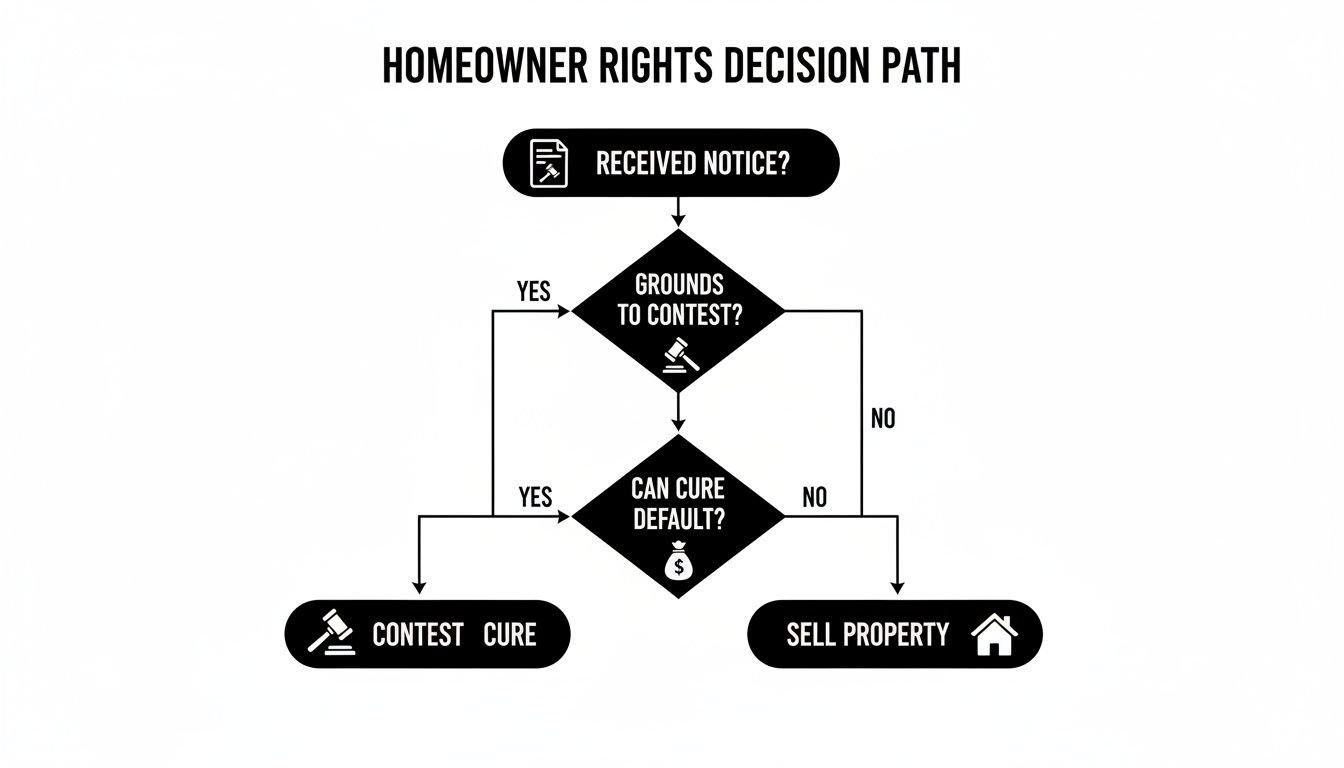
As you can see, it really boils down to three choices: fight it, fix it, or sell it.
Step 4: Choose Your Path
Based on your honest assessment, here are your three options:
- Contest the Notice: If the property isn’t abandoned and you plan on keeping it, you can formally fight the claim. This makes sense if you have every intention of staying or getting the home back in order.
- Cure the Default: This just means you fix the original problem. You might need to catch up on late mortgage payments or make the repairs the county is demanding.
- Sell the Property As-Is: For a lot of folks, especially absentee owners or people feeling the financial pressure, this is the cleanest and fastest way out. Selling your house for cash to a company like DIL Group Home Buyers stops the foreclosure train in its tracks, ends the daily fines, and puts cash in your pocket. It’s a clean break.
Why a Fast Cash Sale Is Your Smartest Move
Once you get a notice of abandonment, trying to sell your house the traditional way is a nightmare. Forget about it. You're suddenly trying to juggle repairs, showings, and realtor commissions while foreclosure looms and city fines are stacking up. It's a slow, expensive gamble, especially for a house that’s sitting empty.
This is where a fast cash sale cuts through all the red tape and stress. It’s not a maybe. It’s a guaranteed solution that puts you back in the driver’s seat.

Skip the Headaches of the Open Market
Let's be real—selling an abandoned property on the market is brutal. You’re expected to get it "show-ready," which could mean shelling out thousands for repairs you don't have. Then you face months of waiting, never knowing if a buyer will just walk away.
A fast cash sale gives you a clean, simple path. It’s one transaction that solves everything.
Selling your house for cash is the fastest way to stop the financial bleeding from a notice of abandonment of property. You stop the foreclosure dead in its tracks, save your credit, and completely sidestep the cost of repairs and those punishing code violation fines.
The Problem With Vacant Houses Is Growing
Your empty home isn't just your problem; it’s part of a huge nationwide issue. In 2024, America had 15.1 million vacant homes, making up about 10% of all housing. This glut of empty houses creates a massive risk for owners like you. Vacant properties are magnets for vandalism and code violations, and sitting empty can slash a property's value by 10-20%. A fast exit isn't just a good idea; it's critical.
If you’re a military family on PCS orders, an out-of-state owner, or someone who inherited a house you can't manage, this situation is a ticking clock. A cash offer turns that liability into instant cash in your pocket. You get a guaranteed closing, fast. No more stress.
The benefits are clear:
- No Repairs Needed: We buy your house completely "as-is." Don't fix a thing.
- No Commissions or Fees: Keep the whole cash offer. You won't pay a dime in agent fees or closing costs.
- Guaranteed Fast Closing: You tell us when to close. It can be as fast as one week.
This is about giving you certainty when you need it most. Our team has seen this exact situation countless times, and we know how to help homeowners in Fayetteville, Hope Mills, and across Cumberland County. To see just how easy we make it, learn more about our process to sell your home for cash.
How We Provide a Solution for Your Property
Getting a notice of abandonment is a huge red flag. It means your property has gone from an asset to a serious liability, and the clock is ticking. We cut through the confusion and turn that problem into cash in your pocket, fast.
It all starts with a simple, no-pressure phone call to our local Fayetteville team. We’ll talk about your situation, and that’s it. No obligation.
Within 24 hours, we’ll give you a fair, all-cash offer for your house. No games, no waiting around. If you like the offer, you tell us when you want to close. Need it done in a week? We can do that. Need a month? That works, too. You’re in control.
Your Direct Path to a Clean Slate
Think of selling to us as your strategic exit. It’s a way to stop the bleeding.
Honestly, it’s a lot like a principle the government itself uses. Federal regulations allow contractors to get rid of worthless inventory when it costs more to keep than it's worth. You can actually read about this concept in Federal Acquisition Regulation 45.603. If you’re a homeowner buried under fines, mortgage payments, and repair bills for a house you’re not even using, you're in the exact same boat. Holding on is costing you more than letting go.
Selling to us is just applying that same commonsense logic. You cut your losses and get rid of an asset that’s draining your bank account.
With DIL Group Home Buyers, you get a clean break. There are absolutely no repairs, no realtor commissions, and no hidden fees. The cash offer you accept is the exact amount you walk away with at closing.
We’ve bought over 150 properties right here in Cumberland County and surrounding towns like Hope Mills and Spring Lake. We get the unique challenges people face here. We’ve helped military families on last-minute PCS orders, landlords who are just done with the headaches, and people who inherited a house they simply can’t manage.
We offer a straight-up, reliable way to turn that problem property into cash. You can stop the fines, dodge foreclosure, and finally move on with your life.
Your Questions About Property Abandonment Notices, Answered
Getting a notice of abandonment of property can feel overwhelming, but you have more control than you think. Let's cut through the confusion and get straight to what you need to know. These are the most common questions we hear from homeowners in your exact situation.
Can I Still Sell My House After Getting an Abandonment Notice?
Yes. Absolutely. Don't let anyone tell you otherwise. Until the foreclosure sale is final, that house is still yours, and you have every right to sell it.
Selling is often the best move you can make. It's how you take back control, stop the foreclosure process cold, and protect your credit from the long-term damage a foreclosure causes. A fast cash sale lets you pay off what you owe and walk away clean.
What If I'm Out of State and Can't Deal With the Property?
This is a situation we see all the time, especially with military families at Fort Bragg getting PCS orders or folks who've inherited a house from a relative. Just because you're an absentee owner doesn't mean the responsibilities go away—you're still on the hook for the mortgage, property taxes, and any fines for code violations.
Selling for cash is the perfect solution for out-of-state owners. We handle everything right here in North Carolina so you don't have to. The entire sale can be managed remotely, giving you a fast, simple closing without a single trip back.
How Fast Can I Sell to Stop the Fines From Piling Up?
Trying to sell on the traditional market can take months. All that time, the fines for uncut grass, unsecured windows, and other issues just keep adding up, putting you in a deeper financial hole.
With a cash buyer, you stop the bleeding immediately. We can give you a fair, no-obligation cash offer within 24 hours. If you accept, we can close in just a few days or on whatever date works for you. The financial drain stops for good, and you can finally put the problem behind you.
If you're dealing with a notice of abandonment and need a quick, guaranteed way out, DIL Group Home Buyers is here to help. We give you a solid cash offer to buy your house "as-is." No repairs, no cleaning, no stress. You can avoid foreclosure and move on with your life.
Get your no-obligation cash offer today at https://dilgrouphomebuyers.com.