
Finding those thin, brownish trails snaking across your ceiling is more than just unsettling—it’s a serious red flag. Those aren't just dirt streaks. They’re active termite tubes in ceiling structures, and they’re proof that you have a hidden, and very busy, infestation.
Their presence means subterranean termites are already inside and feeding on your home.
What Are Those Mud Trails on My Ceiling?
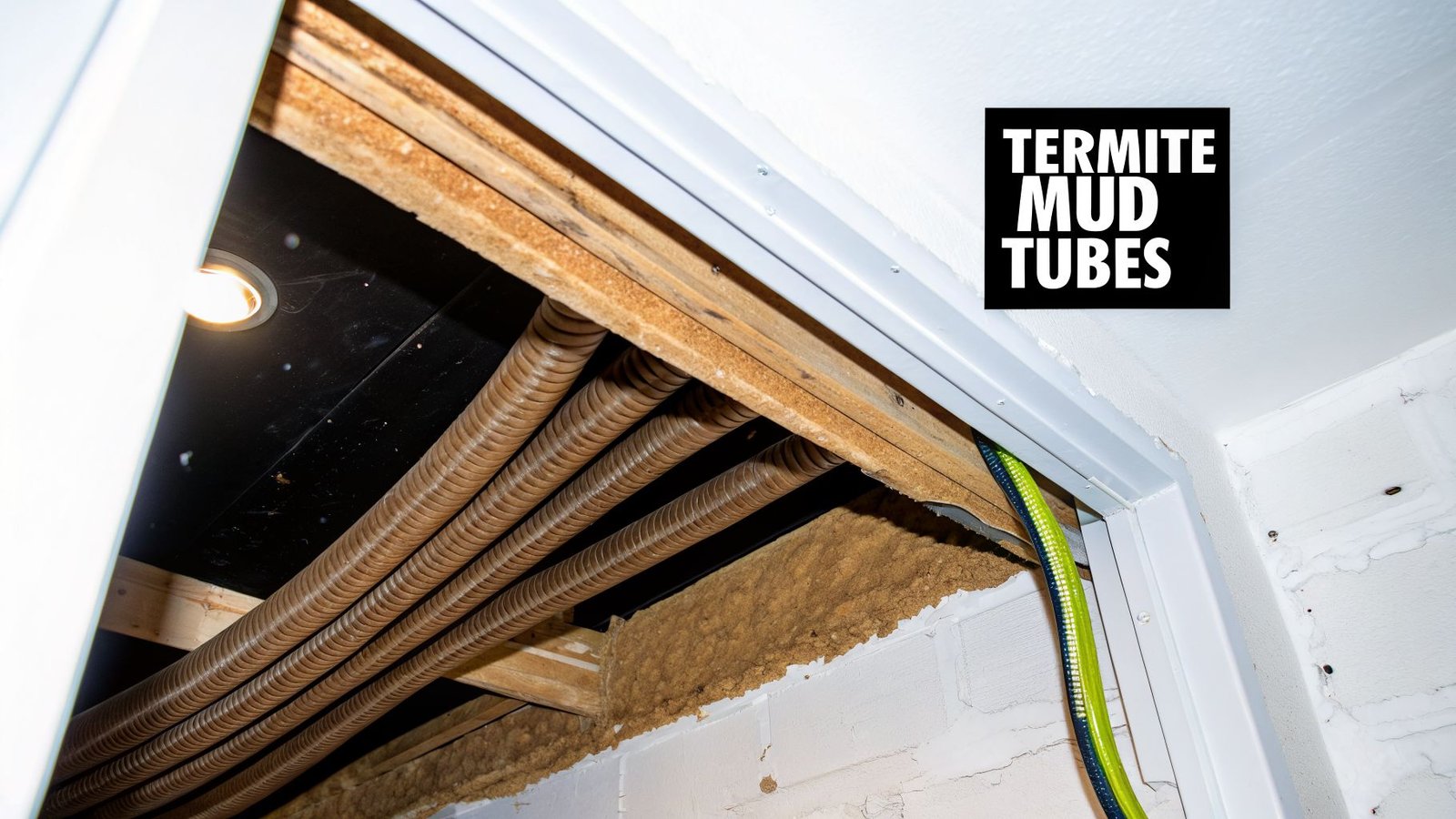
You can think of termite tubes in ceiling areas as covered superhighways, built for one purpose: destruction. Subterranean termites—the most common and destructive kind—construct these tunnels from a mix of dirt, chewed-up wood, and their own saliva. These tubes are absolutely essential for the colony's survival.
A termite tube is basically a protected bridge. It shields thousands of these tiny, soft-bodied pests from predators and dry air, giving them a safe, private road from their underground nest straight to the wood framing your ceiling.
Seeing these tubes is a clear warning sign. It doesn’t just mean termites are somewhere nearby; it confirms they've already gotten past your home's defenses and are actively eating away at its structure. The mud tubes create the perfect dark, damp environment they need to work undetected.
The Highway to Destruction
Imagine a plumbing system designed only to cause damage—that's exactly what these tubes are. They act like a pipeline, funneling a non-stop parade of worker termites and moisture from the soil directly into the wooden heart of your house. From there, they quietly hollow out your ceiling joists, support beams, and rafters from the inside.
Here's the scary part: by the time you actually spot these mud trails, the infestation is far from new. It’s likely been going on for months, maybe even years, silently weakening your home’s integrity. This is especially true here in the humid climate of North Carolina, where termites can cause massive damage in a surprisingly short time.
Spotting these signs means you need to act now. You aren't just looking at dirt on the ceiling; you're looking at the physical evidence of an ongoing assault on your property. Knowing what you're up against is the first step to stopping the damage cold.
Distinguishing Termite Tubes From Other Marks
It’s easy to look at a ceiling and mistake termite tubes for something less sinister, like old water stains or small cracks in the drywall. But if you know what to look for, the differences are obvious.
This quick guide will help you figure out what you're really looking at.
Quick Guide to Identifying Termite Tubes
| Characteristic | Description of Termite Tubes | What It Is NOT |
|---|---|---|
| Texture & Material | Brittle and dry, made of a gritty, dirt-like material. It will crumble easily if you break a piece off. | Flat, discolored stains that are part of the surface, or sections of peeling paint. |
| Shape & Form | Thin, branching lines about the width of a pencil. They often follow structural lines like beams or cross flat surfaces. | Wide, splotchy patches from a roof leak or fine, hairline cracks in the drywall itself. |
| Location | Usually start near foundation walls and travel upward, appearing on ceilings, joists, or coming out of wall joints. | Random spots or circular stains that aren't connected in a clear, linear path. |
Recognizing these key features helps confirm you’re dealing with termite tubes in ceiling structures, not just a simple cosmetic problem that a coat of paint will fix.
Why Termites Build These Tunnels in Your Home
Those dirt trails on your ceiling aren't just random messes. They’re superhighways built by termites, and they're essential for the colony to survive and eat you out of house and home.
Think of subterranean termites as tiny, soft-bodied miners. The open air is their enemy—it dries them out fast. They're also an easy meal for predators like ants.
So, they build these mud tunnels. They're constructed from a mix of soil, chewed-up wood, and termite spit, and they act like climate-controlled subways. This network keeps them safe from the outside world, creating the dark, humid environment they need to get the job done.
From the Ground Up
Let's be clear: a termite problem almost always starts in the soil beneath your house. Subterranean species, like the Eastern Subterranean termite we see all over North Carolina, build huge colonies underground. From that hidden headquarters, they send out search parties looking for one thing: cellulose, the main ingredient in wood.
Termites are relentless explorers. They can enter your home through a foundation crack no wider than a credit card, a small gap around a plumbing pipe, or where wooden structures touch the ground directly.
Once they find a way in, they start their journey up. They build their mud tubes straight up foundation walls, snake them through the inside of your walls, and run them along support beams. That's how they get right to the wood framing in your ceiling.
Seeing termite tubes in ceiling spaces is the final, most visible proof of a long, quiet invasion that started right under your feet.
The Purpose Behind the Pathways
These tubes aren't all the same. Each type has a specific job, and understanding them shows you just how organized the attack on your home really is.
- Exploratory Tubes: You'll see these branching out in different directions. They're thin, break easily, and are built to scout for new food sources. They often look like they lead nowhere.
- Working Tubes: These are the real deal—sturdy, well-traveled highways. They move thousands of worker termites from the nest to the food (your ceiling joists) and back again, creating a constant supply line.
- Swarm Tubes: These are exit ramps built just for the reproductive termites, or "swarmers," to leave the nest and start new colonies. If you see these, usually in the spring, it's a sure sign of a mature, healthy infestation.
Finding these tunnels confirms that termites have set up shop. They aren't just passing through; they've built a sophisticated system to methodically eat away at your home's structure. That hidden underground issue has now become a very visible—and very urgent—problem in your ceiling.
The True Structural Risk Behind Termite Tubes
When you spot termite tubes in your ceiling, it’s easy to get fixated on the visible mess. But what should really worry you is what you can't see. Those mud tunnels are just the highways for a silent, destructive crew that's working around the clock inside your home's framework. The real threat isn't the mud; it's the invisible hollowing-out of your property's wooden skeleton.
Think of a termite colony as a demolition team that never clocks out. The workers travel through their protected tubes and immediately get to work eating away at ceiling joists, support beams, and rafters from the inside. They devour the soft, cellulose-filled interior of the wood, leaving behind a wafer-thin shell that looks perfectly fine on the surface.
This is exactly what makes termites so incredibly dangerous. Your home can look solid and stable from the outside, but its most important supports are being turned into hollowed-out husks. Over time, that hidden damage completely undermines the building's integrity, turning your biggest asset into a major safety hazard.
Spotting Signs of Advanced Damage
Once an infestation gets serious, you might start noticing subtle clues that point to major structural failure. These aren't just cosmetic issues; they are red flags warning you that the damage has become a critical threat. Be on the lookout for these tell-tale signs:
- A Sagging or Drooping Ceiling: This is a classic indicator that the wooden joists above have lost their strength and can no longer hold the weight of the drywall.
- Spongy or Bouncy Floors: If you have an upper story, a floor that feels unusually soft or springy is a bad sign. It often means the floor joists—which are also the ceiling joists for the room below—are severely compromised.
- Faint Rustling or Clicking Sounds: Go into a room and just listen. In the quiet, you might be able to hear faint crackling or clicking sounds from inside the ceiling or walls. That’s the sound of thousands of termites chewing away.
The mud tubes are your first warning shot. But these other signs mean your home's structure is actively failing. Ignoring them can lead to a worst-case scenario, like a total ceiling collapse.
The Financial Devastation of Termite Damage
That structural risk very quickly becomes a financial nightmare. In the U.S., termites chew their way through about 600,000 homes a year, with subterranean species causing up to 95% of that damage. A single, mature colony can eat nearly a pound of wood every single day. Here in North Carolina, with our warm and humid weather, they can seriously weaken a home’s ceiling structure in less than six months.
By the time you see the damage, you’re likely looking at average repair costs anywhere from $3,000 to over $8,000—and that doesn't even include the cost of exterminating the termites.
Here’s the gut punch: this is almost always an expense you have to pay entirely out of your own pocket. Standard homeowner's insurance policies flat-out refuse to cover termite damage. They consider it a preventable problem that falls under routine maintenance. For a homeowner, that means facing a massive, unexpected repair bill with zero help from your insurance company. In the most extreme cases, you may need to learn what happens when a house is condemned, because that becomes a very real possibility.
Professional Treatment Versus DIY Approaches
So, you’ve spotted those tell-tale termite tubes in your ceiling. Your first instinct is probably to grab a can of bug spray and declare war. I get it. But this isn't a fight against a few stray ants; you're up against a hidden, highly organized army.
Choosing between a DIY fix and calling in the pros will be the difference between solving the problem for good and just wasting time while your home gets eaten from the inside out.
Those off-the-shelf baits and sprays you see at the hardware store are tempting. They feel like a quick, cheap win. The problem? They're designed to kill the handful of termites you can actually see. They might knock out a few workers in one section of a mud tube, but they won't do a single thing to the colony itself, which can have over a million termites living deep underground.
Why Professional Treatment Is The Only Real Solution
Think of it this way: using a DIY spray on a mud tube is like trying to fix a burst pipe with a single paper towel. You’ve dabbed at the visible water, but you haven’t done anything to stop the gusher behind the wall.
A real pest control professional is the plumber who comes in, finds the main water valve, and shuts the whole thing down. They know what they're doing because their entire strategy is built on years of experience with termite behavior.
- A Thorough Inspection: They don’t just glance at the ceiling. A pro will comb through your entire property—from the foundation slab all the way up to the attic—to map out every entry point, figure out how bad the damage is, and identify the exact species of termite you're dealing with.
- Targeted Elimination: Armed with that knowledge, they deploy powerful, professional-grade termiticides or sophisticated baiting systems. These aren’t just poisons; they’re designed to be carried back to the nest by the workers, wiping out the entire colony from the inside. Queen and all.
This isn’t just about getting rid of a few bugs. It’s about killing the source. This timeline shows just how fast the damage can spiral when the colony is left to do its work.
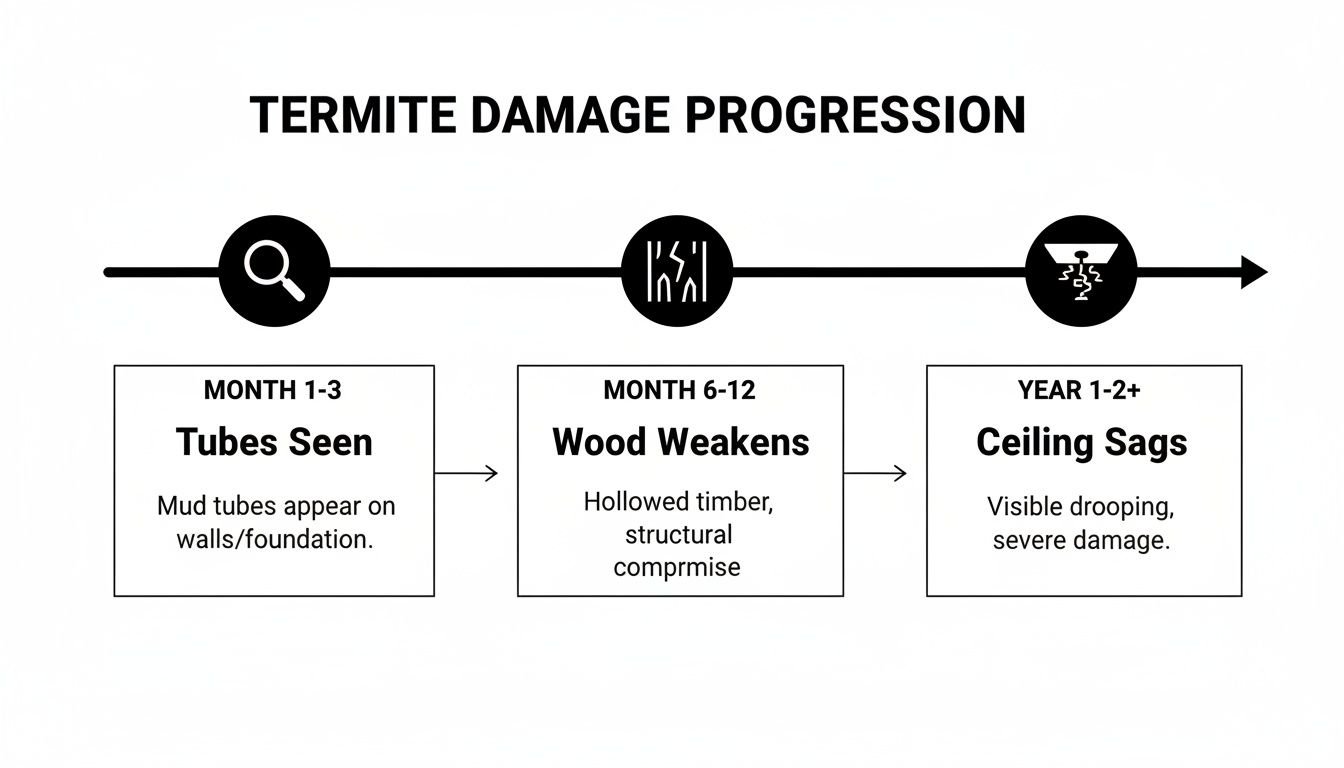
As you can see, those visible tubes are just the tip of the iceberg. They're the first sign of a process that leads to weakened wood and, eventually, serious structural failure if you don't cut it off at the source.
Understanding the Costs
I know what you're thinking—professional treatment sounds expensive. And yes, it's an investment. But it’s a heck of a lot cheaper than the cost of doing nothing.
An initial inspection might be low-cost or even free. A full treatment can run anywhere from $1,200 to $2,500 or more, depending on how big your house is and how severe the infestation has become.
But here’s the key: that cost stops the damage. It protects your home’s value. It’s not a sunk cost like the money you’d waste on ineffective DIY sprays. It's a smart, effective decision. Often, homeowners are dealing with multiple big problems at once, and it's always best to get a professional eye on the situation. For example, people sometimes have to learn how to sell a fire-damaged home, which is another scenario where cutting corners just doesn't work. When it comes to termites, paying for a professional is the only way to truly protect your property.
Your Options for a Home with Termite Damage
Finding those termite tubes in your ceiling is a gut punch. Suddenly, you're facing a tough decision with a lot of money and stress on the line. What do you do next?
When you’re staring at that kind of damage, you really have two choices. Each path has completely different costs, timelines, and headaches involved.
Path One: Repair and Restore
The first option is the one most people think of initially: fix everything. This is the traditional route, but be warned—it’s a long, expensive, and often overwhelming project. You’re not just patching a few spots; you’re signing up for a major renovation.
Here’s what that typically looks like:
- Termite Eradication: First things first, you have to get rid of the pests. This means calling in a pro to treat the entire house, which can cost thousands and might even mean you have to move out for a bit.
- Structural Repairs: Once the termites are gone, a structural engineer needs to tell you how bad the damage really is. Then, you hire contractors to tear out and replace all the compromised wood in your ceiling joists and beams. This is the most expensive part.
- Cosmetic Fixes: After the structure is sound again, you have to deal with the cosmetic mess—patching drywall, repainting ceilings, and making everything look normal again.
This whole process can drag on for months and easily cost you tens of thousands of dollars. If you have the savings, the time, and the patience for a huge project, this can work. But for many, it’s just not realistic.
Path Two: Sell Your Home As-Is
What if you can’t—or just don’t want to—deal with all that? If you're facing a sudden military PCS, dealing with an inherited property, or just don’t have the cash for a massive repair job, there's a much faster way out. You can sell your home as-is to a cash buyer.
Selling "as-is" means you don’t have to fix anything. You don't treat the termites, you don't replace the damaged wood, and you don't even have to clean up. You sell the house in its current condition, damage and all.
We are DIL Group Home Buyers, and this is exactly what we do. We buy houses with serious problems, including homes eaten through by termites. This route lets you skip the entire repair nightmare. Instead of pouring your time and money down the drain, you can get a fair cash offer and be done with it in a few weeks, sometimes even days.
Those dangling termite tubes from a Spring Lake ceiling aren't just an eyesore—they're a sign of a massive problem that costs Americans $5 billion a year. With 600,000 homes hit annually, many owners face average repair bills of $3,300, which can easily jump past $8,000 for severe ceiling damage—costs that insurance almost never covers.
For sellers in a tough spot, this can lead to code violations and a trashed property value. You can learn more about this common issue in our guide on selling a house with code violations. We've helped over 150 owners in these exact situations by buying their termite-damaged homes for cash. It’s a straightforward solution that’s perfect for military families near Fort Bragg and anyone else who just needs to move on. The staggering financial impact of termite damage is real, but it doesn't have to be your problem.
Common Questions About Termite Tubes in Ceilings
Finding what looks like dirt trails on your ceiling is enough to make any homeowner’s heart sink. It's alarming, and you’ve got urgent questions. When you spot termite tubes in ceiling areas, you need answers—fast. Here are the questions we hear all the time.
If I Scrape Away the Mud Tubes Will the Termites Be Gone?
Absolutely not. Knocking down a mud tube is like wiping a muddy footprint off the floor. You’ve cleaned up the mess for a minute, but the person who made it is still walking around your house.
You’ve only destroyed the highway, not the city. The real problem is the colony, which can have over a million termites living underground. They’ll just rebuild the tubes—sometimes in the exact same spot—or find a new way to get to their next meal: your house. It’s a purely cosmetic fix that accomplishes nothing.
How Long Does It Take for Termites to Cause Serious Ceiling Damage?
This all comes down to the colony’s size, age, and species. But it happens a lot faster than you’d think.
A big, mature colony can cause real, structural damage to your ceiling joists in as little as one to two years. Here in North Carolina, our warm and humid weather puts that process into overdrive.
Let’s be clear: by the time you actually see mud tubes on a ceiling, that colony is already well-established. The clock has been ticking for a while, and the damage is already happening inside your walls.
Can I Sell a House That Has Active Termites or Past Damage?
Yes, you can. But selling a house with a known termite problem on the open market is a nightmare. As soon as that inspection report comes back, most buyers run for the hills. Lenders won't even touch a property with active structural pests.
You’re also legally required to disclose the termite issue, which puts you at a huge disadvantage.
The simplest way out is to sell the house "as-is" to a cash home buying company. We specialize in properties with major issues, including termite damage. We buy the house exactly as it is, so you don't have to deal with exterminators or expensive repairs. You get a fast, guaranteed sale and can just walk away from the problem.
Are you facing the stress of termite damage and just want to be done with it? DIL Group Home Buyers can help. We buy houses in any condition for cash, allowing you to walk away from the problem without making a single repair. Get your fair, no-obligation cash offer today at https://dilgrouphomebuyers.com.