
Filing a quitclaim deed is a three-part dance: you draft the document with all the right legal details, sign it in front of a notary, and then get it recorded down at the county’s Register of Deeds office. It's a popular way to move property around, especially inside a family, but it comes with one massive catch—it offers zero guarantee you’re getting a clean title.
What a North Carolina Quitclaim Deed Really Means
Before you even think about filing a quitclaim deed, you have to understand what it does and, more importantly, what it doesn’t do.
Think of it as simply releasing a claim. The person signing the deed (the grantor) is basically saying, "Whatever piece of this property I own, I'm handing it over to you, the grantee."
But that transfer comes with a huge warning label that everyone in Fayetteville, Hope Mills, and beyond needs to see: a quitclaim deed offers zero warranty of title.
The "No Warranty" Catch
"No warranty" isn't just lawyer-speak; it's the whole point. It means the grantor isn’t making a single promise about the property's history. They are not guaranteeing they legally own it, that it’s free from liens, or that some long-lost cousin won’t show up with a claim to it.
The person receiving the deed only gets whatever interest the grantor had to begin with—which could be 100% ownership, 50% ownership, or absolutely nothing.
This is the complete opposite of a General Warranty Deed, which is what you'll see in almost every standard home sale. With a warranty deed, the seller makes several legally binding promises, including that the title is clear and that they’ll defend the buyer if any issues pop up later.
A quitclaim deed is like being handed the keys to a car. The person giving them to you isn't promising they own the car or that there isn't a massive loan on it. You get the keys, but you also get any and all problems that might come with them.
So, When Does a Quitclaim Deed Actually Make Sense?
With that kind of risk, why on earth would anyone use one? It all comes down to trust and context. Quitclaim deeds are really meant for situations where the people involved already trust each other and money isn't changing hands in a typical sale.
Here in Cumberland County, we see them used all the time for things like:
- Passing Property to Family: Gifting a house to a son or daughter, or transferring a shared cabin between siblings. Everyone involved already knows the property's story.
- Changing Title After Marriage or Divorce: A spouse might use a quitclaim to add their new partner to the deed. In a divorce, one spouse will often sign a quitclaim to hand over their share of the house to the other.
- Fixing a "Cloud" on a Title: Sometimes a title search flags a potential issue, like a possible claim from an heir of a previous owner. That heir can sign a quitclaim to officially state they have no interest, clearing up the title for good.
- Moving Property into a Trust: People often use a quitclaim deed to move their home into a living trust as part of their estate plan.
In these situations, the goal isn’t to sell to a stranger—it’s just to officially shuffle ownership between people who already have a relationship. The lack of warranty is okay because the transaction isn’t a high-stakes, arm’s-length sale. Getting this difference is the first step to knowing if a quitclaim is the right move for you.
Drafting Your Quitclaim Deed Correctly
Getting the details right on the deed itself is non-negotiable. A small mistake can cause the Cumberland County Register of Deeds to reject your filing, or worse, create a legal nightmare down the road. This isn't just about filling in blanks; it's about creating a clear, legally sound document that does exactly what you intend it to.
Think of the deed as the official instruction manual for your property's ownership. Vague or incorrect instructions will only lead to confusion.
Identifying the Grantor and Grantee
First things first, you need to clearly name the people involved. The grantor is the person giving up their interest in the property, and the grantee is the one receiving it. Sounds simple, but precision is everything here.
You must use full, legal names. "Bob Smith" isn't going to cut it; you need "Robert J. Smith." If the property is going to a married couple, you'd list both of their full legal names, like "John A. Doe and Jane B. Doe." Getting this wrong can create what’s known as a "cloud" on the title, making it a headache to sell or refinance later.
- Tip for Grantors: Your name on the quitclaim deed has to match exactly how it appears on the current deed that gave you ownership.
- Tip for Grantees: Double-check the spelling of your full legal name. This is how your ownership will be recorded for everyone to see.
The All-Important Legal Description
This is where many DIY quitclaim deeds fall apart. You can't just use the street address, like "123 Main Street, Fayetteville, NC." A legal property description is a highly specific, formal description that pinpoints your exact parcel of land on the planet.
This description might reference lot and block numbers, subdivision names, or even detailed surveyor's measurements known as metes and bounds. A mistake here could mean you accidentally transfer the wrong piece of land or create an invalid deed.
So, where do you find this critical info?
- Look at the Existing Deed: The easiest spot is on the most recent deed recorded for your property.
- Check County Records: The Cumberland County Register of Deeds office has all property records. You can often look up your property online to find the official legal description.
- Review Your Property Tax Statement: Your tax bill often includes the full legal description or a parcel identification number (PIN) that points you to it.
Getting the legal description perfect is not optional. An inaccurate or incomplete description is one of the fastest ways to have your quitclaim deed rejected or, even worse, invalidated years after you file it.
Defining the Consideration Clause
Every deed has to mention "consideration"—the legal term for what's being given in exchange for the property. In a normal sale, the consideration is the purchase price.
With quitclaim deeds, though, money often isn't changing hands. It might be a gift to a family member or part of a divorce settlement. Even in these cases, you still need a consideration clause.
It's common practice in North Carolina to state a nominal amount, such as "For the sum of Ten Dollars ($10.00) and other good and valuable consideration." This language checks the legal box without needing to disclose private financial details or state that the property was a gift.
This flowchart shows three of the most common situations where a quitclaim deed is the right tool for the job.
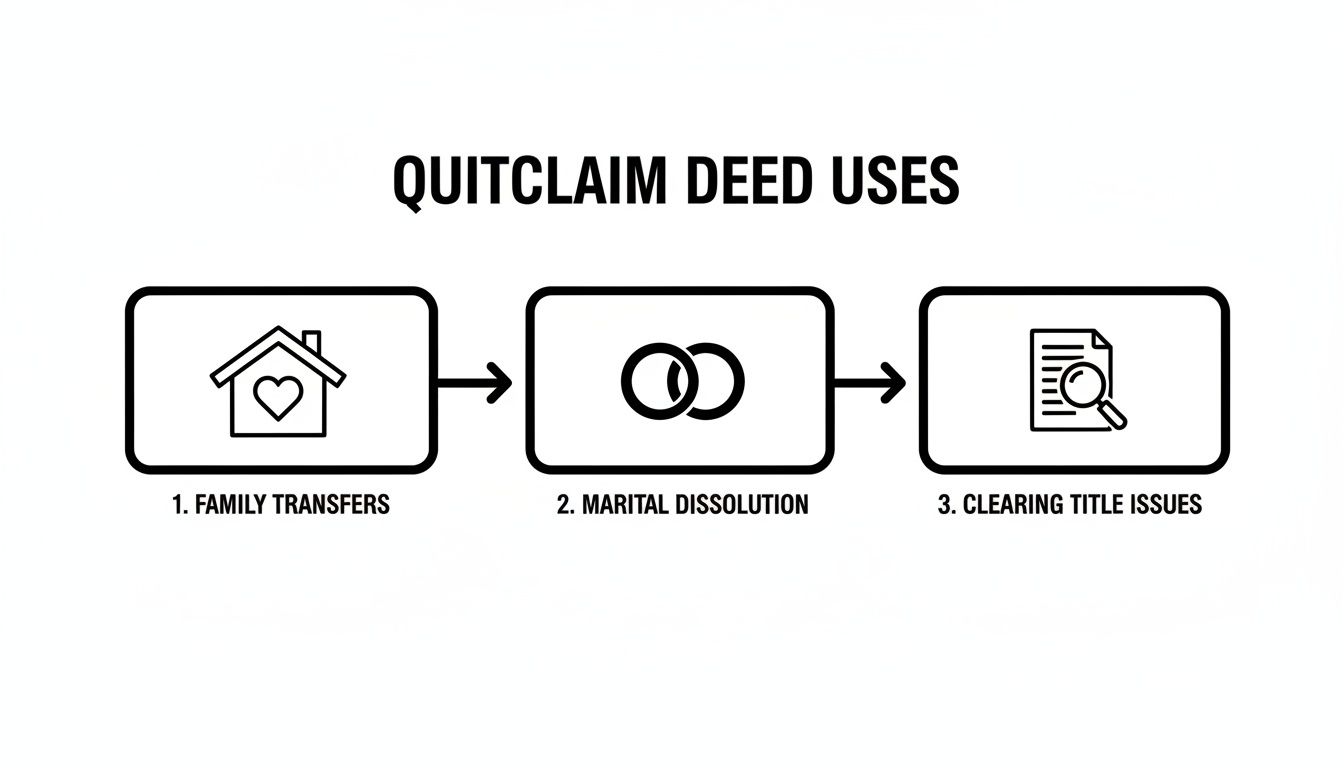
As you can see, these transfers are usually built on trust between family or used to fix a specific title issue—not for a traditional sale to a stranger.
A Quick Drafting Checklist
Before you head to the notary, run through this checklist. A few minutes of review now can save you weeks of hassle.
- Grantor's Name: Is it the full, legal name, spelled correctly, and an exact match to the prior deed?
- Grantee's Name: Is it the full, legal name, spelled perfectly?
- Legal Description: Is it the complete, official description copied word-for-word from a reliable source?
- Consideration Clause: Did you include the "ten dollars" or other appropriate language?
- Preparer's Information: North Carolina deeds often require the name of the person who drafted the document.
By meticulously checking these points, you give yourself the best shot at a smooth filing and a clean transfer of property.
The Right Way to Sign and Notarize Your Deed
You’ve carefully drafted the quitclaim deed, and now you’re at the most critical moment: making it legally binding. This isn’t just about putting pen to paper. A simple slip-up here, like a missed signature or a botched notarization, can unravel the entire transfer and send you right back to square one.
In North Carolina, the law doesn't mess around. The grantor (that’s the person transferring the property) must sign the deed in the presence of a notary public. This is a non-negotiable rule. The Cumberland County Register of Deeds simply won't record it otherwise. The notary is there to act as an official, impartial witness who confirms your identity and makes sure you're signing without being pressured.
Finding a Notary and What to Bring
Luckily, finding a notary public around Fayetteville is pretty easy. Most banks, shipping centers like UPS or FedEx, and local law offices have one on staff. Just searching for a "notary near me" online will give you plenty of options.
When you head to your appointment, make sure you have these items with you:
- The Unsigned Deed: I can't stress this enough—do not sign it ahead of time! The whole point is for the notary to watch you sign.
- A Valid Photo ID: You’ll need your driver's license, a passport, or a military ID. The notary needs to verify you are who you say you are.
- Cash for Notary Fees: North Carolina caps these fees, so it's very affordable, but it's good to have a few dollars on hand to pay for the service.
The notary will watch you sign, ask you to confirm that you’re doing it willingly, and then they'll complete their part of the form with their signature and official seal. That seal is the golden ticket the county needs to accept the deed.
What About Witnesses?
This is a question I get all the time. While some states make you round up a couple of witnesses to sign along with the notary, North Carolina does not. As long as a licensed notary public properly acknowledges the grantor's signature, you’re good to go.
The notary's seal is everything. In North Carolina, that stamp is the official proof that makes a deed recordable. Without it, the Register of Deeds will reject your filing, no matter how perfect the rest of the document is.
Handling Out-of-State Signatures: A Common Scenario for Military Families
What happens if the grantor isn't even in North Carolina? This is a daily reality for military families near Fort Bragg who own property here but are stationed elsewhere. The good news is, the process is almost identical.
The out-of-state grantor just needs to find a licensed notary in their current state. That notary will handle the identity verification and witness the signature just like a local one would. Thanks to the Full Faith and Credit Clause of the U.S. Constitution, North Carolina recognizes a notarization from another state as long as it was done correctly according to that state's laws.
This keeps property transfers moving smoothly, even when people are hundreds or thousands of miles apart.
The key remains the same: the signature must be original and properly notarized. It’s a crucial safeguard. A legitimate quitclaim deed needs the right property description, grantor/grantee names, and transfer date, but the signature is what brings it to life. Unfortunately, criminals can forge deeds, using fake IDs to trick a notary. You can learn more about how criminals exploit the quitclaim deed process and how to protect yourself. This is why a real, verified signature is so vital. Once you've got it, you’re ready to make it official.
Recording Your Deed in Cumberland County
You’ve drafted the quitclaim deed, gotten the signatures, and had it notarized. You're almost there, but there’s one final, absolutely critical step: recording it.
Think of it this way: an unrecorded deed is like a private handshake. It’s a nice gesture, but in the eyes of the law, the property transfer hasn’t officially happened yet. Recording the deed is what makes the change of ownership a permanent, searchable part of the public record, protecting everyone involved.
For anyone with property in Fayetteville, Hope Mills, or anywhere else in the county, this means heading down to the Cumberland County Register of Deeds. This is the official keeper of all land records, and getting your deed on file there is non-negotiable. If you skip this, the new owner (the grantee) is left wide open to future claims or liens against the property.
Where and How to File
The good news is, getting your document recorded is pretty straightforward. You can handle it in person or by mail. The key thing to remember is you absolutely must submit the original, signed, and notarized deed. They will not accept photocopies under any circumstances.
The Cumberland County Register of Deeds is located right in downtown Fayetteville:
- Address: 117 Dick Street, Room 114, Fayetteville, NC 28301
- Hours: Monday through Friday, 8:00 AM to 5:00 PM
- Pro Tip: It never hurts to call their office with any specific questions before you head over.
When you get there, a clerk will give your document a quick review to make sure it meets all of North Carolina’s formatting rules. As long as everything looks correct, they’ll accept it for recording.
Understanding the Recording Fees
You’ll have to pay a recording fee when you file. These costs are set by state law and can change, so it’s always smart to double-check the current amount.
Right now, the standard recording fee in North Carolina is $26.00 for the first 15 pages. A typical quitclaim deed is just a couple of pages long, so that’s likely all you’ll pay.
The Cumberland County office makes payment easy:
- Cash
- Business Check or Money Order (made out to "Cumberland County Register of Deeds")
- Credit or Debit Cards (Visa, MasterCard, Discover)
If you’re mailing the deed in, make sure you include a check or money order for the exact fee. Sending the wrong amount will only cause delays.
Recording your deed isn't just a piece of bureaucratic red tape. It’s the action that legally cements the property transfer. It tells the world who the new owner is, protects their rights, and keeps the chain of title clean for any future sales.
Confirming Your Deed Is Recorded
So, what happens after you file? The Register of Deeds office will scan the original deed into their system, give it an official book and page number, and then mail the original document back to you (or whoever you designate on the form). This usually takes a few weeks.
But you don't have to sit around waiting for the mail to know it's done. The Cumberland County Register of Deeds has an online search portal. A few days after you file, you can usually search by the grantor or grantee’s name and see the recorded document right there on your screen.
This final check gives you peace of mind that the quitclaim deed process is officially complete. It's an especially vital step when dealing with inherited property, as it finalizes the transfer for the estate's records. If you're navigating that situation, our guide on how to sell an inherited property in North Carolina can offer more specific advice.
Common Quitclaim Deed Mistakes and Risks
A quitclaim deed looks simple. It's often just a page or two. But don't let that fool you—its simplicity is exactly what makes it so risky and prone to expensive mistakes. A tiny error, like a misspelled name or an incorrect legal description of the property, is all it takes for the Cumberland County Register of Deeds to reject it. That means delays, headaches, and starting all over again.
Those aren't just paperwork problems, either. They can create real legal nightmares down the road. The biggest danger isn't what's written on the deed, but what's missing: any sort of guarantee for the person getting the property.
The Hidden Dangers for the New Owner
If you’re the one receiving property via a quitclaim deed (the "grantee"), all the risk lands squarely on your shoulders. You're accepting the property completely as-is, warts and all. The person giving it to you (the "grantor") isn't promising they actually own it or that the title is clean.
This means you could suddenly be the proud new owner of a property with some serious financial baggage attached.
- Existing Liens: You could inherit tax liens, liens from unpaid contractors (mechanic's liens), or even judgment liens from old lawsuits.
- Unpaid Mortgages: The original mortgage doesn't just vanish. The lender can—and will—still foreclose on the property, even if your name is on the deed now.
- Title Defects: There might be unresolved ownership claims from long-lost heirs, disputes over property lines, or other "clouds" on the title that are now your mess to clean up.
Since a quitclaim offers zero warranty, you have no legal comeback against the grantor if these issues pop up. You get the property and all its hidden problems. If you find yourself in that boat, you can learn more by checking out our guide on how to remove a lien from a property in North Carolina.
The Alarming Rise of Deed Fraud
Beyond honest mistakes, there's a much scarier risk: quitclaim deed fraud. Scammers love how simple these documents are. They can forge an owner's signature, use a fake ID to get it notarized, and file it with the county—all without the real owner's knowledge.
Just like that, a criminal has a legal-looking document that says they own your property. They can then try to sell it out from under you or take out a loan against it. This isn't a rare occurrence; it's a fast-growing problem for property owners everywhere.
A quitclaim deed's power lies in its simplicity, but that same simplicity makes it a magnet for fraud. One forged signature can strip you of your most valuable asset, leaving you with a costly and emotionally draining legal battle to reclaim what was rightfully yours.
Recent data shows just how vulnerable some properties are. A National Association of REALTORS® report found that 63% of real estate professionals knew of deed fraud happening in their markets just last year. Criminals aren't usually targeting the home you live in. They're looking for properties that aren't closely monitored, like vacant land (which made up 52% of fraud cases) and empty houses. You can read the full research about these deed and title fraud patterns to see why out-of-state owners are especially at risk.
This is why you have to be absolutely meticulous when preparing a quitclaim deed. Every single detail, from names to legal descriptions, must be perfect to ensure the document is valid. Given the potential for error and the serious risks involved, getting professional guidance is almost always the smart move.
Is a Quick Cash Sale a Better Option?
Filing a quitclaim deed is a great tool for simple title transfers, but let's be honest—sometimes it’s just a small fix for a much bigger headache. The paperwork might actually be the easiest part of your problem, especially if you're dealing with a property that's become a source of major stress.
If your house is falling apart, you’re staring down a foreclosure notice, or you’ve inherited a property from halfway across the country, you know the real issues go far beyond signing a document. This is exactly where a direct cash sale shines as a faster, simpler, and more complete solution. The goal isn't just to move a name on a title; it's to end the property problem for good.
When Paperwork Just Isn't Enough
For a lot of homeowners I talk to in Cumberland County, the problems are tangled. A quitclaim deed won't patch a leaky roof, handle a difficult tenant, or convince the bank to stop foreclosure proceedings. In situations like these, what you really need is a clean break, not just a change of ownership on paper.
Think about these all-too-common scenarios:
- A Distressed Property: The house needs thousands in repairs you simply can't afford. Handing it to a family member with a quitclaim deed just passes the financial burden to them.
- An Out-of-State Inheritance: You live hours away and just inherited a home in Fayetteville. Trying to manage repairs, cleanouts, and general upkeep from a distance is a logistical and financial nightmare.
- Urgent Financial Needs: You're behind on the mortgage or other bills and need to get the equity out of your home now. The traditional real estate market can drag on for months you don't have.
In these cases, figuring out how to file a quit claim deed takes a backseat to finding a swift, final resolution.
The Cash Sale Alternative
A direct cash sale gives you a clear path forward. Forget about juggling deeds, realtors, and months of uncertainty. The process is straightforward and built for one thing: speed. It’s designed to lift the entire weight of a problem property off your shoulders in a single transaction.
At DIL Group Buyers, we've honed this process to cut out all the typical stress points of selling a house. You don't worry about repairs. You don't worry about cleaning out the property. You don't even worry about closing costs. We take care of all of it.
A cash sale isn't just about getting money for your house; it's about trading a complicated problem for a simple solution. It allows you to walk away with certainty, knowing the issue is completely resolved without any lingering responsibilities or hidden fees.
Our approach is built on transparency. You make one call, and our team gives you a fair, no-obligation cash offer based on your property's current "as-is" condition. That means you won't spend a single dime or another minute on renovations.
This is especially helpful for anyone who needs to act fast. We can often close in a matter of days, or we can work on a timeline that suits you. That kind of speed and certainty is something a quitclaim deed or a traditional market sale just can't promise. If you’re looking for a no-hassle way to move on, you can learn more about how to sell your home for cash and see if it’s the right move for you.
At DIL Group Buyers, we know every homeowner's situation is different. If you're facing a property challenge in Cumberland County, reach out for a fair, no-pressure cash offer and find out how simple selling your house can be. See how we can help at https://dilgrouphomebuyers.com.