
When you inherit a house in Fayetteville or near Fort Liberty, it can feel like you’ve been thrown into the deep end, especially while you're grieving. The legal and financial duties pile up fast, but you don't have to tackle everything at once.
The secret is to focus on a few immediate tasks that protect the property and set you up for a smoother sale down the road. Let's set aside the legal jargon for a minute and focus on the practical first steps.
Your First Moves After Inheriting a Home
Your first job is to secure the house. Seriously. Make sure every door and window is locked tight. It's often a good idea to change the locks, especially if keys were given out to neighbors or caregivers. Keep the lawn mowed and the mail collected—anything to make it look lived-in. This simple act is your best defense against vandalism and helps preserve the home’s value while you get the estate's affairs in order.
Locating the Will and Understanding Your Role
Next up, you have to find the will. This document is the playbook for everything that follows. It names the executor—the person with the legal green light to manage the estate, which includes selling the property.
If you’re named the executor, your job is to act in the best interest of the estate and all its beneficiaries. If there's no will (this is called being "intestate"), the North Carolina courts will step in and appoint an administrator, usually a close relative, to take on these responsibilities.
Once you have the will, it's time to make some calls. This isn't just a courtesy; it's about protecting the estate from debt and legal headaches.
- Mortgage Lender: Give them a call to inform them of the owner's passing. You'll need to understand the loan's status and make sure it doesn't go into default.
- Utility Companies: Contact the electric, water, and gas providers. You’ll need to decide whether to transfer the services into the estate's name or shut them off. Pro tip: keeping the power and water on can prevent bigger problems, like frozen pipes in the winter.
- Insurance Provider: Make sure the homeowner's insurance policy is still active. This is non-negotiable. You need that protection against fire, theft, or liability until the house is sold.
Taking these first steps methodically will save you from major headaches later. A calm, organized approach turns a massive, overwhelming task into a series of small, manageable actions.
Before you dive in, it’s helpful to have a quick checklist of your first priorities. These are the immediate, must-do items to get the ball rolling.
Initial Action Checklist for Inherited Homes
| Task | Why It's Important | Key Document Needed |
|---|---|---|
| Secure the Property | Prevents vandalism, theft, and squatting, which protects the home's value. | Keys to the property; contact for a locksmith. |
| Locate the Will | Identifies the executor and outlines the deceased's wishes for the estate. | The original Last Will and Testament. |
| Obtain Death Certificate | This is the official proof needed for nearly all legal and financial actions. | A certified copy of the death certificate. |
| Notify Key Parties | Keeps accounts in good standing and avoids legal or financial penalties. | Mortgage statement, utility bills, insurance policy. |
This checklist isn't exhaustive, but it covers the critical first moves that will establish a solid foundation for everything else that needs to happen.
Setting Realistic Timeline Expectations
It's also crucial to set your expectations for the timeline. Selling an inherited property isn't like a typical home sale. It takes a lot longer. We're talking an average of 9 to 18 months, a far cry from the 55 days a standard sale might take.
Why the long wait? It almost always comes down to the probate process, which is the court-supervised procedure for officially transferring ownership to the heirs. You can learn more about the probate timeline on resources like houzeo.com. Having patience is key, especially if you're coordinating with other family members or trying to manage the property from out of state.
Navigating the North Carolina Probate Process
Probate. It’s a word that can make anyone dealing with an inherited property feel instantly overwhelmed. Here in North Carolina, probate is simply the official, court-supervised process for handling a loved one’s estate. It validates the will (if one exists) and gives the executor the legal green light to manage everything—including selling the house.
Think of the Clerk of Superior Court in Cumberland County as the referee, ensuring everything is handled by the book.
If the property was owned solely by the person who passed away, going through probate isn't optional. Without it, you have zero legal authority to sign a sales contract or transfer the deed to a new owner. The whole point is to get a crucial document called Letters Testamentary (with a will) or Letters of Administration (without a will). This piece of paper is your golden ticket, proving you can legally act on behalf of the estate.
The first move is filing the will with the Clerk of Superior Court. Once the court accepts it and you're officially appointed as the executor, your duties kick in. You'll need to notify heirs and creditors, create an inventory of all assets, and eventually, distribute what's left according to the will. We cover these steps in more detail in our guide to probate property sales in NC.
This chart breaks down the very first things you need to do, which lead directly into the formal probate process.
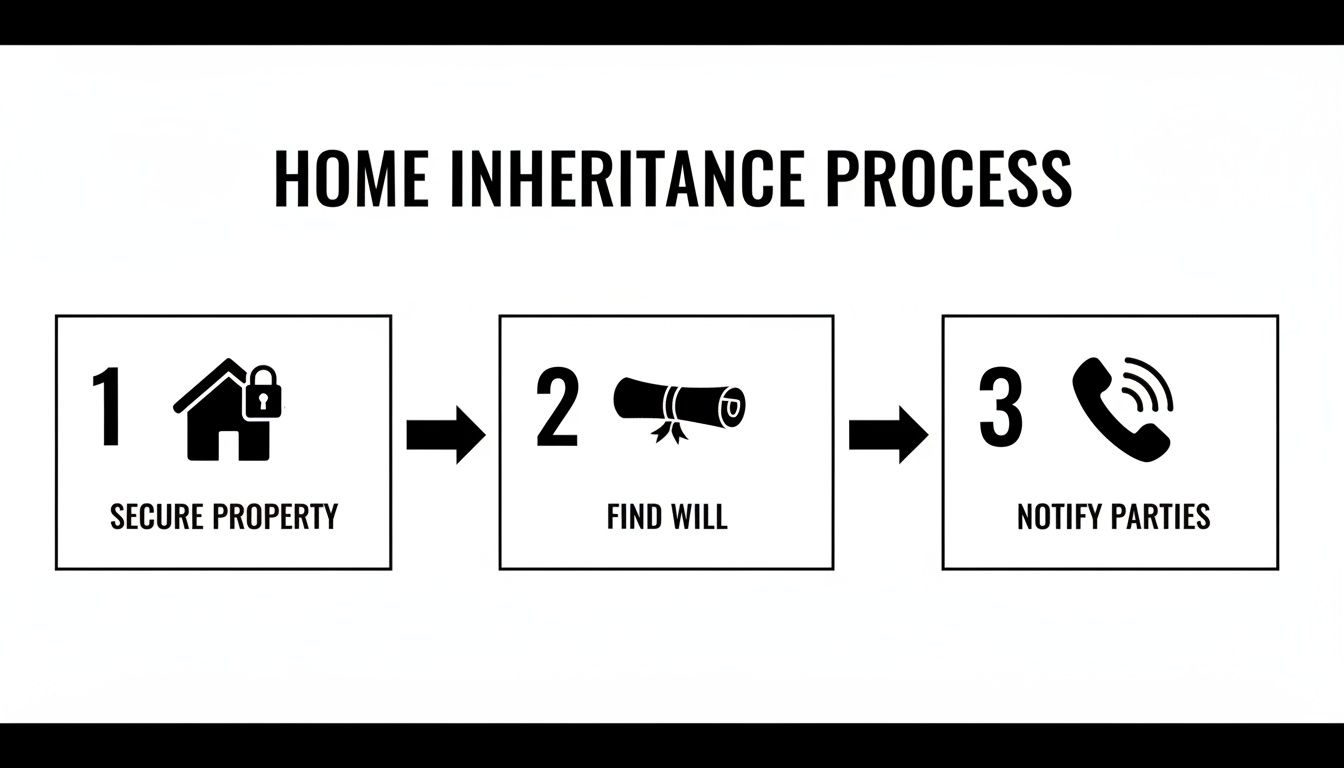
Each step is built on the one before it, creating a clear path from securing the home itself to starting the legal footwork required to sell it.
When There Is No Will: Intestate Succession
So, what happens if your loved one passed away without leaving a will? This situation is called intestate succession, and it means North Carolina state law gets to decide who inherits the property. The process is a lot like probate, but the court appoints an "administrator" instead of an executor to manage the estate.
For example, if the deceased had a spouse and two children, the law might give the spouse the first $60,000 of personal property plus one-third of what's left of the estate. The children would then split the remaining two-thirds. As you can imagine, this gets complicated fast, especially when you have multiple heirs who can't agree on what to do with the house.
The administrator has to strictly follow the state's inheritance hierarchy, which can sometimes lead to results the family never would have wanted.
Potential Roadblocks During Probate
The path through probate is rarely a straight line. All sorts of issues can pop up, dragging out the timeline and piling on the stress. Knowing what these hurdles are ahead of time can help you prepare.
Here are a few common challenges we see:
- Creditor Claims: The executor is responsible for notifying all known creditors and even publishing a public notice for any unknown ones. These creditors have a limited time to make a claim against the estate for unpaid debts. Those bills have to be paid before any heirs get a dime. An old medical bill or forgotten credit card debt can easily hold things up.
- Will Contests: Sometimes, an unhappy family member might challenge the will's validity. They could argue that the deceased wasn't of sound mind or was pressured into signing it. A will contest can lock up the entire estate in a legal battle for months, or even years.
- Disagreements Among Heirs: This is probably the most common roadblock of all. I've seen it countless times. One sibling wants to sell the house for cash right now. Another wants to spend money on renovations and list it with a realtor. And a third wants to keep it in the family as a rental. These disagreements can bring everything to a grinding halt.
Key Takeaway: If heirs absolutely cannot agree, one of them might file a "partition action" with the court to force a sale. This is an expensive, time-consuming last resort that eats away at everyone's inheritance. Finding a simple, fast solution that everyone can live with is always the better way to go.
Facing a complex estate with debts and family disputes can feel like you’re hitting a brick wall. But understanding these potential issues upfront allows you to communicate better with everyone involved, get legal advice early, and keep the process moving toward a successful sale.
Choosing Your Sales Strategy: Listing vs. Selling As-Is
Once you have the green light from the probate court, you've hit a major fork in the road. Now you have to decide how to sell the property. This one choice will shape your timeline, your out-of-pocket costs, and your stress level for the next few months.
Essentially, it boils down to two paths: listing on the open market with a real estate agent or selling directly to a local cash buyer. Each has its place, and what's right for you really depends on the house's condition and your family's situation. There’s no cookie-cutter answer, especially here in Fayetteville and our surrounding military communities.
More and more families are finding themselves in this exact position. In the year leading up to August 2025, a record-breaking 340,000 homes were transferred to heirs. That accounts for 7.4 percent of all home sales—the highest number ever recorded. Clearly, you're not alone in navigating this process. You can dig into this growing trend in recent real estate transaction analyses.
Let’s break down the two main options you have.
The Traditional Real Estate Listing
This is the route most people immediately think of. The big draw is the potential to get top dollar for the house. A good agent markets the property to a wide pool of retail buyers, handles the showings, and negotiates to maximize your final sale price.
But—and it’s a big but—this path requires a heavy lift from you, both in time and money. Retail buyers, especially those needing a mortgage, are looking for a home that's move-in ready.
You’ll be on the hook for:
- The Big Clean-Out: You're responsible for emptying the entire house. This isn't just physically exhausting; it's often an emotional marathon.
- Repairs and Updates: This could be as simple as patching a few holes in the drywall or as expensive as replacing a 20-year-old roof or HVAC system.
- Staging: To catch a buyer's eye, you’ll probably need to paint, update fixtures, and maybe even rent furniture to help people envision themselves living there.
This prep work can drag on for months and easily cost thousands of dollars before you even get an offer. For heirs living out of state or military families getting PCS orders, trying to manage all these projects from afar can turn into a logistical nightmare.
The As-Is Cash Sale Alternative
The other option is to sell the property directly to a cash home buyer, like us at DIL Group Buyers. The biggest advantages here are speed and certainty. A cash sale cuts through all the red tape and hassle that can bog down a traditional sale.
Selling "as-is" means exactly what it sounds like: you sell the house in its current condition. No repairs, no cleaning, no updates.
The real power of an as-is sale is the freedom it gives you. You can take the items and memories you cherish and simply walk away from the rest. The buyer handles the entire clean-out, the repairs, and all the associated headaches.
This approach is a lifesaver in a few common scenarios with inherited properties:
- For Houses in Rough Shape: If the home has a lot of deferred maintenance or is packed with clutter, a cash sale saves you from the overwhelming cost and effort of getting it ready for the market.
- For Out-of-State Heirs: Managing a sale from another city or state is tough. A cash buyer can handle everything on the ground here in Cumberland County, sending documents for you to sign electronically and even closing with a mobile notary at your kitchen table.
- For Multiple Heirs: When siblings can’t agree on what to do, a fast, guaranteed cash offer provides a clean break. It’s a simple solution that lets everyone get their share and move on without months of debate.
While a cash offer will naturally be less than the top market price you might get after renovations, it reflects the home's true value as it sits today. Crucially, it wipes out all repair costs, holding costs, and realtor commissions.
Check out our complete guide to learn more about how you can sell your house as-is in North Carolina. The right choice comes down to weighing the potential for a higher price against the certainty, speed, and convenience of a direct sale.
Traditional Sale vs. Cash Sale for Inherited Property
To make it even clearer, here’s a side-by-side look at how the two approaches stack up. This can help you and your family decide which path makes the most sense for your inherited property here in Cumberland County.
| Factor | Traditional Listing with Agent | Selling to DIL Group Buyers (Cash Sale) |
|---|---|---|
| Sale Price | Potentially higher "top market value" | A fair "as-is" value, no fees or commissions deducted |
| Timeline | 3-6+ months (prep, listing, financing, closing) | 7-14 days (or on your preferred schedule) |
| Repairs & Cleaning | Required. You pay for all repairs and clean-out. | None. We buy the house completely as-is. |
| Commissions & Fees | Yes. Typically 5-6% commission + closing costs. | No. We pay all closing costs. No hidden fees. |
| Showings | Yes. You must accommodate multiple showings. | No. Only one quick walkthrough with us. |
| Certainty of Sale | Uncertain. Sale can fall through due to financing, inspections. | Guaranteed. A cash offer is a sure thing. |
| Convenience | Low. Requires significant time, effort, and money. | High. A simple, stress-free, hands-off process. |
Ultimately, there is no "best" way for everyone. If the house is in great shape and you have the time, money, and energy to go the traditional route, you might make more money. But if you need a fast, simple, and guaranteed solution that lets you close this chapter and move forward, a cash sale is often the perfect fit.
Resolving Debts, Liens, and Financial Obligations
Finding out an inherited house has some financial baggage is more common than you'd think. It's actually pretty rare for a property to be owned completely free and clear. More often than not, heirs are left to sort out an existing mortgage, back property taxes, or other debts tied to the home.
Untangling these financial loose ends is a crucial part of the process. The good news? It's all manageable and absolutely does not have to stop the sale in its tracks.
Uncovering What's Owed with a Title Search
Your first move is to get a professional title search. Think of it as a background check on the property. It digs through public records to confirm who legally owns it and, more importantly, uncovers any claims or financial hooks attached to it.
A local title company or real estate attorney handles this for you, and they're specifically looking for things like:
- Mortgages: This could be a standard mortgage or a reverse mortgage. Both have to be paid off when the owner passes away.
- Property Tax Bills: Unpaid Cumberland County property taxes create a lien that jumps to the front of the line, getting paid before almost anything else.
- Mechanic's Liens: Did a contractor do work on the house but never get paid? They can slap a lien on the property to get their money.
- Judgment Liens: If the person who passed had a court judgment against them for any unpaid debt, that creditor could have placed a lien on the house.
Hearing the word "lien" can sound scary, but it's just a legal notice that a debt exists. These debts simply have to be paid before you can legally hand the keys over to a new buyer.
The most important thing to remember is that you, as the heir, are generally not on the hook for these debts personally. The debt belongs to the estate. It gets paid off using the estate's assets—or, most commonly, with the money from the home sale itself.
How Debts Are Paid Off at Closing
When you sell the house, all those outstanding liens and debts are settled directly at the closing table. It’s a clean, straightforward process. The closing attorney uses the buyer's funds to pay off everyone who has a claim before a single dollar is handed over to the heirs.
Let’s walk through a quick example. Say the house has a $50,000 mortgage and a roofer placed a $5,000 mechanic's lien on it. If you sell the property for $200,000, here’s what the closing agent does:
- Cuts a check to the mortgage lender for $50,000.
- Cuts another check to the roofing company for $5,000 to release their lien.
- Deducts any closing costs.
- The rest of the money (around $145,000) goes to the estate to be distributed to you and any other heirs.
This is how the new buyer gets a "clear title," guaranteeing they own the house free of any old financial claims. It’s a standard part of nearly every real estate deal. You can get more details in our guide on selling a house with a lien on it in NC.
This process is especially simple when you sell to a cash buyer like us. Because we use our own funds and don't need a bank's permission, we can move forward even when a property has a complicated lien situation. We just work directly with the title company to make sure every debt is identified and paid off. It’s seamless for you. You don’t need to find cash to pay off debts before you sell; it all happens automatically as part of the sale.
Understanding the Tax Rules for Inherited Homes in NC

The moment you think about selling an inherited home, the "T" word—taxes—is usually the first thing that causes a knot in your stomach. Most folks immediately imagine a huge, unexpected tax bill wiping out a significant chunk of their inheritance.
Let me put your mind at ease. The reality is often much, much better than people expect, thanks to a few key rules that work in your favor.
First off, let's clear the air on state-level taxes. The good news is that North Carolina does not have an inheritance tax or an estate tax. That's a huge relief right from the start. The state isn't going to take a percentage of the home's value just because you inherited it.
Second, the federal estate tax rarely comes into play for families in our area. For 2024, the federal estate tax exemption is a staggering $13.61 million per person. Unless the total estate is worth more than that, you simply don't have to worry about it.
The Most Important Tax Rule: Stepped-Up Basis
If you only learn one tax term through this whole process, make it stepped-up basis. This rule is the single biggest tax advantage for heirs and is the main reason you'll likely pay very little—or even zero—capital gains tax.
Here's how it works. Normally, when you sell a house, you owe capital gains tax on the profit. That's the difference between what you originally paid for it (your "cost basis") and what you sold it for.
But with an inherited property, the IRS changes the rules. Your cost basis isn't what your parents or loved one paid for the house decades ago. Instead, your basis "steps up" to the home's fair market value on the date of their passing. This one simple adjustment can erase years, even decades, of appreciation.
The stepped-up basis is a game-changer. It means your taxable gain isn't calculated from the original purchase price; it starts from the home's value the day you inherited it. This often reduces your capital gains tax to zero if you sell quickly.
A Real-World Example in Cumberland County
Let's walk through an example we see all the time around Fayetteville and Hope Mills.
Imagine your parents bought their home back in 1985 for $50,000. They lived there for nearly 40 years, and the property's value grew substantially. When you inherited it this year, you had it appraised, and its fair market value was $250,000.
- Original Purchase Price (Original Basis): $50,000
- Fair Market Value at Time of Death (Your Stepped-Up Basis): $250,000
You decide to sell the house a few months later and get an offer for $255,000.
Without the stepped-up basis, your taxable gain would have been a massive $205,000 ($255,000 sale price – $50,000 original price). That would have resulted in a hefty tax bill.
But with the stepped-up basis, your taxable gain is only $5,000 ($255,000 sale price – $250,000 stepped-up basis). The rule just saved you from paying taxes on $200,000 worth of appreciation. That's real money that stays in your pocket.
This powerful tax benefit is one reason why nearly 70 percent of Americans who inherit property choose to sell it. The stepped-up basis allows you to sell the home right away with minimal tax consequences, providing huge financial relief during what is already a stressful time. You can read more about this in a recent analysis of generational wealth transfers.
Common Questions About Selling an Inherited NC Property
When you're dealing with the sale of a loved one's home, questions are bound to come up. It's a complicated process, both legally and emotionally. In our years of helping families across Cumberland County, we've pretty much heard them all.
Here are some straightforward answers to the most common—and often most urgent—questions we get. The goal is to give you clarity so you can feel confident about the path you choose.
What Happens If Heirs Disagree About Selling the House?
This is easily one of the biggest and most emotionally charged roadblocks we see. It’s a classic scenario: one sibling has a deep sentimental attachment and wants to keep the family home, while another, who might be feeling financial pressure or lives three states away, knows a quick sale is the only practical choice.
When everyone can't get on the same page, the whole process can grind to a halt, leaving everyone frustrated.
If things truly reach an impasse, there is a legal route. An heir who wants to sell can file a partition action with the court. This is a lawsuit that forces the sale of the property, with the money split between the owners.
A partition action is a legal right, but it should always be the last resort. It's expensive, takes a ton of time, and means lawyers and court fees are eating away at the estate. In the end, this legal fight just shrinks everyone's inheritance.
A much better way forward is finding a solution that gives everyone a clear, simple resolution. Presenting a guaranteed, all-cash offer can be the key to breaking that stalemate. It puts a definite sale price and a firm closing date on the table, turning an emotional debate into a concrete financial decision. This kind of clarity helps everyone see a way forward and avoid the conflict and cost of a court battle.
Do I Need to Clean Out the House Before I Sell It?
That really depends on how you decide to sell the property. This is a huge factor that can make the difference between months of work and stress-free relief, especially when you're facing decades of accumulated belongings.
If you list with a real estate agent on the open market, the answer is a hard yes. To attract traditional homebuyers, that house needs to be completely decluttered, deep-cleaned, and staged for professional photos and showings. That usually means:
- Sorting through a lifetime of personal items—an emotionally draining job.
- Renting a dumpster or hiring a junk removal service.
- Making repairs and cosmetic updates to make the home look its best.
This work can easily eat up weeks, if not months.
On the other hand, if you sell "as-is" to a cash buyer like DIL Group Buyers, the answer is a simple no. This is one of the biggest reliefs for heirs. You just take what you want—family photos, furniture, heirlooms—and leave the rest. We handle the entire clean-out after the sale is done. It’s an invaluable benefit, especially for heirs trying to manage the sale from another state or those on a tight schedule.
How Can I Sell an Inherited Property If I Live Out of State?
Trying to manage a property sale from hundreds of miles away is a logistical nightmare. Juggling contractors for repairs, trying to be available for showings, and dealing with stacks of paperwork can feel like a full-time job. For out-of-state heirs or deployed military members, it's often an impossible task.
This is exactly where a local cash buyer becomes your best friend. The entire sale can be managed remotely, from the first phone call to the final closing.
Here’s how we typically handle it for our out-of-state clients:
- We coordinate access for one quick, no-fuss walkthrough of the property.
- We get you a fair, no-obligation cash offer, usually within 24 hours.
- All the necessary documents are sent to you electronically to review and sign.
- For the closing, we send a mobile notary right to you—at your home, office, or wherever is convenient—to sign the final paperwork.
You never have to make a trip back to Fayetteville to get the sale done. It's a secure, efficient process built to make selling an inherited property as seamless as possible, no matter where life has you.
How Fast Can I Get Cash for an Inherited House?
The timeline for selling an inherited home is first and foremost set by the probate process. You have to have the legal authority to sell before anything can happen. But once you have that green light, the sales method you pick will make all the difference in how fast you get the funds.
A traditional market sale, even after probate is finished, can easily take another 90 to 180 days. That includes the time for prepping the home, listing it, holding showings, negotiating offers, waiting on the buyer's loan to get approved, and finally getting to the closing table.
With a direct cash sale to DIL Group Buyers, we speed things up dramatically. Once the title is clear and you're ready to move, we can close in as little as 7 to 14 days. We use our own funds, so there are no bank appraisals, loan committees, or financing hiccups to slow things down. You get a guaranteed closing date, which lets you settle the estate, pay off any debts, and get the proceeds to the heirs without any more waiting.
At DIL Group Buyers, we get the unique challenges that come with selling an inherited property. If you need a simple, fast, and compassionate way to sell a home in Cumberland County, we’re here to help. Contact us today for a no-obligation cash offer and see how we can make this difficult process easier for you and your family.