
When you're trying to figure out how to sell your fire damaged home, the first few hours after the disaster are all about damage control and protecting yourself. What you do right away—making the right calls, securing the property, and documenting everything—lays the groundwork for your entire financial recovery and a much smoother sale down the road.
The First 24 Hours After a House Fire: Your Game Plan
The moments right after a fire are a blur of shock and exhaustion. It’s an absolute nightmare, and one that over 344,600 households in the U.S. face every single year. In 2023 alone, these devastating fires caused about $23.2 billion in property damage nationwide. For homeowners here in Fayetteville and Cumberland County, knowing what to do first is critical.
Your Immediate Action Plan
Once everyone is safely out and the fire department has given you the okay to be near the property, your focus has to shift to a few crucial tasks. This isn't about cleaning up; it's about protecting yourself, legally and financially.
After calling 911, your very next calls should be to your insurance agent and then your mortgage company. This gets the claim process rolling and lets your lender know what’s happened, which is a big deal when it comes to future mortgage payments.
Next, you absolutely must secure the property. A fire-damaged home is a massive liability. It's a magnet for trespassers, vandals, or even just curious neighbors, and if someone gets hurt on your property, you could be held responsible.
- Board up windows and doors to keep people out.
- Put up temporary fencing to create a clear barrier.
- Post "No Trespassing" signs so there's no confusion.
Your insurance policy almost certainly requires you to take "reasonable steps" to prevent more damage. If you don't secure the property, they could use it as a reason to deny part of your claim. Don't put this off.
Document Everything Like a Pro
Before a single thing is moved or touched, document the damage like your financial future depends on it—because it does. Your smartphone is your best friend right now. Take hundreds of photos and videos. Get every angle, from wide shots of the destruction to close-ups of specific items.
This visual proof is gold for your insurance claim. It’s undeniable evidence of your home's condition and your lost possessions right after the fire.
Key Paperwork to Start Gathering
In all the chaos, you need to start a file for paperwork. Your insurer, potential buyers, and contractors will all be asking for these documents.
- Official Fire Report: Get a copy from the Fayetteville Fire Department. It will detail the cause, origin, and extent of the fire.
- Insurance Policy: Keep your policy number and your agent’s contact info handy.
- Photo & Video Log: Keep everything you've documented organized with dates.
- Initial Expense Receipts: Start tracking every penny you spend on immediate needs like a hotel, clothes, or materials to board up the house.
Handling these first steps calmly and correctly puts you in the driver's seat. It builds a solid foundation for dealing with your insurance company and sets you up for the next big decision you'll have to make—whether to repair, or to sell your fire damaged home as-is.
Deciding Your Path: Selling As-Is vs. A Full Repair
Once the fire trucks are gone and the dust starts to settle, you’re standing at a major crossroads. This is the moment you have to decide what happens next with your property. Do you dive into a long, costly repair job, or do you take the certain route of selling your fire-damaged home as-is?
Each option has a huge impact on your money, your time, and your sanity.
For homeowners here in Fayetteville, making the right call means looking past the obvious damage and getting real about what both choices involve. The thought of a perfect restoration and selling for top dollar is nice, but it's a marathon, not a sprint.
The Gritty Reality of a Full Repair
Deciding to fully repair your home is a massive project. It’s way more than just hiring a contractor and picking out some new paint. You’re looking at a tangled mess of permits, inspections, and surprise costs that can quickly get out of hand.
First, you’ve got to find a good contractor in the Cumberland County area who knows how to handle fire restoration. That alone can be a major headache. Once you do, you're facing:
- Permit Headaches: Any work on the structure, electrical, or plumbing needs permits from the city or county. That process can easily tack on weeks, if not months, to your timeline.
- Hidden Costs: Fire damage is tricky. What looks like simple smoke damage can turn into deep structural charring or widespread water damage from the firefighters, which often leads to mold. These surprises can blow your budget to pieces.
- Insurance Fights: Your insurance payout might not cover the full cost of repairs, especially with how high construction costs are these days. You could end up in a long back-and-forth with your adjuster and have to pay out-of-pocket to cover the difference.
This path takes a lot of up-front cash and time, with zero guarantee you'll make a profit. It’s a high-risk gamble that can take a huge emotional toll.
Before you can even think about repairs or selling, your very first step is always safety.
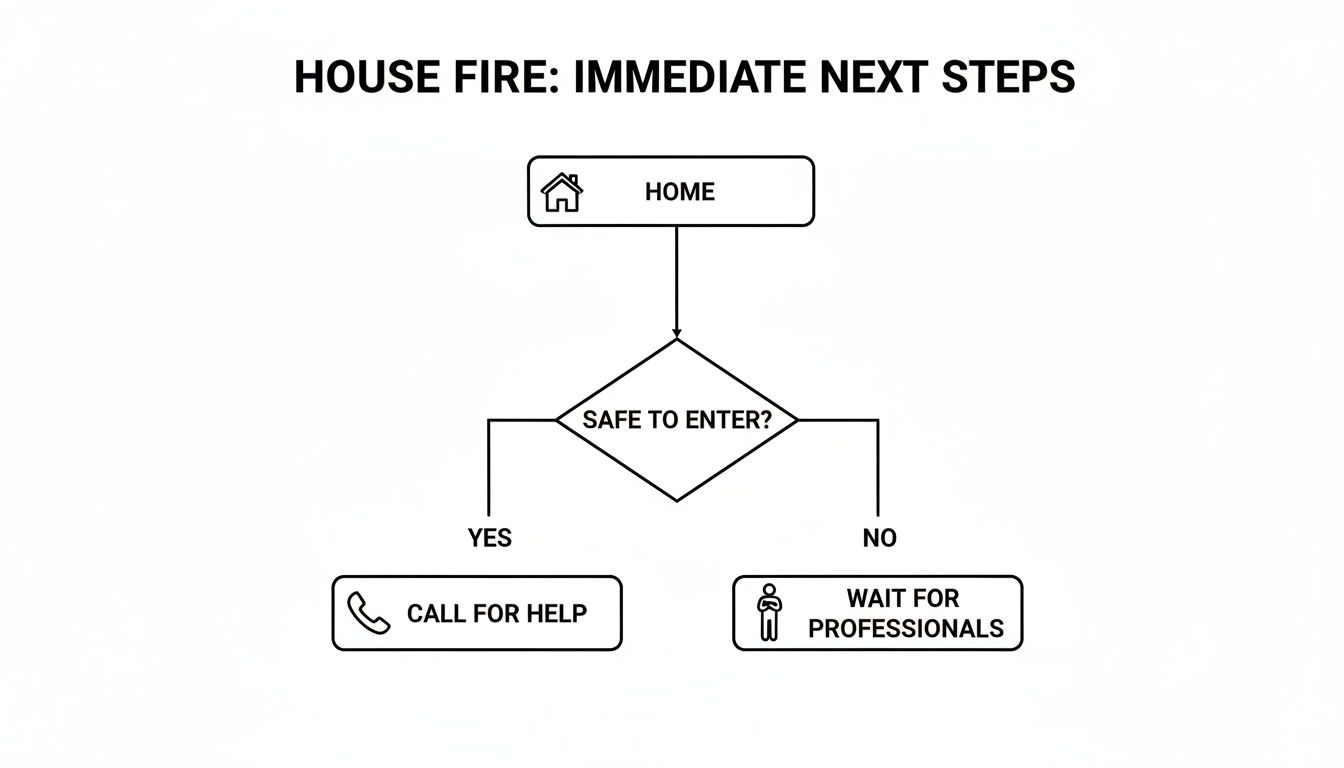
This chart drives home the point: safety first. You have to know if it's even safe to enter the property before you can start figuring out the damage.
The Simple Path: An As-Is Sale
On the other hand, selling your fire-damaged home as-is offers a clear, fast, and simple solution. You sell the property exactly as it is to a cash buyer, and they take on all the risk and responsibility for the repairs, cleanup, and permits.
The biggest win with an as-is sale is that you trade all the unknowns of a huge renovation for the guarantee of a quick, clean closing. You walk away with cash and leave the problems behind.
For many homeowners, especially military families getting a PCS from Fort Liberty or people who live out of state, managing a huge renovation just isn't possible. You can learn more about what it means to sell your house as is in Fayetteville and see all the benefits for yourself. The process is built to be easy.
A cash buyer like DIL Group Buyers will usually:
- Check out the property fast, often within 24 hours.
- Make a fair, no-obligation cash offer based on the home's condition after the fire.
- Handle all the paperwork and closing costs.
- Let you close when you want, sometimes in as little as one week.
You don’t have to clean out debris, deal with contractors, or lose sleep over hidden damage. Just take what you want and leave the rest.
Selling As-Is vs. Repairing Your Fire Damaged Home
Deciding between selling your fire-damaged home as-is or taking on a full repair is a major decision. Each path has its own set of timelines, costs, and headaches. This table breaks down the key differences to help you see which option fits your situation best.
| Factor | Selling As-Is (to a Cash Buyer like DIL Group) | Repairing and Listing (with a Realtor) |
|---|---|---|
| Timeline | Fast. Often close in 7-14 days. | Slow. Can take 6-12+ months for repairs, inspections, and sale. |
| Upfront Costs | Zero. No repairs, no cleaning, no commissions. | High. Thousands for permits, materials, labor, and staging. |
| Convenience | Very High. We handle everything. Just take what you want and leave. | Very Low. You manage contractors, permits, and showings. |
| Risk | Low. The sale price is guaranteed. No surprises. | High. Hidden damage, budget overruns, and market changes. |
| Net Profit | Predictable. The offer is what you get, minus any mortgage. | Uncertain. Sale price isn't guaranteed; commissions and costs cut into profit. |
While the final sale price will be lower than a fully repaired home, when you sell as-is you completely avoid all repair costs, carrying costs (like mortgage and insurance), and realtor commissions. This makes the final amount you walk away with surprisingly competitive—and you get it without months of stress and uncertainty.
How Fire Damage Tanks Your Home’s Market Value
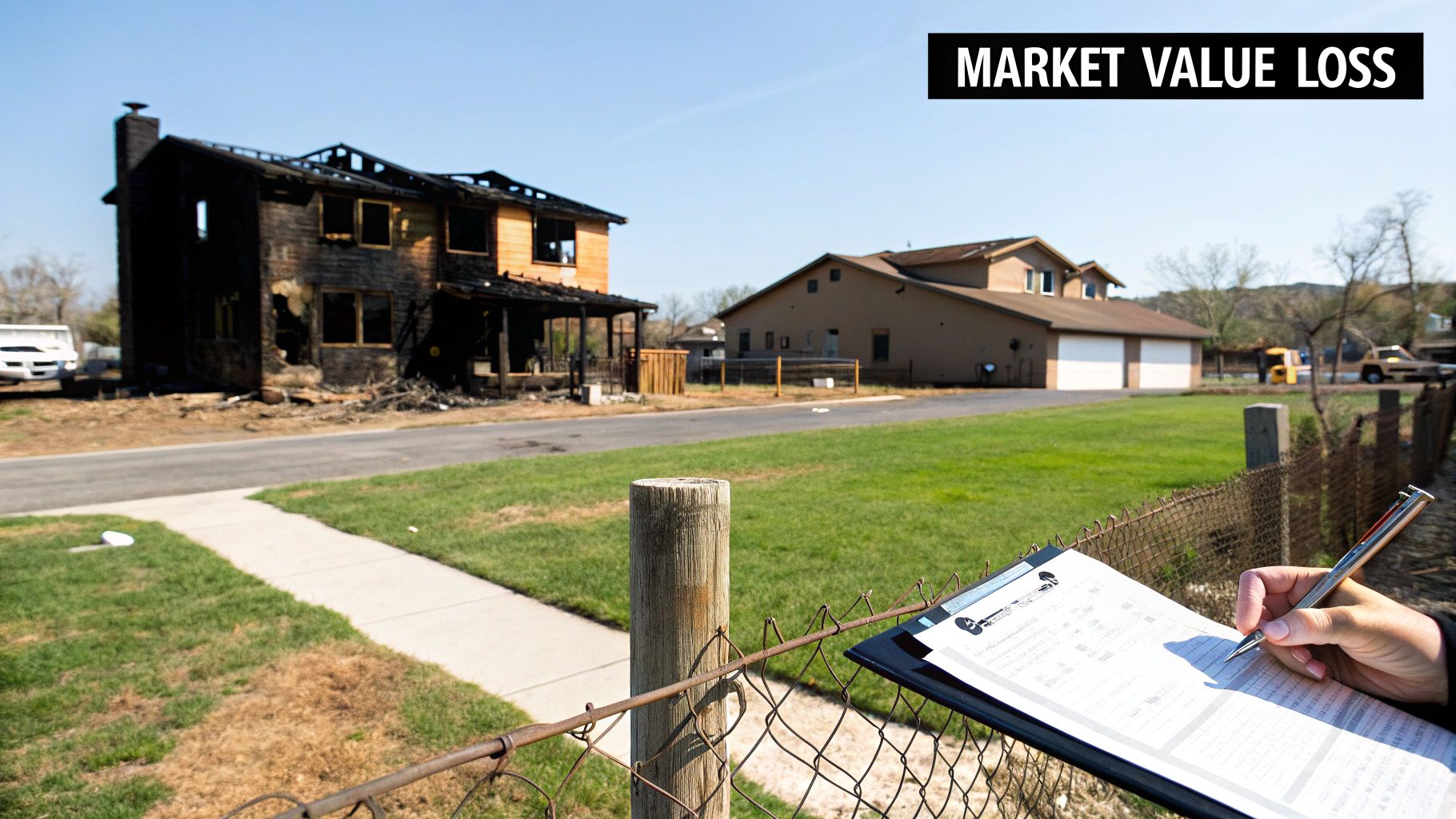
When you're trying to sell a fire-damaged home, you have to throw the Zillow estimate right out the window. The normal rules of real estate just don't apply anymore.
Appraisers and cash buyers like us use a totally different formula to figure out what your property is worth right now, in its current condition. Getting a handle on this calculation is the key to setting realistic expectations for yourself.
The whole thing boils down to a pretty simple equation: After Repair Value (ARV) – Cost of Repairs = Current Market Value.
The ARV is what your home could sell for in the Fayetteville market if it was fixed up and looking its best. We then subtract the total estimated cost to get it there—that includes materials, labor, permits, and hauling away all the debris. What's left is the starting point for a fair cash offer.
Breaking Down the Damage Assessment
Not all fire damage is the same. An experienced buyer will walk through and categorize the destruction to build a realistic repair budget, and this directly impacts your home's value.
- Cosmetic Damage: This is the surface-level stuff like smoke stains, soot everywhere, and that awful smell. It looks bad, but it’s the easiest and cheapest to fix.
- Moderate Structural Damage: Now we're talking about charred support beams, damage to the roof, or weakened floor joists. These repairs get expensive fast and will take a serious chunk out of the ARV.
- Major Structural Failure: This is the worst-case scenario. Load-bearing walls are gone, the foundation is cracked, or the roof system is completely compromised. Often, the house is a total loss.
When the structural damage is that bad, the value of your property is basically just the value of the land it sits on. The house itself becomes a liability that has to be demolished and removed, which is a major expense we have to factor into any offer.
Why Traditional Buyers Can't Get a Loan for Your House
So, why can't you just list it on the MLS? The biggest hurdle is financing.
Banks and mortgage lenders won't touch a property with significant unrepaired damage, especially if it's structural. It's just way too risky for them.
This immediately knocks out almost every regular homebuyer, since they need a mortgage to buy. They simply can't get the money. This is why a cash buyer isn't just a convenient choice—it's often your only real choice.
A company like DIL Group Buyers has the cash on hand to buy the property as-is, skipping the entire mortgage mess. That’s a huge advantage when you need to sell your house fast in Fayetteville and move on.
The Hard Numbers on Value Reduction
Let's be blunt: the financial hit from a fire is severe.
Industry data shows that fire damage can absolutely crush a home's value. We often see the pre-fire price get slashed by 20-40% for moderate to severe damage. Even minor cosmetic issues can easily knock 10-20% off the top.
This is the reality of the situation, and it helps homeowners understand the offers they get from investors. We’re the ones taking on all the risk, time, and cost of a massive, uncertain renovation project.
Juggling Insurance Claims and Legal Paperwork
When you sell a home after a fire, you’re suddenly dealing with a mountain of paperwork that most sellers never see. Between the insurance claim and North Carolina's disclosure laws, it’s easy to feel completely buried.
But here’s the thing: understanding this process is how you protect yourself and get the best possible outcome.
It all starts the moment you call your insurance agent. That one call kicks off a long, detailed process that runs alongside your efforts to sell. This isn't just about getting a check—it's about managing the claim strategically to support your final goal, whether that's rebuilding or selling the property as-is.
Getting What You’re Owed from Insurance
Your insurance adjuster is about to become a very important person in your life. Their job is to evaluate the damage and figure out the payout based on your specific policy. To make sure you get a fair settlement, you have to be an active part of this process.
Start by handing over all the documentation you gathered right after the fire—your photos, videos, and the official fire report. It’s also a good idea to keep a simple log of every single conversation you have with the adjuster. Just jot down the date, time, and what you talked about. You’ll be glad you have it if there are any disagreements later on.
- Show Up for Inspections: Always make a point to be there when the adjuster or their contractors visit. You knew your home best before the fire, and you can point out damage they might otherwise overlook.
- Don't Jump at the First Offer: The first settlement offer they give you is usually just that—a first offer. If it feels low, you have every right to get your own estimates from trusted local Fayetteville contractors to push back with real numbers.
- Know Your Policy: Figure out if you have Replacement Cost Value (RCV), which pays to rebuild with today's materials and costs, or Actual Cash Value (ACV), which only covers the depreciated value. The difference in your payout can be huge.
A crucial takeaway: The insurance company wants to pay out as little as possible. Your goal is to get what you're rightfully owed. Staying organized, being persistent, and knowing your stuff is the best way to avoid a lowball offer.
A Smarter Way: Assigning Your Claim
For a lot of homeowners, the idea of fighting with an insurance company for months on end is just draining. There’s a powerful option that many people don't know about when they sell to a cash buyer: assigning your insurance claim.
What does this mean? As part of the sale, you legally sign over the rights to your insurance claim to the buyer. You get your cash for the house fast and just walk away, completely done.
The buyer—someone like us at DIL Group Buyers—then takes over the entire headache of battling the insurance company to get the funds needed for the repairs. It's a game-changer for sellers who just need to move on and don’t have the time or energy for a long, drawn-out claims process.
Disclosures: What You Have to Tell Buyers in North Carolina
Even though North Carolina is known as a "buyer beware" state, that doesn't mean sellers have no responsibilities. When you sell any home here, you're required to give the buyer a Residential Property and Owners' Association Disclosure Statement.
You have to be upfront on this form. It asks direct questions about things like fire or smoke damage, and it’s illegal to hide that information. Trying to cover up the extent of the damage can land you in serious legal and financial trouble later.
Here’s how to handle it the right way:
- Be Transparent: State clearly that the property has had fire and smoke damage.
- Provide Documents: Share the official fire report and any damage assessments you’ve received.
- Use "No Representation": For many questions on the form, you can check the "No Representation" box. This means you aren't making a specific promise about that item's condition, which helps protect you from being liable for issues you didn't even know about.
When you sell a fire-damaged house as-is to an experienced buyer, this whole process is much, much simpler. We already know there’s damage—that's why we're buying it. We document the property's condition clearly in our purchase contract, protecting both you and us and making sure the sale is clean and straightforward.
Why a Local Cash Buyer Is Your Best Option
Let's be honest. When you need to sell a fire damaged home, the traditional real estate market just isn't built for your situation. Trying to host open houses with picky buyers and haggling over repairs is a nightmare under normal circumstances. After a fire? It feels downright impossible.
This is exactly why a specialized, local cash buyer isn't just another option—it's often the most practical and sensible way forward. For homeowners here in Fayetteville and Cumberland County, it's a direct path out of a tough, emotionally draining spot. It's about swapping uncertainty for a guaranteed sale.
Speed and Certainty When You Need It Most
The single biggest reason to work with a local cash buyer is the sheer speed of the deal. A normal sale on the MLS can drag on for months, from listing to finally closing. When you're dealing with the fallout from a fire, you just don't have that luxury.
We see this all the time with military families at Fort Liberty who get sudden PCS orders. They can't wait a year for an insurance payout, repairs, and then a sale. They need a solution that fits their timeline so they can move on without a damaged, money-draining property holding them back.
A cash buyer like DIL Group Buyers cuts out all the usual delays:
- No Bank Financing: We use our own money. That means no waiting around for a mortgage underwriter to approve a loan on a damaged house—which, frankly, they almost never do.
- No Appraisals: The sale isn't hanging on whether an appraiser agrees with the price. Our offer is based on the home's real "as-is" value.
- No Inspections: We buy the property exactly as it is. You won't get hit with a last-minute list of repair demands that could crater the entire deal.
This whole process removes the guesswork. Once you accept our fair cash offer, you know your closing date and the exact amount of money you'll walk away with.
Skip the Repairs and Endless Costs
The thought of managing a full-blown fire restoration is overwhelming for anyone, especially if you're an out-of-state owner. Can you imagine trying to coordinate contractors, pull permits, and check on a major renovation from hundreds of miles away? It’s a logistical headache waiting to happen.
A cash sale completely erases this problem. You don't have to haul out debris, hire remediation crews, or spend a single dime on repairs. We buy the house in its current state, taking on the full cost and responsibility of the restoration.
When you sell your fire-damaged home as-is to a cash buyer, you're not just selling a property; you're selling the problem. You walk away with cash, and we take over the entire headache.
This is a lifeline for so many sellers. Because banks often refuse to finance fire-damaged homes, cash buyers have become crucial in this market. In fact, due to these mortgage hurdles, 78-83% of homes damaged by fire nationwide become opportunities for investors who can pay with cash. There are even services like Firedamagedproperties.com that use AI to find these properties for investors, showing just how strong the demand is.
Your Local Fayetteville Partner
Working with a local buyer really matters. A company with deep roots in the Fayetteville area knows the local market, the permitting offices, and the best contractors. We’re not some faceless national hotline; we live and work here, too. We’ve helped homeowners all over Cumberland County get out of tough spots.
Our process is direct, simple, and honest. You pay no realtor commissions, no closing costs, and no hidden fees. The offer we give you is the cash you get. That kind of transparency is crucial when you’re dealing with such a stressful event. If you want to learn more, check out our guide on companies that buy houses for cash in your area.
At the end of the day, selling to a local cash buyer puts you back in control. It lets you close the book on a painful chapter quickly and confidently, giving you the cash and the peace of mind to start fresh.
Common Questions About Selling a Fire Damaged Home
When you're dealing with the aftermath of a fire, it’s completely normal to feel overwhelmed. The last thing you need is more uncertainty. We get a lot of questions from homeowners right here in Fayetteville, and we want to give you direct, honest answers based on our years of experience helping local families through this exact situation.
Can I Sell My House If the Insurance Claim Is Still Open?
Yes, absolutely. This is a lot more common than you might think, and you don’t have to wait for the insurance company to finally close your file before moving on. Selling while the claim is active can actually be a really smart move.
Here's how it often works: you can sell the property to a cash buyer like us and legally assign the insurance claim benefits over as part of the sale. This is a huge relief for most sellers. It means you get cash in your pocket quickly from the sale, and we take over the headache of battling the insurance company. You walk away, and we handle the fight.
Do I Have to Clean Anything Before Selling to You?
No. Not a single thing. One of the biggest reasons people sell to a cash buyer after a fire is the sheer relief of not having to deal with the mess. We expect the property to be a disaster—that’s what we’re here for.
Just take the personal items and memories you want to save, and leave the rest.
Leave the debris. Leave the damaged furniture. Leave the soot on the walls. We handle the entire cleanout and disposal after we buy the house. Your only job is to focus on what comes next for you and your family.
This saves you thousands of dollars you would have spent on dumpsters and professional cleaning crews, not to mention the emotional pain of sorting through everything that was lost.
How Quickly Can I Close the Sale in Fayetteville?
We built our entire process for speed and certainty. After a fire, you need a solution now, not more delays. From the moment you call us, we can usually do a quick walkthrough and get a fair, no-obligation cash offer in your hands within 24 hours.
If you decide to accept, we can move straight to closing. We can often get the sale finalized and cash in your bank account in as little as 7 to 14 days. But here's the thing—we work on your timeline. If you need more time to sort things out, we can set the closing date for whenever works best for you.
Will Selling My Home As-Is Hurt My Credit Score?
No, it actually protects your credit. In fact, it's one of the smartest things you can do for your financial health after a disaster. If the fire has made your home unlivable, you’re probably worried about making mortgage payments on a place you can't even use. If you start missing payments, the bank could start foreclosure proceedings, which would crush your credit for years.
A quick cash sale stops that from ever happening. The money from the sale pays off your mortgage and any other debts tied to the property. Your mortgage account is closed in good standing, and you can start fresh without a foreclosure hanging over your head. It’s a clean break that secures your financial future.
Ready to get a fair, no-obligation cash offer and move on from your fire-damaged property? The team at DIL Group Buyers is here to provide a fast, simple, and stress-free solution. Contact us today to see how we can help. Learn more at https://dilgrouphomebuyers.com.
Pingback: Homeowners Claim Dispute Guide To Fight A Low-Ball or Denied Claim