
Let's cut right to the chase: No, North Carolina does not have an inheritance tax. If you've just inherited property here, that's fantastic news. You won't be writing a check to the state just because a loved one left you their assets.
But while the answer is simple, it wasn't always this way.
North Carolina Inheritance Tax: The Simple Answer
If a loved one left you a house in Fayetteville or anywhere else in Cumberland County, you can breathe a little easier. The state government isn't going to take a slice of that inheritance. This is a huge relief, especially when you're already juggling so many other things.
Inheriting a property often comes at a tough time. Maybe you're dealing with:
- An unexpected military PCS from Fort Liberty that's forcing you to move.
- The stress of a potential foreclosure hanging over the property.
- Trying to manage a run-down or neglected home from another state.
Knowing there’s no state inheritance tax to worry about helps clear the path forward. It’s one less headache. This wasn’t always the case, though. For years, North Carolina had a "death tax" that made an already difficult process even more complicated for families.
Everything changed on July 23, 2013. That's the day Governor Pat McCrory signed HB 998 into law, getting rid of the state's estate tax for good. The law was even made retroactive to January 1, 2013, wiping out state-level death taxes completely. It was a game-changer for anyone passing down property in NC. You can learn more about this major tax policy shift and how it affects families like yours.
So, Is It an Inheritance Tax or an Estate Tax? Let's Break It Down.

It’s easy to get these two mixed up. People toss "inheritance tax" and "estate tax" around like they’re the same thing, but they are completely different animals.
Knowing the difference is huge, especially since North Carolina decided to do away with both of them. It really highlights how much simpler the process is for families here.
Here's a straightforward way to think about it.
Imagine a pizza. An estate tax is like someone taking a slice out of the whole pie before anyone else gets to grab one. The tax is calculated on the total value of the deceased person's property, and the estate itself foots the bill.
An inheritance tax, on the other hand, is when each person who gets a slice has to pay a little something for it after it's on their plate. The person who inherits the asset—the heir—is the one responsible for paying this tax.
Who Gets the Bill?
This really comes down to one simple question: who has to write the check?
- Estate Tax: The tax is charged against the deceased's total net worth. The executor of the estate has to settle up with the government before any assets get handed out to the beneficiaries.
- Inheritance Tax: This tax is aimed directly at the individual heir. The amount you’d owe often depends on how closely related you are to the person who passed away. A son or daughter might pay nothing, while a cousin or friend could face a hefty tax.
Here's the most important thing you need to remember: Since North Carolina has neither an estate tax nor an inheritance tax, you don't have to worry about the state taking a bite out of your inherited property.
That’s fantastic news for anyone inheriting a home in Fayetteville or anywhere in Cumberland County.
While we're in the clear, it's worth knowing that a few states do still have these taxes on the books. As of 2024, only five states still charge an inheritance tax: Kentucky, Maryland, Nebraska, New Jersey, and Pennsylvania. This puts North Carolina in a really favorable spot, making life a lot easier for families dealing with inherited homes and other assets.
It's hard to believe now, but for a long time, North Carolina had its own "death tax." This added a whole lot of complexity and financial stress for families just trying to settle a loved one's affairs.
At first, it was a full-blown inheritance tax. Later, the state got a bit more clever and switched to what they called a “pick-up” or “sponge” tax. Think of it this way: instead of creating a new tax, the state just took a piece of the federal estate taxes a family was already paying.
The feds offered a credit for state death taxes, and North Carolina just made sure to "pick up" that credit. It was a pretty smart system, really. If an estate was large enough to owe federal taxes, the state got its cut. If the estate was too small to owe federal taxes, then it didn't owe North Carolina anything, either. Simple as that.
The Game-Changer: The 2013 Repeal
Everything changed in 2013 when House Bill 998 became law. This bill completely wiped out North Carolina's estate tax, and they even made it retroactive to January 1, 2013. For families all over the state, especially those dealing with inherited property in places like Fayetteville and Cumberland County, this was a massive relief.
The impact was immediate and huge. Getting rid of the state death tax completely changed how people approached estate planning and what they decided to do with inherited homes.
You can see the shift clear as day in the state’s tax numbers. Between the 2019 and 2022 fiscal years, death tax collections dropped from $360 million to just $90 million. That’s a 75% freefall. It shows you just how big of a deal the 2013 repeal was. If you're curious, you can explore more data on these fiscal changes to see the full story.
So, when people ask today if North Carolina has an inheritance tax, we can give them a simple, direct answer: absolutely not.
What You Need to Know About the Federal Estate Tax
So, while we've established that the answer to "does North Carolina have an inheritance tax" is a firm no, another question sometimes pops up: what about the federal estate tax?
This tax, often called the "death tax," is handled by the U.S. government, not the state. But here's the good news—it affects an incredibly tiny number of people. For most families inheriting a home in Fayetteville or anywhere else, this tax is simply not something you'll ever have to worry about.
The High Exemption Threshold
The reason so few people pay the federal estate tax is because the government gives everyone a massive exemption. Think of it as a free pass before any tax is due.
Just how high is it? So high that over 99.9% of estates in the U.S. owe nothing at all. The government adjusts this number for inflation, so it's only gotten bigger over the years, giving families a huge financial shield.
For 2024, that exemption has climbed to a staggering $13.61 million per person. That means nearly all estates, including almost every family home passed down to heirs, are completely untouched by this tax. For our clients, this is great news. It means keeping more money from the sale of an inherited property, which has helped us streamline things for the 150+ homes we've purchased right here in the Fayetteville region. You can discover more insights about these tax rules if you're curious.
Key Takeaway: Unless your loved one's total estate is worth well into the multi-millions, the federal estate tax almost certainly won't apply to you.
What Is Portability?
As if that wasn't enough protection, the federal government also allows for something called portability. It's basically a way for married couples to team up and combine their exemptions.
Here’s how it works: If one spouse passes away and doesn’t use up their full $13.61 million exemption, the surviving spouse can "port," or transfer, the leftover amount for their own future use.
This move effectively doubles the potential exemption for a married couple to over $27 million. It offers serious peace of mind for families with significant assets and makes it even more certain that federal estate taxes remain a non-issue for the average American family.
What Happens After You Inherit a Home? The Probate Process Explained
So, you've learned that North Carolina won't hit you with an inheritance tax bill. Great news! But that doesn't mean the house keys are yours just yet. Before you can officially take ownership, the estate has to clear a legal hurdle called probate.
Think of probate as the court's way of supervising the wrap-up of a person's final affairs. It’s a formal process designed to make sure everything is done by the book—from confirming the will is valid to paying off any lingering debts. For you, it’s the official step that gets the home’s title legally transferred into your name.
Here in Cumberland County, the Clerk of Superior Court oversees this whole process. It usually kicks off when the executor—the person the will names to handle the estate—files the first round of paperwork.
What Probate Means for the House
That inherited house is now a major piece of the estate's puzzle. It's an asset, and what happens to it depends on the estate's overall financial picture. Before the property can be passed on to you, the executor has a few critical jobs to do.
They'll need to handle things like:
- Paying Off Debts: The executor has to use the estate's assets to settle any of the deceased's final bills, whether it’s credit card balances, medical expenses, or taxes.
- Clearing Liens: If there’s still a mortgage on the home or other claims against it (like from a contractor or the IRS), those have to be paid off.
- Managing Property Expenses: Until the house is either sold or officially transferred to you, the executor is on the hook for paying the mortgage, property taxes, insurance, and utility bills.
The probate process is all about making sure every financial obligation is met before the heirs get their inheritance. This protects everyone involved—creditors get paid, and you get a clean title without any old legal strings attached.
Getting a handle on these steps is important. If you’re thinking about selling the property, it helps to understand how the court's involvement impacts the sale. You can get a much deeper look into the specifics of probate property sales and what to expect. This oversight ensures that when you finally take control, the home is truly yours, free and clear.
Exploring Your Options for an Inherited NC Property
So, the good news is you don’t have to worry about a North Carolina inheritance tax. Now you can focus on the real question: what are you going to do with the house you just inherited? This is a moment that brings both a big opportunity and a serious responsibility, and what’s right for you depends completely on your unique situation.
Generally, you have three main paths to choose from. Each has its pros and cons, especially if you’re trying to manage things from out of state or if the house needs a lot of work.
Deciding Your Next Steps
First, you could move into the house. This is a great way to keep a beloved family home in the family, particularly if it's in a great spot like Fayetteville. But moving in also means you’re taking on everything—the mortgage, insurance, property taxes, and all the upkeep that comes with owning a home.
Another option is to rent the property out. Becoming a landlord can create a nice, steady income stream. It also comes with its own brand of headaches, like finding good tenants you can trust, dealing with late-night repair calls, and managing the property from afar, which is a real challenge for out-of-state owners.
The third path, and often the most straightforward, is to sell the property. This gives you a clean break and turns the asset into cash you can use for other things. Selling gets rid of the long-term burdens of being a homeowner and is often the simplest solution, especially if the house needs expensive repairs you’re just not ready to tackle.
But before you can make any of these moves, you'll need to deal with the legal side of things, which starts with the will.
This flowchart gives you a quick look at how the presence of a will gets the ball rolling in the probate process.
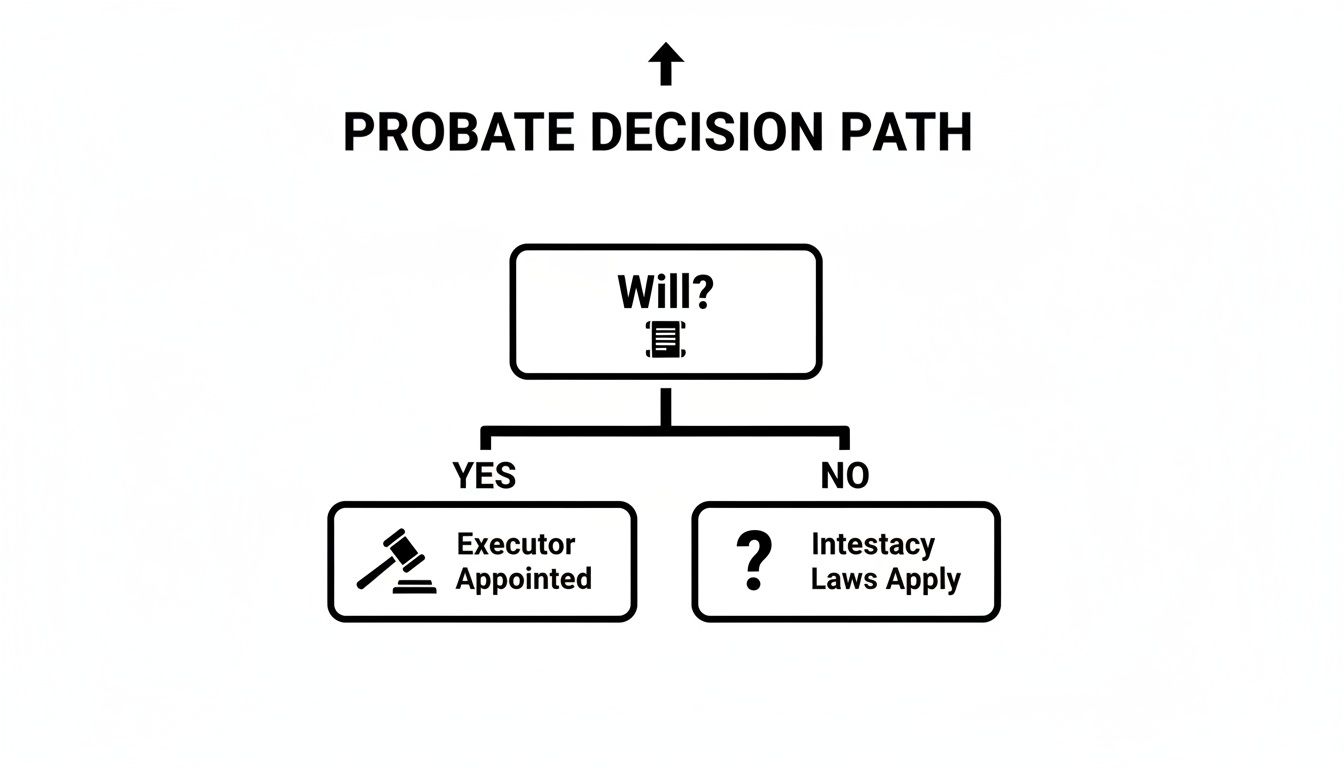
Whether there's a will or not, the property has to go through probate before you can legally sell it.
Selling Your Inherited Home
If you decide selling is the way to go, you’ve got two main choices: listing it with a traditional real estate agent or selling it directly to a cash home buyer. Going the traditional route might get you a higher sale price on paper, but it usually means you’ll be making repairs, staging the home for showings, and then waiting months for a buyer whose financing might not even come through.
For a lot of heirs, a faster, more certain path is exactly what's needed. Selling to a local cash buyer like DIL Group cuts out all the waiting and wondering.
We've helped military families near Fort Liberty, landlords tired of empty rentals, and owners facing tough financial spots turn their property into cash, fast. You skip the repairs, avoid the realtor commissions that average 5-6% (that's $18,000 on a $300,000 home!), and don't pay any attorney fees. We've streamlined this for over 150 families right here in the area.
Deciding between these two paths can be tough. This table breaks down the key differences to help you figure out what's best for your inherited property in Fayetteville.
Selling Your Inherited Home Traditional Listing vs Cash Sale
| Factor | Traditional Real Estate Agent | Cash Home Buyer (DIL Group) |
|---|---|---|
| Repairs & Prep | You're responsible for all repairs, cleaning, and staging. | None. We buy the house "as-is." |
| Timeline | Can take 3-6+ months from listing to closing. | You can close in as little as 7-14 days. |
| Commissions & Fees | Typically 5-6% in realtor commissions, plus closing costs. | Zero commissions or hidden fees. |
| Sale Certainty | Sale can fall through due to financing or inspections. | Guaranteed all-cash offer. The sale is certain. |
| Showings | Multiple showings and open houses disrupt your life. | Just one quick walkthrough with us. |
| Convenience | A long, stressful process with lots of moving parts. | A simple, hassle-free process from start to finish. |
Ultimately, the right choice depends on what you value more: a potentially higher price with a lot more work and uncertainty, or a fast, guaranteed sale that lets you move on quickly.
A cash sale offers speed and simplicity. There are no showings, no back-and-forth negotiations over inspection reports, and no risk of a buyer's loan getting denied at the last minute. You get a fair, guaranteed offer and close on your schedule.
This is a lifesaver when multiple heirs are involved and you all need a quick, fair way to split the value of the home. If there are any snags with the title, it's a good idea to understand how to file a quitclaim deed to clear up ownership before you sell.
A Few Common Questions We Hear About Inheritance
When you inherit a property, it's natural to have a lot of questions. We get it. Here are some quick, straightforward answers to the things most people ask us, helping you figure out your next steps with confidence.
Do I Have to Pay Capital Gains Tax on the House I Inherited?
This is a big one, but the answer is usually better than people expect. When you inherit a home, you get what’s called a “stepped-up basis.”
Basically, the home’s value is reset to what it was worth on the day the original owner passed away. You only pay capital gains tax on the profit you make after that point. If you sell the house fairly quickly, there’s often very little or even no gain to tax.
What Happens if There Was No Will?
If someone passes away without a will, it’s known as dying “intestate.” When this happens, North Carolina’s state laws decide who gets the property.
Typically, the assets go to the closest living relatives, like the surviving spouse and children. The probate court still has to oversee the whole process to make sure the home’s title is transferred legally and correctly.
Can I Sell an Inherited House While It’s Still in Probate?
Yes, you can, but it requires the court’s permission. The executor of the estate is the one who handles the sale, and any money from it must first be used to pay off the deceased’s debts.
This is also when you'll need to figure out if you can sell a house with a lien on it, because any of those claims against the property have to be settled before you can finalize the sale.
Is your inheritance situation feeling complicated? Or maybe you just want to get it done fast and simple. At DIL Group Home Buyers, we give guaranteed cash offers for inherited homes in any condition. You can close on your timeline with absolutely zero commissions or fees. Get your fair cash offer today!