
When you hear "sell a house as is," it means exactly what it sounds like: you're selling the property in its current state. No repairs, no updates, no improvements.
For homeowners here in Fayetteville, this is a way to cut straight to a quick, no-nonsense sale. It lets you sidestep the time, money, and sheer hassle that comes with getting a home ready for the traditional market. It’s a choice that puts speed and convenience first, rather than chasing top dollar through renovations.
Understanding When to Sell Your House As Is
Deciding to sell your house "as is" isn't just about dodging repairs. It's a smart, strategic move that makes sense in certain life situations. I've worked with countless homeowners in the Fayetteville area who found this was the only practical solution to some really tough problems. The trick is knowing when the benefits of a fast, guaranteed sale are worth more than a potentially higher price on the open market.
This way of selling has become a lot more common as cash buyers have stepped up their game. Think about it: roughly 32.8% of U.S. home sales in the first half of 2025 were all-cash deals. That’s way up from what we saw before the pandemic. These are the folks who make "as-is" deals happen because they aren’t tied to picky lenders who demand repairs before they’ll approve a loan.
Common Scenarios for an As Is Sale
Some situations just scream for an "as-is" sale. If you're nodding along to any of these, this path might be the right one for you.
- Sudden Military Relocation: For our service members at Fort Liberty getting hit with a Permanent Change of Station (PCS), time is a luxury you just don't have. Selling as is lets you close the deal quickly and focus on your next assignment without a property hanging over your head.
- Inherited or Probate Property: Dealing with a loved one's home, especially if you're out of state, is an emotional and logistical nightmare. Selling it as is turns a complicated asset into cash—no need for endless trips, cleanouts, or repairs. It can also head off the family drama and legal headaches that pop up when a house sits empty.
- Significant Repair Needs: Is your home facing a new roof, a full electrical rewire, or foundation issues? These are huge, expensive jobs that can run into the tens of thousands. Selling as is means you can just walk away, letting a buyer who is equipped to handle those projects take over.
- Financial Distress or Foreclosure: If you're struggling financially or have foreclosure looming, a fast cash sale can be a real lifeline. It gets you immediate funds to pay off debts and can save your credit from the major hit a foreclosure delivers. If you need answers fast, you should check out our guide on how to sell your house fast in Fayetteville, NC.
Selling a home 'as is' is fundamentally about trading a potentially higher sale price for certainty, speed, and simplicity. It’s an empowering option for homeowners who need to move forward without the delays and costs of a conventional sale.
At the end of the day, it all comes down to what you need right now. If your goal is a fast, predictable, and stress-free sale, then choosing to sell my house as is is often the most logical and beneficial path forward. It cuts out the uncertainty and puts you back in the driver's seat.
How to Price an As-Is Home Realistically
Pricing a house you plan to sell "as is" can feel like you're just guessing. Forget those online home value estimators—they’re programmed for pretty, market-ready homes. They have no clue how to account for a leaky roof, a 1970s kitchen, or those unsettling cracks in the foundation.
When you want to sell your house as is, you have to start thinking like the most likely buyer for these types of properties: a cash investor.

Seasoned cash buyers don't just pull numbers out of thin air. They rely on a specific, repeatable formula to figure out exactly what they can offer. If you can wrap your head around this math, it's the single best way to know if an offer is fair and realistic for your home's actual condition.
The Cash Buyer Offer Formula Explained
At its core, a cash offer is a business calculation. An investor starts with the potential future value of your home and works backward, subtracting every single cost and risk they'll have to take on.
Here’s a look at the key pieces they use to build their offer:
- After Repair Value (ARV): This is what your house could be worth on the market after all the necessary repairs and renovations are done. A buyer will look at fully updated, comparable homes (we call them "comps") that recently sold in your Fayetteville neighborhood to pin this number down.
- Cost of Repairs: This is the big one. The buyer does a detailed walkthrough to estimate the total cost of materials and labor needed to get the house up to its ARV. This isn’t just paint and flooring; it includes the big-ticket items like plumbing, HVAC, electrical, and the roof.
- Holding Costs: A property doesn't fix itself overnight, and it costs money just to own it during the renovation. These are expenses like property taxes, insurance, utilities, and maybe loan interest. These costs can easily add up to 1-2% of the ARV every single month.
- Selling Costs: Once the house is all fixed up, the investor has to sell it on the open market. That means paying for real estate agent commissions, closing costs, and transfer taxes, which typically run about 8-10% of the ARV.
- Minimum Profit: At the end of the day, an investor has to make a profit to stay in business and compensate for the risk they took. This margin is usually somewhere between 10-15% of the ARV, depending on the market and the size of the project.
By understanding these five elements, you can see exactly how an investor lands on their final number. The formula is pretty straightforward: ARV – Repair Costs – Holding Costs – Selling Costs – Profit = Your Cash Offer.
Finding Your Own Comps
To get a ballpark idea of your home's potential ARV, you need to find the right comparables. Don’t look at that beautiful, turnkey home for sale down the street—that's not your competition. You need to find properties that were in a similar condition to yours when they sold.
Check out recent sales in nearby areas like Hope Mills or Spring Lake. When you search on real estate sites or public records, look for keywords like "fixer-upper," "TLC," or "investor special." These are the homes that give you a realistic baseline for what a buyer might actually pay for a house needing a ton of work.
Sure, you won't be able to calculate repair costs with the precision of a seasoned contractor, but this simple exercise gives you a vital reality check. It helps anchor your expectations and empowers you to look at any offer you receive with confidence, because you'll know exactly where that number came from. This knowledge turns the whole process from a mystery into a simple business deal.
Comparing Your Selling Options: Cash Buyers vs. Agents
So, you’ve decided to sell my house as is. Now you've hit a critical fork in the road. Do you go the traditional route and list with a real estate agent, or do you work directly with a local cash home buyer?
Both paths can get your house sold, but the journey—and the actual outcome—are worlds apart. Understanding the difference is crucial for making the right call for your unique situation. This isn't just about the final price on paper; it's about speed, certainty, and how much money you actually have in your hand when the dust settles.
The Real Estate Agent Route
Listing an "as is" property with a real estate agent means putting it on the MLS (Multiple Listing Service), right alongside pristine, move-in-ready homes. While this gets you a lot of eyeballs, it also puts your home’s flaws under a microscope for a very picky audience: retail homebuyers.
These buyers almost always depend on mortgage lenders, and lenders are anything but flexible. A bank might flat-out refuse to finance a property with a leaky roof, old wiring, or foundation issues. This can blow up a deal weeks or even months into the process, sending you right back to square one.
Even if you find a buyer who's up for a project, you need to be ready for:
- A long, drawn-out timeline. The average closing for a traditional sale can take anywhere from 45 to 90 days—and that's after you've already spent time on showings, negotiations, and inspections.
- Endless repair negotiations. The term "as is" doesn't stop buyers from demanding a lower price or credits after a home inspection uncovers problems.
- Hefty costs. Agent commissions, which are typically 5-6% of the sale price, plus seller closing costs, can take a huge bite out of your profit.
The Cash Buyer Advantage
Working with a direct cash buyer like DIL Group Home Buyers completely changes the game. We buy houses with our own funds, which means there are no banks, no appraisals, and zero risk of financing falling through. When we make you an offer, it’s a solid promise to buy your property exactly as it is today.
Our entire process is built for speed and certainty. It’s simple: you call us, we take a look at the property, and you get a fair, no-obligation cash offer. If you like it, we can close in as little as a week or on whatever date works best for you.
Selling directly to a cash buyer gets rid of the biggest headaches of a traditional sale. You get a guaranteed closing date and a net offer that won't get whittled down by commissions or last-minute repair demands.
To make it even clearer, let's break down the two options side-by-side.
Selling As Is: Comparing Your Options
| Factor | Selling to a Cash Buyer (e.g., DIL Group) | Listing with a Real Estate Agent |
|---|---|---|
| Repairs & Cleaning | None. We buy the house completely "as is." | You'll likely need to make repairs and clean to attract buyers. |
| Timeline | As fast as 7-10 days, or on your schedule. | Typically 45-90+ days from listing to closing. |
| Financing Risk | Zero. Our cash offers are guaranteed. | High. Deals often fall through due to lender financing issues. |
| Showings | Just one visit from our team. | Multiple showings and open houses are required. |
| Commissions & Fees | None. You pay no commissions or closing costs. | Expect to pay 5-6% in commissions plus other seller fees. |
| Certainty | High. Our offers are firm and closing is guaranteed. | Low. The sale depends on inspections, appraisals, and financing. |
The table really highlights the trade-offs. While you might see a higher list price with an agent, the cash buyer path offers a guaranteed, faster, and far simpler way to get your money without the usual stress.
A Real-World Fayetteville Scenario
Let's put this into perspective. Imagine you inherited your aunt's house over in Fayetteville, but you live a few states away. The house is packed with her old belongings and hasn't been touched since the 1980s. You're already grieving, and the idea of managing a massive cleanout, hiring contractors, and dealing with an agent from a distance is just too much.
If you list it, you’re looking at months of uncertainty. You’d have to coordinate repairs, deal with lowball offers from buyers scared by the inspection report, and then pay out thousands in commissions.
Now, picture the cash buyer path. You make one phone call. A local expert from our team visits, assesses the condition, and gives you a fair cash offer. You don't have to clean out a single closet or fix a leaky faucet. A local attorney handles the closing, and the money is wired straight to your bank account. The problem is solved in days, not months. You can learn more about how to sell your home for cash and see just how simple it can be.
For an out-of-state heir, a military family on a tight PCS timeline, or anyone who just wants a fast, guaranteed solution, the benefits are undeniable. You trade the potential for a higher market price for the certainty of a quick, hassle-free sale that puts cash in your hand right when you need it.
What About Liens, Foreclosure, or Inherited Homes?
Sometimes, the reasons you need to sell a house "as is" go way beyond just a leaky roof or outdated kitchen. You might be staring down some serious financial and legal hurdles. Things like property liens, the looming threat of foreclosure, or the tangled mess of an inherited property are heavy burdens to carry.
I see it all the time here in North Carolina. These situations can feel completely overwhelming, but a direct, as-is sale is often the cleanest and quickest way out. A cash home buyer can slice through the red tape that would stop a traditional sale dead in its tracks, giving you a fresh start.
Selling a House with a Lien on It
So, what exactly is a lien? Think of it as a legal "IOU" attached to your property for a debt you haven't paid. This creates a "cloud" on your title, which is a deal-breaker for most regular buyers. Their mortgage company simply won't approve a loan for a property that doesn't have a clear title.
Here in Cumberland County, I typically run into a few common types:
- Tax Liens: This happens when property taxes go unpaid, and the county puts a claim on the house.
- Mechanic's Liens: A contractor did work on your home but never got paid? They can file one of these.
- Judgment Liens: If you lose a lawsuit and a court says you owe money, a lien can be placed on your property to make sure you pay up.
But here’s the good news: you can absolutely sell a house with liens. When you sell to a cash buyer like me, we handle all of this at the closing table. The money from the sale first goes to pay off whatever is owed, and the rest goes straight into your pocket. It’s a single, clean transaction that settles your debts and clears the property's title.
The beauty of a cash sale is its simplicity. The closing attorney uses the proceeds from the sale to pay off all outstanding debts—tax liens, contractor bills, or court judgments—and you walk away with the remaining equity, free and clear.
This means you don't have to scramble to find thousands of dollars to clear the title before you sell. The sale itself becomes the solution.
How a Quick Sale Can Stop Foreclosure
Facing foreclosure is, without a doubt, one of the most stressful things a homeowner can go through. The clock is ticking, the bank is calling, and the pressure is immense. A fast, as-is sale is one of the most powerful ways to stop the foreclosure process cold.
Foreclosure isn't just about losing your home; it's a financial nightmare that follows you for years. It will absolutely tank your credit score, making it tough to get loans or even rent a place for up to seven years. By selling quickly to a cash buyer, you pay off the mortgage before the bank forecloses. This saves your credit and lets you start over on your own terms.
Because cash buyers can close in just days, we can almost always beat the bank's auction date. Taking this step puts you back in the driver's seat. You get to walk away with any equity you have left, instead of watching the bank take everything. If you're in this spot, our guide on how to stop foreclosure on my home lays out the specific steps for homeowners here in North Carolina.
Dealing with an Inherited Property
Inheriting a house, especially if you live out of state, can feel less like a gift and more like a huge, complicated problem. These homes are often dated, filled with a lifetime of someone else's belongings, and then you have to deal with the Cumberland County probate court.
Probate is the official legal process for handling a deceased person's assets. It can be painfully slow and expensive, particularly if there are several family members involved who don't see eye-to-eye. Disagreements can drag the process out for months, even years, while the empty house just sits there, racking up taxes and maintenance bills.
Selling an inherited house as is to a cash buyer cuts right through the drama and offers a simple solution for the whole family.
- No Cleanout Needed: Seriously. Just take the sentimental items you want and leave the rest. The buyer will deal with everything else.
- No Out-of-Pocket Repairs: You don't have to spend a dime fixing up a house you never lived in and don't want.
- Makes Probate Easier: A simple, straightforward cash offer gives all the heirs a clear number to agree on, which can speed up the entire probate process.
By turning a complicated property into a simple cash distribution, you can settle the estate quickly and fairly. It allows everyone to move forward without the stress and financial drain of an unwanted property.
From Offer to Cash in Hand: The As-Is Closing Process
Getting an offer is a fantastic feeling, but it's not the finish line. Next up is the closing process—the legal and financial steps that officially make the buyer the new owner. In a traditional sale, this part can be a minefield of delays and stress. But with a cash buyer, it's a completely different ballgame. The process is straightforward, predictable, and incredibly fast.
You can finally breathe easy. There are no last-minute financing fiascos, no low-ball appraisals to kill the deal, and no buyer getting cold feet. A cash sale cuts right through all that red tape. The focus is simply on clear communication and getting things done efficiently, putting you on a direct path to getting paid.
What the Closing Timeline Really Looks Like
Once you sign the purchase agreement, the closing process officially begins. Everything is handled by a neutral third party—usually a local closing attorney or title company—who makes sure all the i's are dotted and t's are crossed according to North Carolina law. Their job is to be the quarterback, coordinating all the paperwork and payments.
Here’s a quick rundown of what happens:
- Opening Escrow: We deliver the signed agreement and the buyer’s earnest money deposit to the closing attorney. This is the official "go" signal that everyone is serious.
- Title Search: The attorney digs into public records to confirm you're the rightful owner and check for any liens or claims against the property. This is a critical step to ensure the title is "clear."
- Preparing the Paperwork: Next, the attorney drafts all the necessary legal documents, including the deed that legally transfers ownership.
- Closing Day: On the day you choose, you sign the final paperwork. Don't worry if you're not in town; this can almost always be done remotely. As soon as the documents are signed and the funds are verified, the sale is recorded with Cumberland County, and the money is wired straight to your bank account.
With a cash buyer, this entire process can wrap up in as little as seven days. The best part? You pick the closing date that works for your schedule, giving you total control.
This flowchart shows how even tricky situations are handled smoothly within this simple process.
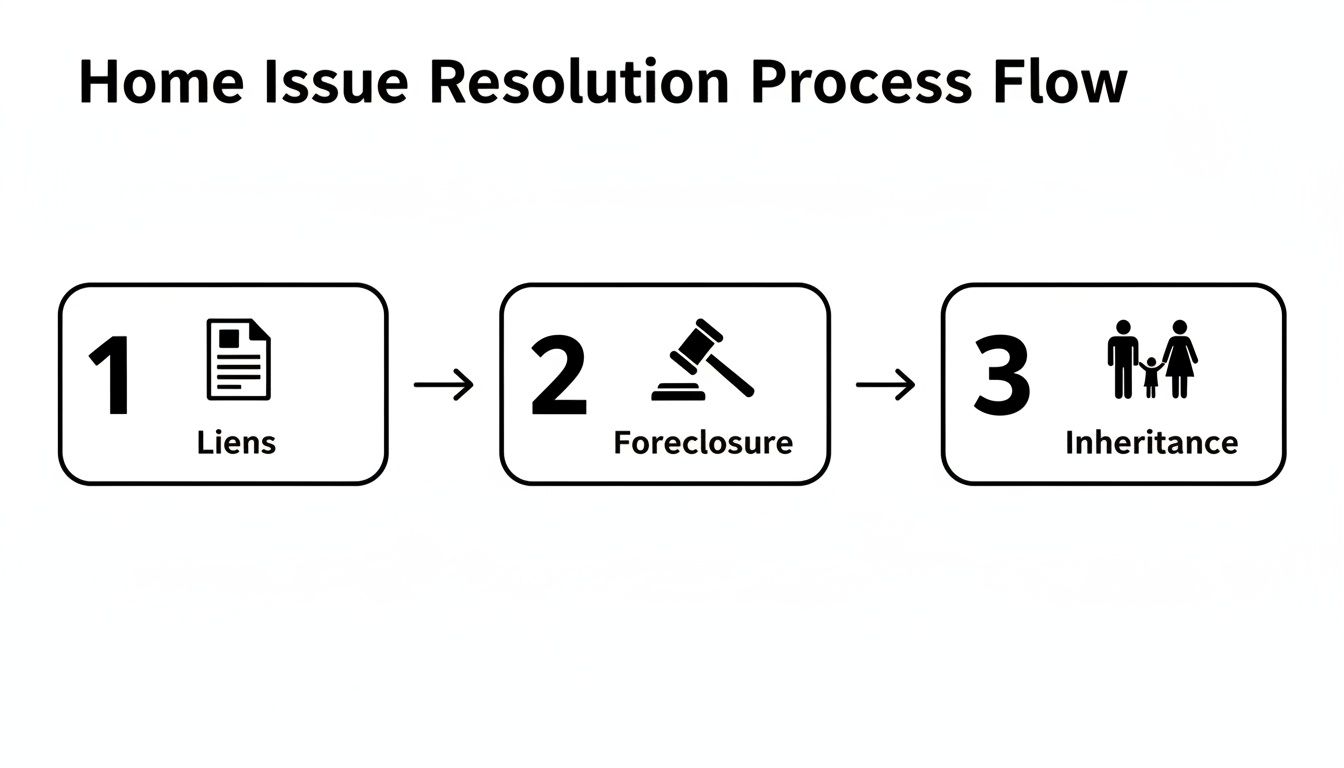
As you can see, things like liens or foreclosure aren't deal-breakers. They're just items on a checklist that get resolved as part of the structured closing.
No Surprise Costs, No Hidden Fees
One of the biggest reliefs of selling your house as-is to a direct buyer is knowing exactly what you'll walk away with. The offer you accept is the net amount you get. Period. No surprise deductions, no last-minute charges nibbling away at your cash.
- No Realtor Commissions: You pay zero commissions. That’s a huge saving, typically 5-6% of the sale price.
- No Closing Costs: We cover all the standard closing costs. That's our part of the deal.
- No Repair Credits: You’re selling as-is. We’re buying as-is. There are no haggling sessions over inspection reports.
This no-nonsense approach is why all-cash transactions are becoming more popular. In fact, data from the National Association of REALTORS® shows that all-cash purchases hit a record high, averaging 26% of all sales last year. For people who've sold a home before, almost one in three pay all cash, skipping the mortgage headache entirely. It just goes to show that more and more people are choosing the speed and certainty that a cash sale delivers.
Got Questions About Selling As Is in Fayetteville? We’ve Got Answers.
Even when you know the steps, making the call to sell your house as is can feel like a big leap. You're bound to have questions, and that's perfectly normal. We hear them all the time from homeowners right here in Cumberland County, so we’ve put together some straight, no-fluff answers to the most common ones.
Do I Really Have to Disclose All My Property's Problems?
Yes, you absolutely do. "As is" isn't a magic wand to make problems disappear or a pass to hide them. North Carolina law is very clear: you're legally required to disclose any major issues you know about, even if you have no intention of fixing them. This is usually handled with the Residential Property and Owners' Association Disclosure Statement.
Think of it this way: being upfront builds trust and keeps you out of legal hot water later. Any reputable cash buyer not only expects this, we appreciate it. Full transparency helps us make a fair, accurate offer and keeps the whole process honest. Trying to cover up a known problem, like a crack in the foundation, is just asking for a lawsuit down the road.
What Can I Leave Behind When I Move Out?
Honestly, this is one of the biggest reliefs for people selling to a cash buyer like us. You can take whatever you want and leave the rest. We mean it. Don't stress about that old sofa in the basement, the random stuff in the attic, or the junk piled up in the garage.
We handle the entire cleanout ourselves after we close. This is a huge help for folks who are:
- Dealing with an inherited house full of a relative's belongings.
- Stuck with a mess left behind by tenants.
- Simply don't have the time, energy, or desire to clear everything out.
Just pack up the things that matter to you, and we’ll deal with everything else. This alone saves sellers hundreds—sometimes thousands—in junk removal fees and frees them from weeks of back-breaking work.
Does Selling "As Is" Just Mean I'm Going to Get a Lowball Offer?
Not at all. What it does mean is that your offer is based on the home's real, current condition. A professional cash buyer isn't trying to pull a fast one; we're making a straightforward business decision based on the numbers: the After Repair Value (ARV) minus the cost of repairs, our holding costs, and a reasonable profit.
Sure, the offer will be less than what you’d get for a picture-perfect, fully updated house. It has to be—it reflects the real money and work the property needs.
An "as is" offer is a net offer. It's the exact amount of cash you walk away with. There are no surprise commissions, no repair credits, and no closing costs chipped away at the end. It’s a number you can count on.
Don't forget what you get in return for that price: a guaranteed quick closing, zero fees, and freedom from any repair headaches. For many sellers, that certainty is worth its weight in gold.
How Fast Can We Actually Get This Done?
The timeline is completely in your hands. Once you say "yes" to our offer, we can often close the deal in as little as 7 to 10 days. How? We use our own cash, which means we get to skip the painfully slow bank appraisals and loan underwriting that bog down traditional sales.
But we also know that not everyone is in a huge rush. If you need a few weeks or even a month to get your next move lined up, that's fine too. We work on your schedule. You tell us the closing date that works best for you.
What if My Siblings and I Inherited the House Together?
This is a situation we see all the time, and selling as-is is often the cleanest path forward. When a property is left to multiple family members, things can get complicated fast. Arguments pop up over who pays for repairs, which real estate agent to use, and what the asking price should be.
Selling to a cash buyer cuts through all that drama. We give you a single, fair cash offer that everyone can see and discuss. It instantly turns a complicated asset—the house—into cash, which is simple to divide fairly based on the will. It helps keep the peace in the family and allows the estate to be settled quickly.
Whether you're dealing with a complicated property situation or you just want the fastest, simplest way to sell, DIL Group Home Buyers is here. We make guaranteed cash offers that give you certainty and control. Get your no-obligation offer today by visiting us at https://dilgrouphomebuyers.com.